
ESRS 2 – General disclosures
Creating transparency
Sustainability is at the heart of the Deutsche Telekom Group’s multinational business activities. We report on our progress annually, also in the combined management report. The requirements for transparency in corporate sustainability are constantly increasing. In light of the anticipated transposition of the European Corporate Sustainability Reporting Directive (CSRD) into national law, we have already based the preparation of the combined sustainability statement (“sustainability statement”) on the first set of the European Sustainability Reporting Standards (ESRS) as a framework for the Group’s sustainability statement and applied these standards in full.
This sustainability statement is divided into the sections “General information,” “Environment,” “Social,” and “Governance.” When applying the ESRS, the concept of “materiality” is of utmost importance and defines the content to be included in sustainability reporting. In line with the principle of double materiality, we show how we manage material impacts of our business activities on society and the environment, as well as the material risks and opportunities along our entire value chain, in the following ESRS topical standards:
- ESRS E1 – Climate change
- ESRS E5 – Resource use and circular economy
- ESRS S1 – Own workforce
- ESRS S2 – Workers in the value chain
- ESRS S4 – Consumers and end-users
- ESRS G1 – Business conduct
- G-Company-specific: cybersecurity
In addition, we comply with the reporting requirements that have been mandatory since the 2021 reporting year with regard to environmentally sustainable economic activities in accordance with Regulation (EU) 2020/852 of the European Parliament and of the Council on the establishment of a framework to facilitate sustainable investment and amending Regulation (EU) 2019/2088 (the “EU Taxonomy”).
Unless otherwise stated, all disclosures in this sustainability statement apply to the Deutsche Telekom Group (also referred to as “we” or “us”).
The Supervisory Board of Deutsche Telekom AG is responsible for the review of the content of the sustainability statement. It did this with the support of Deloitte GmbH Wirtschaftsprüfungsgesellschaft (external auditor) in the form of a limited assurance engagement. The two non-financial performance indicators energy consumption and CO2 emissions (Scope 1 and 2) are included as management-relevant performance indicators in the reasonable assurance engagement on Deutsche Telekom’s consolidated financial statements and the combined management report. The sustainability statement engagement is based on International Standard on Assurance Engagements ISAE 3000 (Revised). To avoid repetition within the combined management report, we refer to further information provided in other sections wherever relevant. References within the combined management report that are part of the sustainability statement are indicated as such. Notes about further information in the combined management report do not form part of the sustainability statement. Links to disclosures outside of the combined management report or the consolidated financial statements constitute further information that goes beyond the legal requirements for sustainability reporting and is not subject to external audit.
As the parent company, Deutsche Telekom AG is obligated to submit a non-financial statement and a consolidated non-financial statement and makes use of the option to combine the two reports. The disclosures that Deutsche Telekom AG is required to make in accordance with § 289c (2) and (3) HGB are contained in the general disclosures and the ESRS topical standards. The combined Group sustainability statement/non-financial statement has been prepared for Deutsche Telekom AG (parent company) in accordance with §§ 289b through 289e and for the Deutsche Telekom Group in accordance with §§ 315b and 315c in conjunction with §§ 289c through 289e HGB as well as in accordance with the ESRS. A transition of the aspects required under HGB to the content of the report under the ESRS is presented in the following section.
Transition to the ESRS
In preparation for the transposition of the CSRD into national law, Deutsche Telekom applied the ESRS as framework on a voluntary basis when preparing the 2025 Group sustainability statement. The crosscutting standard “ESRS 2 – General disclosures” and the main ESRS topical standards determine the content of the report that is material for Deutsche Telekom and can be allocated to the five aspects set out in § 315c (1) HGB in conjunction with § 289c (2) HGB:
|
|
|
Aspect pursuant to § 315c (1) HGB in conjunction with § 289c (2) HGB |
Reflected in ESRS topical standards |
Selected content |
|---|---|---|
Aspect 1 – Environmental concerns |
ESRS E1 – Climate change |
Greenhouse gas emissions, energy efficiency, and resource use |
Aspect 2 – Employee concerns |
Guidance and actions on the topics of working conditions, such as health and safety or social dialogue, as well as equal treatment and opportunities for all |
|
Aspect 3 – Social concerns |
ESRS S1 – Own workforce |
Dialogue formats, whistleblower systems, as well as protection of consumers and end-users |
Aspect 4 – Respect for human rights |
Processes for complying with human rights and environmental due diligence in the upstream value chain and in own business activities, labor standards at suppliers |
|
Aspect 5 – Fighting corruption |
Anti-corruption and anti-bribery instruments |
The aspects described in the ESRS topical standards in accordance with the requirements of the HGB are supplemented by information on strategies, actions, targets, and metrics related to the impacts, risks, and opportunities of our business activities. An overview of these impacts, risks, and opportunities can be found at the beginning of each topical standard under “ESRS 2 SBM-3.”
Basis for preparation
The index below shows the general disclosures required by the standard ESRS 2 – General Disclosures.
ESRS index under ESRS 2 IRO-2
| Disclosure requirement | Name with reference | |
|
ESRS 2 General disclosures |
||
|
ESRS 2 BP-1 |
General basis for preparation of the sustainability statement |
|
|
ESRS 2 BP-2 |
||
|
ESRS 2 GOV-1 |
The role of the administrative, management, and supervisory bodies |
|
|
ESRS 2 GOV-2 |
||
|
ESRS 2 GOV-3 |
Integration of sustainability-related performance in incentive schemes |
|
|
ESRS 2 GOV-4 |
||
|
ESRS 2 GOV-5 |
Risk management and internal controls over sustainability reporting |
|
|
ESRS 2 SBM-1 |
||
|
ESRS 2 SBM-2 |
||
|
ESRS 2 SBM-3 |
Material impacts, risks, and opportunities and their interaction with strategy and business modell |
|
|
ESRS 2 IRO-1 |
Description of the process to identify and assess material impacts, risks, and opportunities |
|
|
ESRS 2 IRO-2 |
Disclosure requirements in ESRS covered by the undertaking’s sustainability statement |
|
We see ourselves as a global enterprise with a considerable presence in Europe, European roots and values, and an extremely strong business in the United States. However, our Group strategy does not aim to micromanage all local units, but to provide a strategic framework and to utilize local strengths such as networks and competitive standing. Our T‑Mobile US business in the United States in particular has operated under this decentralized approach for many years, enjoying considerable success. In this context, T‑Mobile US is sometimes discussed separately in the topical standards, and relevant policies, actions, and targets are presented separately as required.
ESRS 2 BP-1 – General basis for preparation of the sustainability statement
This sustainability statement was prepared on a consolidated basis. The scope of consolidation of the companies included generally consists of Deutsche Telekom AG and its subsidiaries. Subsidiaries classified as not material from a financial perspective were analyzed in terms of their impact on society and the environment caused by our business activities, as well as risks and opportunities, and are also not material for the sustainability statement. Both the consolidated financial statements and the combined sustainability statement therefore refer to the same scope of consolidation. The sustainability statement covers both our own business activities and our upstream and downstream value chain.
When preparing the statement we did not make use of the option to omit specific pieces of information corresponding to intellectual property, know-how, or the results of innovation. The same applies to the disclosure of impending developments or matters in the course of negotiation.
ESRS 2 BP-2 – Disclosures in relation to specific circumstances
The following table provides an overview of the metrics we identified by means of estimates and describes the basis for preparation and the resulting level of accuracy.
|
|
|
Metrics of the upstream and downstream value chain |
Description of the basis for preparation |
Description of the resulting level of accuracy |
|---|---|---|
Scope 3 emissions and emissions factors |
Due to a lack of primary data, particularly in the upstream and downstream value chain, coupled with a lack of product-related emissions factors, we used estimates to determine greenhouse gas (GHG) emissions. |
We use only recognized sources from public bodies. Software solutions and increasingly digitalized data collection ensure a reliable calculation basis. By performing an annual comparison of the data used against the publicly available sources and the latest findings, we increase our data quality year by year. In this way, we ensure that the overall data quality continues to improve. Given the highly complex relationships in the supply chain and the difficulties involved in collecting and compiling data (life-cycle analysis), the annual assessment forms an integral part of discussions with customers and supplier selection. It includes life-cycle analyses, surveys, and updated emissions factors based on CDP data. The aim is to reduce emissions and improve the accuracy of the emissions data collected with the help of our suppliers. |
For further information on the calculation of Scope 3 emissions, please refer to the section “ESRS E1‑6.”
The following table shows an overview of metrics that are subject to a high level of measurement uncertainty. It also indicates the sources of those measurement uncertainties.
|
|
|
Metrics that are subject to a high level of measurement uncertainty |
Information on the sources for measurement uncertainty |
Assumptions, approximations, and judgments on which the measurement was based |
|---|---|---|
Resource inflows: optical fiber and antennas |
Data on the weight of optical fiber and antennas used is known but it is not practical to record it at the component level, which is why we work with average values and extrapolations and use clustering to determine weight efficiently. |
We use historical average values to record data on fiber-optic cables and mobile communications antennas. For cables, these are based on data on the total length of purchased cables and the average weight per unit of length. To calculate the total weight of the antennas, we multiply the number of antennas by the average weight per unit. When collecting data for both cables and antennas, we use two weight categories in order to measure the weights of different cable and antenna types per unit as precisely as possible. |
Use of sustainably sourced biological materials for the build-out and maintenance of the network infrastructure |
Since manufacturers did not submit any information on this, an estimate was made based on experience from previous years. The level of accuracy of the estimate is limited. |
Due to the low weight of the packaging in relation to the total weight, the proportion of biological materials used is estimated at 5 % of the total weight. |
Use of recycled materials in network technology packaging, components, and materials |
The level of accuracy of the estimate is considered low because no data is disclosed and the estimate is based on assumptions derived from experience in previous years. |
The recycling rate for packaging is estimated at 15 % of the total weight. |
The following overview shows the information that we incorporate by reference.
|
|
Disclosure requirement (datapoints) |
Reference, section |
|---|---|
ESRS 2 GOV-5 – Risk management and internal controls over sustainability reporting (para. 36 a, b, d, e) |
|
ESRS 2 SBM-1 – Strategy, business model, and value chain (para. 40a-i + ii) |
|
ESRS 2 SBM-1 – Strategy, business model, and value chain (para. 40b) |
|
ESRS 2 SBM-2 – Interests and views of stakeholders (para. 45a-i) |
Governance
ESRS 2 GOV-1 – The role of the administrative, management, and supervisory bodies
The Board of Management and Supervisory Board of Deutsche Telekom AG collaborate closely for the benefit of the Company and maintain regular contact. The Board of Management coordinates the strategic direction with the Supervisory Board and works towards its implementation in the Group in accordance with applicable law and the existing opportunities for influence under company law. Local adaptations are and remain possible at our national companies. We determine a uniform strategic framework by integrating minimum standards into our Group-wide policies, such as the Code of Human Rights, wherever this is legally possible. The Board of Management and Supervisory Board discuss progress in the implementation of the strategy at regular intervals.
As of December 31, 2025, the responsibilities of the Board of Management of Deutsche Telekom AG were distributed across eight Board departments. The Supervisory Board of Deutsche Telekom AG advises the Board of Management and oversees its management of business. It is composed of 20 members: 10 represent the shareholders and 10 the employees.
The members of the Board of Management have the relevant experience to be able to perform their function. As a whole, the Board of Management is in particular to have many years of experience in the telecommunications sector, technology, innovation, finance, digitalization, artificial intelligence, human resources management, and legal and compliance affairs. Since January 27, 2025, as a rule, members of the Board of Management are not to be older than 67 years of age. No Board member is currently older than this limit. In view of the Group’s international focus, it is our aspiration for at least one member of the Board of Management to have an international background. The Supervisory Board members also have experience that is relevant to our sector, our products, and the geographical locations where we operate. As a whole, the Supervisory Board must in particular have experience in the areas of business that are important for Deutsche Telekom, especially the fields of telecommunications and infrastructure, as well as experience with strategy, finance, control, innovation, ESG, and human resources.
The following table shows the gender diversity of the Board of Management and Supervisory Board of Deutsche Telekom AG.
% |
|
|
|
Dec. 31, 2025 |
Dec. 31, 2024 |
|---|---|---|
Percentage of female members on the Board of Management of Deutsche Telekom AG |
25 |
37.5 |
Percentage of female members on the Supervisory Board of Deutsche Telekom AG |
45 |
45 |
According to the assessment of the shareholders’ representatives on the Supervisory Board, all members on the shareholders’ side (100 %) are independent within the meaning of the German Corporate Governance Code (GCGC) as of December 31, 2025.
|
|
|
|
|
Body |
Members |
|
Body |
Members |
|---|---|---|---|---|
Board of Management |
|
|
Supervisory Board |
|
|
Tim Höttges |
|
|
Dr. Frank Appel |
|
Dr. Ferri Abolhassan |
|
|
Odysseus D. Chatzidis |
|
Birgit Bohle |
|
|
Eric Daum |
|
Rodrigo Diehl |
|
|
Rachel Empey |
|
Dr. Christian P. Illek |
|
|
Constantin Greve |
|
Thorsten Langheim |
|
|
Dagmar P. Kollmann |
|
Dominique Leroy |
|
|
Natalie Knight |
|
Dr. Abdu Mudesir |
|
|
Petra Steffi Kreusel |
|
|
|
|
Harald Krüger |
|
|
|
|
Kerstin Marx |
|
|
|
|
Dr. Reinhard Ploss |
|
|
|
|
Stefan Ramge |
|
|
|
|
Frank Sauerland |
|
|
|
|
Christoph Schmitz-Dethlefsen |
|
|
|
|
Susanne Schöttke |
|
|
|
|
Nicole Seelemann-Wandtke |
|
|
|
|
Karl-Heinz Streibich |
|
|
|
|
Margret Suckale |
|
|
|
|
Karin Topel |
|
|
|
|
Stefan B. Wintels |
The Board of Management assesses, manages, and monitors the social and environmental impacts of our business activities identified in the double materiality assessment, as well as risks and opportunities. The Supervisory Board advises the Board of Management and oversees its performance of these activities. For this purpose, it has set up an Audit and Finance Committee as well as a Strategy, ESG, and Innovation Committee, among others.
The Supervisory Board of Deutsche Telekom AG is informed regularly about the corporate responsibility (CR) strategy, its implementation, and its key metrics. The Supervisory Board additionally has a number of committees. The Audit and Finance Committee monitors the effectiveness of the internal control system and the risk management system, as well as the sustainability reporting and the audit thereof. By contrast, the Strategy, ESG, and Innovation Committee addresses matters such as the Company’s activities in the areas of environment, social, and governance (ESG) and the implementation of the sustainability strategy. The Board of Management of Deutsche Telekom AG adopts Group-wide sustainability-related policies and strategic objectives. It is regularly informed by representatives of the business areas about the status and progress in implementing the CR strategy and about the status of the targets and related actions. The Group Corporate Responsibility (GCR) department is a key center of competence for strategy, strategic policies and projects, functional and process-related advice, external reporting, and stakeholder management of sustainability topics. The segment heads are responsible for implementing strategy, objectives, and targets within the segments, reporting on these to the Board of Management, and fleshing out the CR strategy in line with business requirements. The management bodies of the Group companies are responsible for implementing strategy, objectives, and targets in the Group companies, reporting on them to their own segment, and also fleshing out the CR strategy.
Processes, controls, and procedures used to monitor, manage, and oversee sustainability-related impacts, risks, and opportunities are not the responsibility of only one specific position or committee in the Company. Rather, they are part of the standard process of the Group-wide risk and opportunity management system. The Group risk report, which presents the major risks, is prepared for the Board of Management on a quarterly basis. The Audit and Finance Committee of the Supervisory Board of Deutsche Telekom AG also examines this report at its meetings. In addition, the Board of Management briefs the Supervisory Board on the Group’s sustainability-related impacts, risks, and opportunities.
Deutsche Telekom has established a Group-wide internal control system (ICS) to ensure the accuracy of its financial reporting. The effectiveness of all controls is reviewed internally every year.
For further information on our integrated control and monitoring system, please refer to the section “Governance and other disclosures.”
The Supervisory Board monitors the definition of targets related to material impacts, risks, and opportunities, and the progress in achieving these targets, by continuously monitoring and assessing them and by regularly obtaining information about progress from GCR.
Thanks to her proven expertise in the area of ESG, in particular her responsibility for this subject area at a DAX company (including a role as Head of the Corporate Sustainability Board) and on association level (Chair of the Committee at the German Chemical Industry Association, VCI), Margret Suckale was appointed by the Supervisory Board as an ESG expert to specifically address the Group’s sustainability-related topics and areas. Moreover, Ms. Suckale undergoes continuous training in the area of ESG. In addition, the Supervisory Board’s Strategy, ESG, and Innovation Committee was established in 2024. Furthermore, GCR experts provide training to the Supervisory Board on sustainability matters. GCR also briefs the Board of Management on sustainability matters. In doing so, we take our material impacts, risks, and opportunities into account and enable our Board of Management and Supervisory Board to properly monitor sustainability matters.
ESRS 2 GOV-2 – Information provided to and sustainability matters addressed by the undertaking’s administrative, management, and supervisory bodies
The Chair of the Board of Management is responsible for GCR. GCR informs the Board of Management every quarter in the Group Performance Report about the status of the most important sustainability indicators. In addition, a deeper exchange between the members of the Board of Management about these indicators and about developments in the Group takes place in a sustainability business review. Additionally, the Global CR Board serves as a Group-wide steering committee and preparatory body for the Board of Management. GCR also regularly updates the Supervisory Board on the CR strategy and progress in implementing it, as well as on new sustainability-related requirements for the Supervisory Board.
The Board of Management of Deutsche Telekom AG and the management of the individual Group companies are responsible for implementation of and compliance with our due diligence processes. Periodic and/or event-driven internal reporting on human rights and environmental results in decision-making bodies (e.g., management bodies) is designed to ensure that informed decisions can always be made.
The Board of Management and the Supervisory Board were informed by GCR in the reporting year of the outcome of the double materiality assessment and the identified sustainability-related impacts, risks, and opportunities, and discussed these. The Supervisory Board and the Board of Management of Deutsche Telekom AG take the material impacts, risks, and opportunities into account when monitoring the strategy, the decisions of the Company on major transactions, and its risk management process by risk and opportunity management. Compromises in relation to our impacts, risks, and opportunities are only accepted if there are no breaches of the law and, at the same time, all relevant codes and sustainability targets are complied with. Deviations from the Group strategy are reported. We take corresponding actions to mitigate our negative impacts on society and the environment. The Board of Management and Supervisory Board addressed all material impacts, risks, and opportunities during the reporting year. A list of the material impacts, risks, and opportunities can be found in the disclosure requirements for SBM-3 in the relevant topical standards.
ESRS 2 GOV-3 – Integration of sustainability-related performance in incentive schemes
In accordance with § 113 of the German Stock Corporation Act (AktG), the remuneration to be granted to the members of the Supervisory Board is submitted to the Shareholders’ Meeting of Deutsche Telekom AG for resolution whenever material changes are made, but at least every four years. The remuneration system for the members of the Board of Management is initially approved by the Supervisory Board of Deutsche Telekom AG. In accordance with § 120a AktG, the Shareholders’ Meeting is likewise required to approve the remuneration system for the Board of Management members whenever material changes are made, or at least every four years.
While the remuneration of the Supervisory Board members is comprised exclusively of fixed basic remuneration, committee remuneration, and meeting attendance fees, the remuneration system for the members of the Board of Management provides for basic remuneration in addition to one-year and multi-year variable remuneration components, with target achievement depending on both financial and non-financial performance indicators. In the following, we will consider only the non-financial performance indicators of the variable remuneration instruments for Board of Management members.
Please refer to the separate Remuneration Report and the remuneration systems for detailed information on remuneration components of the remuneration system for Board of Management members and on the remuneration system for Supervisory Board members.
As part of the one-year variable remuneration for Board of Management members (Short-Term Incentive, STI), the Supervisory Board decided to incorporate the non-financial social performance indicators of customer retention/satisfaction and employee satisfaction in the remuneration system in addition to financial performance indicators using a combined ESG and strategy multiplier. The multiplier can have values between 0.8 and 1.2 and is intended to ensure that the Board of Management is appropriately committed to the interests of customers and employees (Deutsche Telekom excluding T‑Mobile US). Customer retention/satisfaction is measured using the globally recognized TRI*M method. When measuring employee satisfaction, the Supervisory Board uses the results of the biennial employee survey and the biannual pulse survey (in each case for Deutsche Telekom excluding T‑Mobile US).
For further information on our non-financial performance indicators for employee satisfaction (engagement score) and customer retention/satisfaction (TRI*M index), please refer to the section “Management of the Group.”
Before the start of a financial year, the Supervisory Board derives the target and threshold values for these performance indicators from the company planning. The 100 % target value corresponds to the budget value from the planning. The target achievement level for each target parameter of the STI can vary between 0 % and 166.67 %.
In addition to the financial performance indicators ROCE (return on capital employed) and adjusted EPS (adjusted earnings per share), the long-term variable remuneration for Board of Management members (Long-Term Incentive, LTI) includes an ESG multiplier incorporating the non-financial environmental performance indicators “energy consumption” and “CO2 emissions” (Scope 1 and 2). The ESG multiplier may have values between 0.8 and 1.2. All values below 1.0 have the effect of a penalty (malus) and all values above 1.0 have the effect of an additional reward (bonus) for Board of Management members. Furthermore, the new remuneration system stipulates that the LTI will expire in its entirety if the total shareholder return (TSR) falls by 20 % or more during the term of the plan. Since 2022, the two environmental performance indicators have also been applied for the variable remuneration of our eligible managers (Deutsche Telekom excluding T‑Mobile US) and all employees not covered by collective agreements in Germany.
The target achievement level for each target parameter of the LTI can vary between 0 % and 150 %. The LTI is designed as a cash- and share-based plan with a term of four years. At the start of the LTI plan, the participation contribution of a member of the Board of Management is converted into phantom shares of the Company and divided equally among each of the four years of the plan.
We use the energy consumption performance indicator to record the energy consumed in our own business operations. The aim is to incentivize the members of the Board of Management to behave in a way so as to ensure that energy consumption remains at least stable through 2027 compared with 2023 (Deutsche Telekom excluding T‑Mobile US). This target is supported by programs and investments in energy-saving measures for all energy sources, the optimization of infrastructure, and through the use of innovative technology components. The CO2 emissions performance indicator (Scope 1 and 2) is designed to motivate the Board of Management members to sustainably promote 100 % of electricity from renewable energy sources, to optimize consumption levels in buildings, and to successively convert the Group’s vehicle fleet from fossil fuels to emission-free or low-emission engine types. The level of ambition and the target achievement for both performance indicators were calculated excluding T‑Mobile US. We also report a Group-wide ambition that includes T‑Mobile US.
ESRS 2 GOV-4 – Statement on due diligence
The following overview shows how and in which sections of the sustainability statement the main aspects and steps of the due diligence process are considered.
ESRS 2 GOV-5 – Risk management and internal controls over sustainability reporting
Risk management and the internal controls of sustainability reporting are part of Deutsche Telekom’s risk management process. As a rule, we assess all sustainability-related risks and opportunities in our risk and opportunity management system, including those in relation to the sustainability reporting process. In the reporting year, no significant risks relating to the sustainability reporting process were identified in this system. However, the internal control system includes continuous process-related controls that address the Group-wide, IT-based collection process with regard to completeness and integrity of the ESG data from the ESRS E1, E5, and S4 topical standards.
For further information on our risk management process, please refer to the section “Risk and opportunity management.”
The various systems implemented by the Board of Management (in particular the internal control system and the risk and opportunity management system including the compliance management system) to record and mitigate risks work together as part of a mutually complementary control and monitoring system and are subject to review by Internal Audit.
The ICS supports the organizational implementation of the Board of Management’s decisions. This includes achieving the business targets, proper and reliable accounting, and compliance with significant legal requirements and regulations. Sustainability aspects, such as sustainability reporting, which are continuously developed on the basis of regulatory requirements, are also taken into consideration.
Effectiveness is regularly reviewed applying the dual-checking principle and, depending on the risk exposure of the controls within the functional unit, across departments or (additionally) by Internal Audit. The aim is to identify control gaps and non-effective controls, in particular to analyze the impact on financial reporting and to initiate and monitor suitable countermeasures.
The ICS process is completed with a cascaded approval process, starting with the function owners in the entities and the local finance and managing directors, through to Group level. The ICS Steering Committee, with the involvement of the Group’s most important function owners, then evaluates the results and makes recommendations to the Board of Management. Based on this, the Board of Management decides on the appropriateness and effectiveness of the ICS twice a year. The Audit and Finance Committee is informed in detail on the status and results of the ICS process at least three times a year and discusses the alignment of the ICS with management and the external auditors. Nevertheless, there are inherent limitations in every ICS. No control system – even if it is deemed to be appropriate and effective – can ensure that all relevant process-related control risks are identified and are being completely and effectively addressed by means of controls.
For further information on our integrated control and monitoring system, please refer to the section “Governance and other disclosures.”
Strategy
ESRS 2 SBM-1 – Strategy, business model, and value chain
Our Group is divided into five operating segments plus the Group Headquarters & Group Services segment.
We explain the segments in detail in the section “Group organization.”
The Germany, United States, Europe, and Systems Solutions operating segments make a significant contribution to the Group’s sustainability performance. As the Group Headquarters, Deutsche Telekom AG exercises strategic and cross-segment management functions and provides services to other Group companies.
FTEs |
|
|
|
Dec. 31, 2025 |
Dec. 31, 2024 |
|---|---|---|
Germany |
70,751 |
74,550 |
International |
127,327 |
123,644 |
Total number of employees |
198,079 |
198,194 |
Of which: other EU member states |
46,415 |
48,169 |
Of which: rest of Europe |
2,041 |
2,105 |
Of which: North America |
70,208 |
65,355 |
Of which: rest of world |
8,664 |
8,015 |
Please refer to the section “Development of business in the Group” for an overview of the contributions of the segments to net revenue and for further information.
|
|
|
No. |
Goal |
Scope by geographical areas |
|---|---|---|
1 |
Environment |
|
1.1 |
Climate change |
|
1.1.1 |
We reached our target of achieving net zero emissions in our own business operations (Scope 1 and 2) by the end of 2025. To achieve this, we reduced emissions from our own operations globally by more than 94 % against the 2017 level. We offset the remaining emissions of our CO2e footprint through high-quality projects to remove CO2 from the atmosphere, for example, through reforestation. |
Group-wide/global |
1.1.2 |
We endeavor to reduce CO2e emissions across Scopes 1–3 by 55 % against the 2020 level in absolute terms by 2030. |
Group-wide/global |
1.1.3 |
By 2040 at the latest, we aim to reduce our emissions along the entire value chain by at least 90 % compared with 2020 and achieve net zero emissions across all three scopes. To achieve this, we aim to reduce total emissions by at least 90 % from a 2020 baseline; only up to 10 % may be offset through high-quality CO2e removal projects. |
Group-wide/global |
1.2 |
Resource use and circular economy |
|
1.2.1 |
We aim to be almost fully circular in terms of our technology and terminal equipment by 2030. |
Europe (incl. Germany) and global for the Systems Solutions segment |
2 |
Social aspects |
|
2.1 |
Own workforce |
|
2.1.1 |
Increasing the proportion of women in management positions to 30 % by the end of 2027; changed from the original target year of 2025. |
Group-wide/global |
2.2 |
Consumers/end-users |
|
2.2.1 |
Our goal is to reach over 80 million people (Beneficiaries – Digital Society ESG KPI: cumulatively in the period 2024–2027) who will benefit from Deutsche Telekom’s social commitment in the Digital Society area. |
Group-wide/global |
The following table shows the assessment of the currently most significant products and services, as well as significant markets and customer groups, in relation to Deutsche Telekom’s sustainability-related goals.
|
|
|
|
|
|
||
Customer groups |
Products and services |
Germany (incl. Systems Solutions) |
Europe (excl. Germany; incl. Systems Solutions) |
North America (incl. Systems Solutions) |
Sustainability-related goal (no.) |
||
|---|---|---|---|---|---|---|---|
Consumers |
Mobile communications |
x |
x |
x |
1.1.1, 1.1.2, 1.1.3, 1.2.1 (Deutsche Telekom excluding T‑Mobile US), 2.2.1 |
||
Fixed network |
x |
x |
|
1.1.1, 1.1.2, 1.1.3, 1.2.1, 2.2.1 |
|||
TV |
x |
x |
|
1.1.1, 1.1.2, 1.1.3, 1.2.1 (Deutsche Telekom excluding T‑Mobile US) |
|||
Business Customers: SMEs (small and medium-sized enterprises) |
Mobile communications |
x |
x |
x |
1.1.1, 1.1.2, 1.1.3, 1.2.1 (Deutsche Telekom excluding T‑Mobile US), 2.2.1 |
||
Fixed network |
x |
x |
|
1.1.1, 1.1.2, 1.1.3, 1.2.1, 2.2.1 |
|||
Cloud |
x |
x |
x |
1.1.1, 1.1.2, 1.1.3, 1.2.1 (Deutsche Telekom excluding T‑Mobile US) |
|||
Security |
x |
x |
x |
1.1.1, 1.1.2, 1.1.3 |
|||
Business Customers: L |
Journey-to-Digital (standard applications, process transformation and integration, data analytics) |
x |
x |
x |
1.1.1, 1.1.2, 1.1.3 |
||
Scalable telecommunications platforms |
x |
x |
x |
1.1.1, 1.1.2, 1.1.3, 1.2.1 (Deutsche Telekom excluding T‑Mobile US) |
|||
Business Customers: XL |
Advisory |
x |
x |
x |
1.1.1, 1.1.2, 1.1.3 |
||
Security |
x |
x |
x |
1.1.1, 1.1.2, 1.1.3, 1.2.1 (Deutsche Telekom excluding T‑Mobile US) |
|||
Digital |
x |
x |
x |
1.1.1, 1.1.2, 1.1.3, 1.2.1 (Deutsche Telekom excluding T‑Mobile US) |
|||
Connectivity |
x |
x |
x |
1.1.1, 1.1.2, 1.1.3, 1.2.1 (Deutsche Telekom excluding T‑Mobile US) |
|||
Productivity, e.g., UCC (Unified Communication Collaboration tools) |
x |
x |
x |
1.1.1, 1.1.2, 1.1.3, 1.2.1 (Deutsche Telekom excluding T‑Mobile US) |
|||
Public sector |
Digitalization and connectivity at public institutions (e.g., local authorities and schools) |
x |
x |
x |
1.1.1, 1.1.2, 1.1.3, 1.2.1 (Deutsche Telekom excluding T‑Mobile US), 2.2.1 |
||
Wholesale |
Telecommunications |
x |
x |
x |
1.1.1, 1.1.2, 1.1.3 |
||
App and IT landscapes |
x |
|
|
1.1.1, 1.1.2, 1.1.3 |
|||
|
|||||||
Sustainability has been a component of our corporate activities for nearly three decades. We see ourselves as a responsible company and have made this part of our Group strategy. Our aspiration is therefore to implement sustainability along our value chain and to play an important role in meeting environmental, economic, and social challenges.
Our CR strategy is derived from the Group strategy. It focuses on good governance and on four environmental and social areas in which we aim to lead by example:
- Our strict commitment to climate-neutral business practices: We want to reach net zero by 2040 at the latest across all three scopes along the entire value chain. To achieve this, we aim to reduce total emissions by at least 90 % from a 2020 baseline; only up to 10 % may be neutralized with high-integrity carbon removals.
- Our determined efforts to ensure our products and services are compatible with the circular economy: In this context, we aim to ensure by 2030 that almost all of the products we bring into the market are circular. This includes all network technology, most T‑branded products, and a large share of the mobile devices we sell. (Deutsche Telekom excluding T‑Mobile US).
- Our promotion of corporate culture and inclusion and our investment into future skills: We want to provide a safe, supportive environment where we promote equity among people – across all dimensions of diversity.
- Our determination to help shape a digital society that is based on fundamental democratic values and in which all people can participate safely, competently, and with autonomy: We want to make the digital world a tolerant, safe space for everyone and enable society to bridge the digital divide.
Good governance is the basis of these strategic pillars. To implement this, we concentrate on a number of different but equally important aspects:
- Data protection, cybersecurity, and information security
- Risk and opportunity management system and internal control system including compliance management system
- Application of the basic principles of digital responsibility
- Respect for human rights and the sustainable development of supply chains
- Investment based on environmental and social criteria and transparent communication about our activities relating to ecological and social sustainability
In terms of the associated challenges, we are working on solutions to address the most important challenges. We intend to further develop and integrate them in the coming years. For us, this involves:
- integrated ESG management in the Group’s value chain, e.g., through a project on supplier management with regard to Scope 3 emissions or by implementing a management system to meet the requirements of the German Act on Corporate Due Diligence in Supply Chains (Lieferkettensorgfaltspflichtengesetz – LkSG),
- developing cross-industry standards for the key sustainability indicators in the value chain through collaborations, and
- enabling employees and managers to overcome specific sustainability challenges in their respective roles through the Telekom Sustainability Campus, a learning platform for digital ESG training.
We are one of the leading telecommunications companies worldwide. We have structured our business into the areas of fixed network, mobile communications, merchandise (sale of hardware for using the network), and the Systems Solutions business (Business Customers).
For further information on our business model, please refer to the sections “Group organization” and “Group strategy.”
The following figure shows our value chain along our business areas, including the inputs used and outputs generated by our Company. We have considered the impacts, risks, and opportunities for the telecommunications industry as part of our double materiality assessment and examined a potential relationship with our value chain and business model. We explain material potential impacts, risks, and opportunities in the relevant topical standards.
Value chain
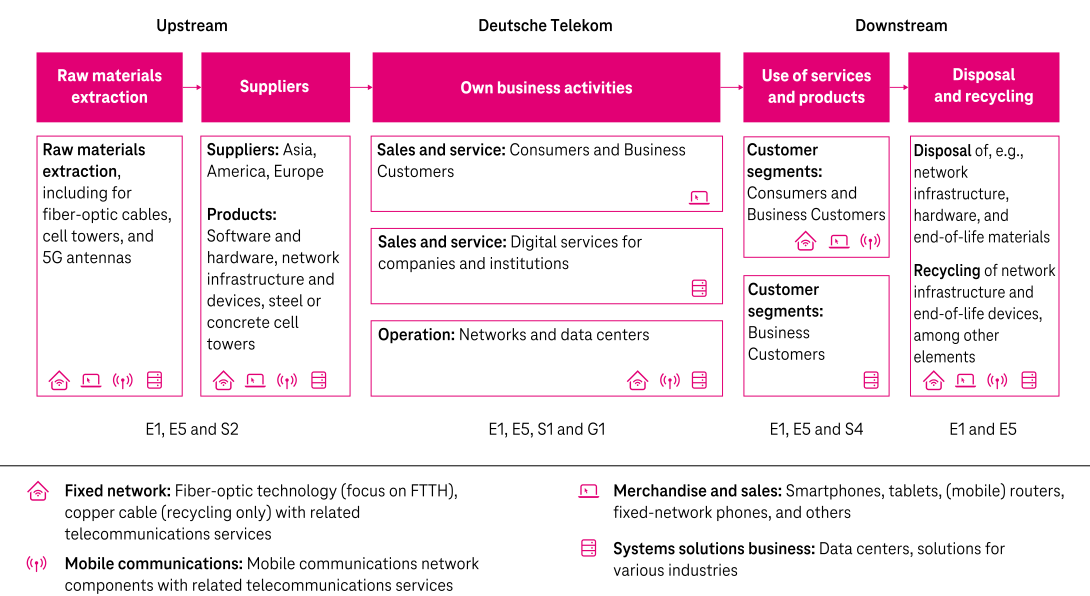
Our goal is to make our product portfolio increasingly sustainable. To achieve this, we take a holistic approach to resource conservation and are committed to the responsible use of resources along our entire value chain. Reusing products and materials and extending their use phase not only saves on resources, but also reduces energy consumption and emissions.
For further information on our approach to the extraction of raw materials as well as disposal and recycling, please refer to the section “ESRS E5.”
The most important economic actors for Deutsche Telekom are its suppliers, customers, and investors.
- Suppliers: For the build-out of our network infrastructure, our suppliers from the civil engineering sector and manufacturers of fixed-network and mobile devices and ICT network technology are particularly important. They provide the infrastructure services, technology, devices, and network technology required to operate and develop the telecommunications infrastructure. Deutsche Telekom works closely with its suppliers to achieve common sustainability-related goals, for example reducing emissions from CO2 equivalents (CO2e) and promoting a circular economy. In addition, we have requested our suppliers of network technology and terminal equipment (Deutsche Telekom excluding T‑Mobile US) to make their products and services almost completely circular by 2030. The relationship between Deutsche Telekom and its economic actors is distinguished by close cooperation on the one hand and by interdependencies on the other hand. The two sides are working to achieve common goals and promote sustainable practices.
- Customers: Our customer portfolio comprises consumers, business customers, the public sector, and wholesale. These customer groups use the different telecommunications services and products that Deutsche Telekom offers, such as mobile communications, fixed-network, internet, and TV services. Our relationship with our customers is shaped by our high standards in terms of service quality and customer satisfaction. We also attach great importance to the protection of their privacy and data.
- Investors: One of the main objectives of our finance strategy is to ensure unrestricted access to capital markets. Investors are therefore critically important to us as a company, providing the capital we need to grow, innovate, and expand. They enable us to share risks and offer strategic support and valuable networks that help us to secure our ability to obtain financing and optimize our value chain. The liquidity this provides us with is indispensable for scaling up our business model. The support received from investors thus strengthens our long-term competitiveness and sustainability, enabling us to efficiently achieve our business goals and continuously evolve.
ESRS 2 SBM-2 – Interests and views of stakeholders
Interaction with our stakeholder groups does not only help us to find support for our concerns. It also provides input that helps us identify key trends early on. In this way, it facilitates our innovation processes.
For a list of our stakeholder groups and further information, please refer to the section “Management of the Group.”
To involve our stakeholder groups in our business activities, we have developed an approach based on the AA1000 principles developed by the non-governmental organization (NGO) AccountAbility: materiality, inclusivity, and responsiveness. In the reporting year, we intensified our dialogue with employees to further embed the topic of sustainability in our internal processes, e.g., at the CR management meeting in Warsaw, through regular virtual meetings with the CR network, and through a series of virtual information events. This includes, for example, refining our strategic approach to promoting digital inclusion, designing training programs in the field of sustainability, and exchanging best practices for measuring and managing GHG emissions.
We organize our stakeholder engagement in three forms: participation, dialogue, and information. We use our recurring case-related relevance analysis to determine how intensively we involve our stakeholders. The more relevant a stakeholder group is to the topic or project concerned, the more intensively that stakeholder group is to be engaged. We list some examples of our active stakeholder management below:
- Data Privacy Advisory Board: As an independent advisory body to Deutsche Telekom AG’s Board of Management, the Data Privacy Advisory Board advises on key data privacy and data security issues. The Advisory Board also covers aspects of digitalization, societal developments, and ethical issues. It includes members of stakeholder groups from science, business, politics, and independent organizations.
- “Telekom hilft” (Telekom helps out): We include customers and end-users by giving them the opportunity to ask questions and provide answers in the community, as well as to take part in discussions, read and comment on blogs on Deutsche Telekom topics, and test new Deutsche Telekom products.
- “Telekom Ideenschmiede” (Telekom’s Ideas Forge): Deutsche Telekom’s Ideas Forge also facilitates dialogue with customers, end-users, and interested parties and gives them the opportunity to share and assess ideas for innovations. Our employees can also submit ideas and suggestions for improvement through our idea management program.
- Deutsche Telekom’s Municipal Advisory Board: The board of municipal representatives provides the framework for direct dialogue between municipalities and Deutsche Telekom. It functions as a platform for discussing ideas, interests, and expectations and for finding a rapid resolution to certain issues. The board may also invite outside experts to attend individual meetings.
- Dialogue with our employees: Our employees can exchange ideas in various areas of interest through our internal communities, such as GreenPioneers, the Human-Centered Technology Community, and Telekom@School.
- Town hall meetings: The members of the Board of Management regularly enter into dialogue with our employees and answer questions on current topics. The format was also made more international in the reporting year by holding some of the Group-wide broadcast town hall meetings at the locations of different national companies.
- “Hack4Humans x AI” hackathon: In the reporting year, employees worldwide took part in a three-day competition to develop innovative AI solutions for the Group. By promoting people-centered technology use, the format gives experts from different areas of the organization a further opportunity to network at an international level.
The feedback we receive from our stakeholders is incorporated into the alignment of our CR activities and has an impact on the CR program.
Our approach is to address the concerns of stakeholders, if possible, where dialogue with the stakeholder takes place. The areas involved in the dialogue receive direct feedback and can incorporate this directly into the organization of their work. They are responsible for referring concerns that cannot be resolved locally to the appropriate bodies within the Group. This also applies accordingly to the specific topics that are relevant in the context of the due diligence process and the materiality assessment. If a topic proves to be of particular interest to certain stakeholders, we initiate a topic-specific response and, if necessary, develop special dialogue formats. We are also committed to respect for human rights and are dedicated to protecting them in connection with our business operations, our suppliers, and our customers at both global and regional level. Our actions are based, among others, on the relevant recognized international standards and guiding principles, which we describe in the section “ESRS S2‑1.” In addition, we express our commitment to this in our Code of Human Rights.
The Board of Management and the Supervisory Board of Deutsche Telekom AG were informed in the 2025 financial year about the views and interests of affected stakeholders with regard to the Company’s sustainability-related impacts in the context of the presentation of the materiality assessment.
ESRS 2 SBM-3 – Material impacts, risks, and opportunities and their interaction with strategy and business model
In the relevant topical standards, we examine in detail the ESRS topics identified as being material. There we describe Deutsche Telekom’s material impacts, risks, and opportunities and their interactions with our strategy and business model. We also discuss the related policies, targets, actions and metrics.
We continuously review the current and anticipated effects of the impacts, risks, and opportunities on our strategy, business model, value chain, and decision-making and their interaction and develop actions to address these. Neither the identified impacts, risks, and opportunities nor the actions taken and planned led to a change in strategy or the business model in the reporting year. Furthermore, the material risks and opportunities did not have any relevant current financial effects on our financial position, financial performance, and cash flows in the reporting year. We aim to foster change towards greater sustainability through new technologies and innovative ideas and by offering more sustainable products and services. This is our response to the effects of climate change. We always take care to comply with the due diligence process and consider all aspects for sustainable governance. The results of the recurring risk analysis pursuant to the LkSG in our own business areas and in the upstream value chain serve, for example, as a basis for deriving actions and are also integrated into corporate decision-making processes (Deutsche Telekom excluding T‑Mobile US). As a company listed in the US, T‑Mobile US carries out a company-specific risk assessment using its own methodology. The results are regularly reported to the relevant governing bodies, which include representatives of Deutsche Telekom AG.
The actual and potential impacts on the different stakeholders, on which we report under ESRS S1, S2, and S4, arise from our strategy or our business model (ESRS S1) or are connected with these through the procurement of goods (ESRS S2) and our focus on the advancing network build-out (ESRS S4). All material negative impacts on the affected stakeholders that we identified in the double materiality assessment are of a systemic nature; they are not connected with individual incidents or with specific business relationships of Deutsche Telekom. In addition to reporting on how we deal with significant impacts, we also disclose information in the social topical standards on the relationship between significant risks and opportunities arising from impacts and dependencies with regard to our different stakeholders.
Deutsche Telekom’s Business Continuity Management (BCM) is a process within operational security and risk management that helps protect business processes from the consequences of damaging incidents and disruptions. By continuously analyzing, assessing, and managing risks, BCM aims to ensure the continuity of business processes and to guarantee the resilience of the Group.
In addition, Deutsche Telekom reports on its climate risk analysis taking into consideration the recommendations of the Task Force on Climate-related Financial Disclosures (TCFD) in order to ensure resilience, particularly with regard to risks arising from the consequences of climate change.
For further information, please refer to the section “ESRS E1.”
The following table provides an overview of the impacts, risks, and opportunities covered by additional entity-specific disclosures.
When the materiality assessment was being updated, changes were made to our material impacts, risks, and opportunities. The positive impact on the employment and inclusion of persons with disabilities, which had been classified as material in the previous year, was no longer assessed as material in the reporting year. Moreover, the financial risk arising from rising costs for carbon offsets was no longer classified as material. At the same time, a significant risk in connection with cybersecurity was identified for the first time in the reporting year and corresponding company-specific disclosures were made.
|
|
|
Impacts, risks, and opportunities |
Entity-specific disclosure |
Reference |
|---|---|---|
T‑Systems’ data centers mainly use indirect free cooling. Refrigeration systems are deployed if additional capacity is required, and when outside temperatures are high, adiabatic (evaporative) cooling systems are used. |
PUE ESG KPI (Power Usage Effectiveness) |
|
Using and maintaining the networks provided by Deutsche Telekom also requires large amounts of energy. |
Energy Intensity ESG KPI |
|
The ongoing build-out of Deutsche Telekom’s network infrastructure facilitates access to information. The ability to share opinions with a wider audience has a fundamentally positive impact on the exercise of the right to freedom of expression. The network build-out will thus also help to ensure that all people have equal opportunities to be a part of the digital society. |
Community Contribution – Digital Society ESG KPI |
|
Through the services it provides and the ongoing network build-out, Deutsche Telekom creates the basis for digital inclusion and actively promotes social inclusion. A variety of complementary measures serve, for example, to increase media literacy and promote accessibility and non-discrimination. These will continue to support equal access to digital products and services going forward and allow people from all generations to actively participate in digital society. Company-specific metrics such as the Community Contribution – Digital Society and Beneficiaries – Digital Society ESG KPIs reflect the involvement in these initiatives and the progress made. |
Community Contribution – Digital Society ESG KPI |
|
The advances in digitalization and the increasing sophistication of technological systems pose growing challenges for data security. Overcoming these challenges requires not only technical and organizational resources, but also continuous innovation. This in turn can cause costs to rise. |
Cybersecurity |
Impact, risk, and opportunity management
ESRS 2 IRO-1 – Description of the process to identify and assess material impacts, risks, and opportunities
We performed an extensive double materiality assessment in 2024 to identify our impacts, risks, and opportunities. The objective of the double materiality assessment was, first, to identify all actual and potential material impacts on society and on the environment that are caused by our business activities and locations along the entire value chain. Second, our objective was to obtain a thorough understanding of the financial risks and opportunities for Deutsche Telekom that may arise from the responses of stakeholder groups and from climate change. The materiality assessment is reviewed annually.
The comprehensive double materiality assessment is continuously refined. It is based on extensive research that considered both studies and other publicly available information. This approach has been enhanced through engagement with internal and external stakeholders in the form of qualitative interviews. In 2025, interactive workshops were again held with topic owners and internal experts. The lessons learned, plus the outcome of an AI-based trend analysis, which serves as a forward-looking addition, were systematically built into the double materiality assessment.
For the double materiality assessment, the functional units addressed the disclosure requirements of all ESRS in the reporting year and considered their relevance for Deutsche Telekom’s business. They also compared the maturity of the existing management systems with the requirements of the sustainability standards. To ensure that all disclosure requirements had been reviewed and that Deutsche Telekom is complying with its disclosure obligations, the experts compared the results with all the datapoints required by the ESRS.
We considered both the negative and the positive impacts of our business activities and locations on society and on the environment and along the entire value chain. We then assessed our financial sustainability opportunities and risks, also considering transition risks and physical risks and opportunities connected with biodiversity and ecosystems. This process also considered systemic risks. The results were subsequently validated in an internal workshop with attendees from various functional units. They also raised the concerns of different external stakeholders whose positions they are well aware of due to their work. In this context, we conducted a biodiversity analysis that identified social and environmental impacts along Deutsche Telekom’s entire value chain. Fixed-network and mobile communications infrastructure is primarily installed in built-up urban areas. In rural areas and biodiversity-sensitive areas, any intervention takes place in accordance with the national legal requirements (e.g., environmental impact assessments) and is coordinated with the local environmental authorities as required. However, our activities do not have any material impacts on these areas. Nevertheless, Deutsche Telekom attaches great importance to this topic and will continue to track it.
We made the following basic assumptions to allow us to analyze Deutsche Telekom’s business activities and value chain realistically and efficiently:
- We have structured our business into the areas of fixed network, mobile communications, merchandise (sale of hardware for using the network), and the systems solutions business (business customers).
- As a service provider that generally does not manufacture products itself, we distribute the products of our suppliers. These are primarily manufacturers of mobile devices. Deutsche Telekom only has a very limited influence on the extraction of raw materials for its merchandise and does not establish a direct link between these activities and its own business model.
Our due diligence process is based on the ESRS dimensions of severity and likelihood of occurrence. Based on these criteria, we used an assessment scheme to evaluate the relevance of positive and negative actual and potential impacts. We considered the following aspects and determined the severity when assessing actual and potential impacts:
- Scale: How grave is the impact?
- Scope: How widespread is it?
- Irreversibility: How difficult is it to reverse it? (only for negative impacts)
In addition, potential impacts are assessed based on their likelihood of occurrence and the time horizon (short, medium, or long term), and we used a five-point scale for this which is based on the recommendations of the December 2023 Implementation Guidance of the European Financial Reporting Advisory Group (EFRAG). We also identified the stage in the value chain where each impact occurs or could occur.
The structure of the financial materiality assessment follows the four-level assessment logic of our established risk and opportunity management system. To determine our financial risks and opportunities, we inventoried and assessed them, allocated them to the ESRS subtopics, and identified correlations with the impacts. They were divided into the following categories:
- Strategic risks and opportunities
- Operational risks and opportunities
- Regulatory risks and opportunities
- Litigation and anti-trust proceedings
- Compliance risks
- Financial risks and opportunities
For further information on our risk management process, please refer to the section “Risk and opportunity management.”
We also identified the stages of the value chain where risks and opportunities arise. Likewise, we assigned the time horizon during which they may arise for us to the risks. The two criteria we use – probability of occurrence and risk extent – are taken from the established criteria in our Group-wide risk and opportunity management. Any individual risks or opportunities that exceed GCR’s internal monitoring thresholds are reported as part of the Group-wide risk and opportunity management process. In 2025, we continued to apply the assessment scheme from our risk and opportunity management, which is linked to our materiality processes. GCR uses the risk and opportunity inventory as part of the materiality assessment to track new sustainability-related risks and take the assessment scheme into account accordingly in the Group-wide risk and opportunity management system.
After identifying our sustainability-related impacts, risks, and opportunities, we prioritized these on the basis of a threshold. The negative and positive impacts close to the materiality threshold are subject to internal control processes and are continuously observed to determine their potential materiality.
Responsible, appropriate management of risks and opportunities is a core component of our governance. The Board of Management has implemented systems for risk identification and mitigation, in particular the risk and opportunity management system and the internal control system, including the compliance management system. Sustainability topics are integrated into both the risk and opportunity management system and the internal control system. Both systems incorporate sustainability aspects, which are becoming increasingly important as regulatory requirements continue to evolve.
The Group-wide risk and opportunity management system covers risks and opportunities of all segments and central departments. In addition, all material risks and opportunities are measured and disclosed separately based on ESG criteria. Sustainability-related goals are also a component of the Group’s risk reporting. The internal control system includes controls that address the Group-wide, IT-based collection process for ESG data from the ESRS E1, E5, and S4 topical standards.
The risk and opportunity inventory for the extensive double materiality assessment from 2024 was based on the previous year’s inventory. It was enhanced and reviewed for plausibility following the analysis of the ESRS datapoints. In 2025, we finally updated the materiality assessment carried out in 2024, systematically reviewing the inventory of impacts, risks, and opportunities once again and adding relevant changes and challenges. The findings from the LkSG risk analysis were taken into consideration for the 2025 financial year. At a procedural level, a particular focus of our attention was on integrating an AI-based trend analysis, which will help to identify and assess future sustainability drivers in Deutsche Telekom’s specific environment. We incorporated the insights gained into a new validation process.
Following a comprehensive review of our business activities and sites, four topical standards fell below the materiality threshold:
- ESRS E2 – Pollution has been assessed as not material because we have not identified any material impacts, risks, or opportunities from raw materials extraction or from the production and disposal of materials and products in relation to pollution of air, water, and soil.
- ESRS E3 – Water and marine resources has been assessed as not material. No material impacts, risks, or opportunities in connection with water and marine resources have been identified, for example through high water withdrawal for the processing of materials for hardware and network infrastructure or ocean pollution from the discharge of contaminated water.
- ESRS E4 – Biodiversity and ecosystems has been assessed as not material. The materiality assessment for 2024 and 2025 shows that Deutsche Telekom’s business activities – from raw materials extraction to installation and all the way to the disposal of infrastructure – do not have significant impacts, risks, or opportunities with regard to biodiversity. Sites located in or near biodiversity-sensitive areas are also not affected. No mitigation measures are therefore required.
- ESRS S3 – Affected communities has been assessed as not material. The related impacts, risks, and opportunities have been assessed as not material, partly due to limited insights and only indirect opportunities to exert influence.
ESRS 2 IRO-1 E1 Description of the processes to identify and assess material climate-related impacts, risks, and opportunities
As part of our materiality assessment, we identified actual and potential sources of greenhouse gas emissions for our own operations and along the value chain. The main levers have been systematically analyzed.
For further information on the calculation of GHG emissions, please refer to the section “ESRS E1‑6.”
In the course of the climate risk analysis, we identified the material climate-related opportunities and risks with experts from the areas of technology, procurement, and strategy and risk management, and began weighting them on this basis. In the process, we considered the consequences for our business activities that may result from the physical impacts of the ongoing climate change. On the other hand, we analyzed the potential impacts as a result of political, technological, and social developments associated with the transition to a low-emission economy that has already begun. The analysis also involved a financial quantification of transition risks. This process was last carried out in full in 2023; in 2024, we reviewed the defined risks and updated the data basis for the physical climate risks. The physical climate risk analysis was expanded in the reporting year to include an analysis of the upstream value chain.
In 2023, we analyzed selected Deutsche Telekom locations in Germany, Hungary, Greece, and Croatia with regard to their physical climate risks. The analysis included all data centers as well as critical infrastructure in the fixed network and sampling in the mobile communications network. We extended this analysis to Austria, Poland, Slovakia, the Czech Republic, and the US in 2024. The analysis thus comprises the units that made up nearly 100 % of our revenue in 2025. Locations related to mobile communications, fixed networks, and data centers whose functionality has a material influence on our business activities were taken into account. In total, we analyzed more than 8 thousand sites using a recognized software platform that is based on the climate scenarios developed by the Intergovernmental Panel on Climate Change (IPCC).
The analysis comprised nine climate indices. We considered the risks for the various sites in light of two climate scenarios of the IPCC: a business-as-usual scenario (RCP 4.5/SSP2-4.5), with a global temperature increase of more than two degrees, and a four-degree scenario (RCP 8.5/SSP5-8.5).
In addition to the climate scenarios, we examined the risks in different time periods: for the years 2030, 2040, and 2050.
Deutsche Telekom has defined short-, medium-, and long-term time horizons based on the existing time horizons from the Group-wide risk and opportunity management system. Our intention is to ensure that climate risks are integrated into our risk and opportunity management system and that all business risk categories follow a comparable approach. We also selected a time horizon up to 2050 for the scenario analysis. On the one hand, this matches the time horizons of international agreements on climate change mitigation, such as the Paris Agreement. On the other, it corresponds to a realistic planning horizon for internal strategic planning and the useful life of classic Deutsche Telekom assets such as infrastructure components.
When assessing climate risks, we assessed the probability of occurrence and risk extent. We assessed both the physical climate risks and the transition hazards, taking into account the geographical coordinates of Deutsche Telekom’s key locations. We also analyzed the upstream and downstream value chain for the transition risk assessment.
To identify transition opportunities and risks, we also applied the Net Zero Emissions (NZE) 2050 scenario described in the section “ESRS 2 SBM-3 E-1.” The process for assessing the opportunities and risks associated with climate change includes:
- identifying and quantifying the important trends
- calculating the impacts on the undertaking
- analyzing the impacts on the value chain
As part of our risk management activities, we quantify a number of risks and publish these in the questionnaire for the CDP, a tool for disclosing climate-related indicators to investors, for example. We factor the extent of the risks into our corporate planning. We also assess the applicability and benefits of management tools that we use to regularly integrate sustainable, attractive financing models, e.g., related to climate protection aspects in investment decisions.
We have not identified any assets and business activities that are incompatible with a transition to a carbon-neutral economy or that require significant effort to be compatible with a transition to a carbon-neutral economy. No critical climate-related assumptions have been used to date to measure assets and liabilities in the consolidated financial statements.
ESRS 2 IRO-2 – Disclosure requirements in ESRS covered by the undertaking’s sustainability statement
The following table contains a list of the disclosure requirements that we complied with in preparing the sustainability statement, following the outcome of the double materiality assessment, as well as the disclosures required by Article 8 of Regulation (EU) 2020/852 (Taxonomy Regulation). The datapoints to be reported and hence the material information were determined using qualitative mapping based on an in-depth examination at a content level of the identified impacts, risks, and opportunities. The mapping is based on the criteria defined in para. 31 of ESRS 1. The following topical standards have been assessed as material:
|
Topical standard with reference |
|---|
General information |
Environment |
Disclosures pursuant to Article 8 of Regulation (EU) 2020/852 (Taxonomy Regulation) |
Social |
Governance |
In addition to the topical standards set out above and to ensure fiscal transparency, every year we publish an excerpt from the Country-by-Country Report on our material countries and Group companies.
The excerpt from the Country-by-Country Report on our material countries and Group companies can be accessed on Deutsche Telekom’s website.
The following table contains all the datapoints that derive from other EU legislation, as listed in ESRS 2 Appendix B. It also indicates where the datapoints can be found in our report and which datapoints are assessed as “not material,” “not reported,” and “not relevant.”
|
|
|
|
|
|
|
|
|
||
Disclosure requirement |
Datapoint |
Name |
SFDR reference |
Pillar 3 reference |
Benchmark Regulation reference |
EU Climate Law reference |
Materiality |
Section |
||
|---|---|---|---|---|---|---|---|---|---|---|
ESRS 2 GOV-1 |
21d |
Board’s gender diversity |
x |
|
x |
|
|
|||
ESRS 2 GOV-1 |
21e |
Percentage of board members who are independent |
|
|
x |
|
|
|||
ESRS 2 GOV-4 |
30 |
Statement on due diligence |
x |
|
|
|
|
|||
ESRS 2 SBM-1 |
40d-i |
Involvement in activities related to fossil fuel activities |
x |
x |
x |
|
Not relevant |
– |
||
ESRS 2 SBM-1 |
40d-ii |
Involvement in activities related to chemical production |
x |
|
x |
|
Not relevant |
– |
||
ESRS 2 SBM-1 |
40d-iii |
Involvement in activities related to controversial weapons |
x |
|
x |
|
Not relevant |
– |
||
ESRS 2 SBM-1 |
40d-iv |
Involvement in activities related to cultivation and production of tobacco |
|
|
x |
|
Not relevant |
– |
||
ESRS E1‑1 |
14 |
Transition plan to reach climate neutrality by 2050 |
|
|
|
x |
|
|||
ESRS E1‑1 |
16g |
Undertakings excluded from Paris-aligned Benchmarks |
|
x |
x |
|
|
|||
ESRS E1‑4 |
34 |
GHG emissions reduction targets |
x |
x |
x |
|
|
|||
ESRS E1‑5 |
38 |
Energy consumption from fossil sources disaggregated by sources (only high climate impact sectors) |
x |
|
|
|
|
|||
ESRS E1‑5 |
37 |
Energy consumption and mix |
x |
|
|
|
|
|||
ESRS E1‑5 |
40–43 |
Energy intensity associated with activities in high climate impact sectors |
x |
|
|
|
|
|||
ESRS E1‑6 |
44 |
Gross Scopes 1, 2, 3, and total GHG emissions |
x |
x |
x |
|
|
|||
ESRS E1‑6 |
53–55 |
Gross GHG emissions intensity |
x |
x |
x |
|
|
|||
ESRS E1‑7 |
56 |
GHG removals and carbon credits |
|
|
|
x |
Not relevant (para. 56a) |
|||
ESRS E1‑9 |
66 |
Exposure of the benchmark portfolio to climate-related physical risks |
|
|
x |
|
Not reported |
– |
||
ESRS E1‑9 |
66a, 66c |
Disaggregation of monetary amounts by acute and chronic physical risk/Location of significant assets at material physical risk |
|
x |
|
|
Not reported |
– |
||
ESRS E1‑9 |
67c |
Breakdown of the carrying value of its real estate assets by energy-efficiency class |
|
x |
|
|
Not reported |
– |
||
ESRS E1‑9 |
69 |
Degree of exposure of the portfolio to climate-related opportunities |
|
|
x |
|
Not reported |
– |
||
ESRS E2‑4 |
28 |
Amount of each pollutant listed in Annex II of the EPRTR Regulation (European Pollutant Release and Transfer Register) emitted to air, water, and soil |
x |
|
|
|
Not material |
– |
||
ESRS E3‑1 |
9 |
Water and marine resources |
x |
|
|
|
Not material |
– |
||
ESRS E3‑1 |
13 |
Dedicated policy |
x |
|
|
|
Not material |
– |
||
ESRS E3‑1 |
14 |
Sustainable oceans and seas |
x |
|
|
|
Not material |
– |
||
ESRS E3‑4 |
28c |
Total water recycled and reused |
x |
|
|
|
Not material |
– |
||
ESRS E3‑4 |
29 |
Total water consumption in m3 per net revenue on own operations |
x |
|
|
|
Not material |
– |
||
ESRS 2 SBM-3 E4 |
16a-i |
|
x |
|
|
|
Not material |
– |
||
ESRS 2 SBM-3 E4 |
16b |
|
x |
|
|
|
Not material |
– |
||
ESRS 2 SBM-3 E4 |
16c |
|
x |
|
|
|
Not material |
– |
||
ESRS E4‑2 |
24b |
Sustainable land/agriculture practices or policies |
x |
|
|
|
Not material |
– |
||
ESRS E4‑2 |
24c |
Sustainable oceans/seas practices or policies |
x |
|
|
|
Not material |
– |
||
ESRS E4‑2 |
24d |
Policies to address deforestation |
x |
|
|
|
Not material |
– |
||
ESRS E5‑5 |
37d |
Non-recycled waste |
x |
|
|
|
|
|||
ESRS E5‑5 |
39 |
Hazardous waste and radioactive waste |
x |
|
|
|
|
|||
ESRS 2 SBM-3 – S1 |
14f |
Risk of incidents of forced labor |
x |
|
|
|
Not material |
– |
||
ESRS 2 SBM-3 – S1 |
14g |
Risk of incidents of child labor |
x |
|
|
|
Not material |
– |
||
ESRS S1‑1 |
20 |
Human rights policy commitments |
x |
|
|
|
|
|||
ESRS S1‑1 |
21 |
Due diligence policies on issues addressed by the fundamental International Labor Organisation Conventions 1 to 8 |
|
|
x |
|
|
|||
ESRS S1‑1 |
22 |
Processes and measures for preventing trafficking in human beings |
x |
|
|
|
|
|||
ESRS S1‑1 |
23 |
Workplace accident prevention policy or management system |
x |
|
|
|
|
|||
ESRS S1‑3 |
32c |
Grievance/complaints handling mechanisms |
x |
|
|
|
|
|||
ESRS S1‑14 |
88b, 88c |
Number of fatalities and number and rate of work-related accidents |
x |
|
x |
|
|
|||
ESRS S1‑14 |
88e |
Number of days lost to injuries, accidents, fatalities, or illness |
x |
|
|
|
|
|||
ESRS S1‑16 |
97a |
Unadjusted gender pay gap |
x |
|
x |
|
|
|||
ESRS S1‑16 |
97b |
Annual total remuneration ratio of the highest-paid individual to the median annual total remuneration for all employees |
x |
|
|
|
|
|||
ESRS S1‑17 |
103a |
Incidents of discrimination |
x |
|
|
|
|
|||
ESRS S1‑17 |
104a |
Non-respect of UNGPs on Business and Human Rights and OECD Guidelines |
x |
|
x |
|
|
|||
ESRS 2 SBM3 S2 |
11b |
Significant risk of child labor or forced labor in the value chain |
x |
|
|
|
|
|||
ESRS S2‑1 |
17 |
Human rights policy commitments |
x |
|
|
|
|
|||
ESRS S2‑1 |
18 |
Policies related to value chain workers |
x |
|
|
|
|
|||
ESRS S2‑1 |
19 |
Non-respect of UNGPs on Business and Human Rights and OECD Guidelines |
x |
|
x |
|
|
|||
ESRS S2‑1 |
19 |
Due diligence policies on issues addressed by the fundamental International Labor Organisation Conventions 1 to 8 |
x |
|
|
|
|
|||
ESRS S2‑4 |
36 |
Human rights issues and incidents connected to its upstream and downstream value chain |
x |
|
|
|
|
|||
ESRS S3‑1 |
16 |
Human rights policy commitments |
x |
|
|
|
Not material |
– |
||
ESRS S3‑1 |
17 |
Non-respect of UNGPs on Business and Human Rights, ILO Principles or OECD Guidelines |
x |
|
x |
|
Not material |
– |
||
ESRS S3‑4 |
36 |
Human rights issues and incidents |
x |
|
|
|
Not material |
– |
||
ESRS S4‑1 |
16 |
Policies related to consumers and end-users |
x |
|
|
|
|
|||
ESRS S4‑1 |
17 |
Non-respect of UNGPs on Business and Human Rights and OECD Guidelines |
x |
|
x |
|
|
|||
ESRS S4‑4 |
35 |
Human rights issues and incidents |
x |
|
|
|
|
|||
ESRS G1‑1 |
10b |
United Nations Convention against Corruption |
x |
|
|
|
|
|||
ESRS G1‑1 |
10d |
Protection of whistleblowers |
x |
|
|
|
|
|||
ESRS G1‑4 |
24a |
Fines for violation of anti-corruption and anti-bribery laws |
x |
|
x |
|
|
|||
ESRS G1‑4 |
24b |
Standards of anti-corruption and anti-bribery |
x |
|
|
|
|
|||
|
||||||||||