
ESRS E5 – Resource use and circular economy
We are committed to responsible use of resources along our entire value chain. In addition to conserving and avoiding resources, we aim to make products and materials as durable as possible and to ensure they are returned into circulation at the end of their lifetimes. By means of longer use phases and reusing, we are able to not only save on resources, but also to reduce energy use and emissions, thus contributing to climate change mitigation.
The following index shows the disclosure requirements relating to the topical standard “Resource use and circular economy” identified by the materiality assessment.
ESRS index under ESRS 2 IRO-2
| Disclosure requirement | Name with reference | |
|
ESRS E5 – Resource use and circular economy |
||
|
ESRS 2 SBM-3 E5 |
Material impacts, risks, and opportunities and their interaction with strategy and business model |
|
|
ESRS 2 IRO-1 E5 |
Description of the processes to identify and assess material impacts, risks, and opportunities |
|
|
ESRS E5‑1 |
||
|
ESRS E5‑2 |
Actions and resources in relation to resource use and circular economy |
|
|
ESRS E5‑3 |
||
|
ESRS E5‑4 |
||
|
ESRS E5‑5 |
||
|
ESRS E5‑6 |
Anticipated financial effects from material resource use and circular economy-related risks and opportunities |
|
Strategy
ESRS 2 SBM-3 E5 – Material impacts, risks, and opportunities and their interaction with strategy and business model
In our double materiality assessment, we considered possible impacts, risks, and opportunities in relation to resource use and circular economy. The table below shows the material impacts of our business activities on society and the environment that we identified in the process.
We provide overarching information on how material impacts, risks, and opportunities interact with our strategy and business model in the section “ESRS 2 SBM-3.”
|
|
|
Value chain/ |
Nature of impacts |
Description |
|---|---|---|
Resource inflows, including resource use |
||
Upstream/ |
Negative |
We procure large quantities of products and components for the maintenance and build-out of fixed-network and mobile communications infrastructure (primarily for antenna or fiber-optic build-out). These resource inflows for the network build-out are associated with negative impacts on the depletion of non-renewable resources and the use of renewable resources. |
Downstream/ |
Positive |
Through new business models such as leasing or selling refurbished technical equipment, we can have a positive impact. A leasing model for fixed-network equipment, for example, will help us achieve circular economy targets. With these models we reduce resource inflows and avoid the use of new materials. We also sell used network components through third parties to extend product life cycles. An internal marketplace for network technology has also been set up so that products can be used for longer. |
Waste |
||
Own business activities and downstream/ |
Negative |
The construction and operation of office buildings, which we need to provide our services, generates waste. The construction and operation of data centers also generates waste that can harm the environment if not disposed of properly. In addition, large quantities of electronic waste are generated during the build-out and maintenance of the networks. |
Own business activities and downstream/ |
Positive |
Deutsche Telekom’s zero waste ambitions may – at least potentially – have positive impacts on the avoidance of waste. |
The following overview illustrates Deutsche Telekom’s material risks and their financial effects on our financial position, financial performance, and cash flows.
For further information on risks and opportunities that represent a top risk or top opportunity in the next two years, please refer to the section “Risk and opportunity management.”
|
|
|
Value chain |
Risk/opportunities |
Description |
|---|---|---|
Resource inflows, including resource use |
||
Upstream |
Risk |
The growing scarcity of raw materials due to wars, pandemics or the finite nature of resources poses a financial risk to our business activities. We are already facing rising material, production, logistics, and energy costs due to scarcity. |
Impact, risk, and opportunity management
ESRS E5‑1 – Policies related to resource use and circular economy
We aim to minimize our negative impact in the context of resource inflows and resource use in the field of network technology by taking a variety of approaches to achieve efficient use of resources and promote a circular economy. The sourcing volume will remain high in the coming years due to the continuous network build-out. By promoting the reuse of products and materials, we are reducing our raw material requirements. In addition, we are endeavoring to repair more network technology components and to reuse them elsewhere, so as to reduce the amount of new equipment needed.
In 2025, we made preparations to roll out a comprehensive set of KPIs (Telco Circularity Score, TCS). From January 2026, we (excluding T‑Mobile US) intend to use this to measure our holistic approach to increasing our circularity. It helps us to manage the underlying strategic actions. The set of KPIs includes a specific KPI for the circular material use ratio for network technology, which takes into account the proportion of reused or refurbished network technology and the share of circular materials when it comes to new procurement. This is another way in which we aim to counteract the negative impact of our resource inflows for the network build-out. Responsibility for implementing the circular business models lies with the relevant business units, i.e., at company level.
Our procurement strategy and the implementation policies derived from it address sustainability throughout the entire sourcing process. We are committed to ensuring that our suppliers comply with our environmental, social, and ethical sustainability requirements. In the course of tenders, we weight our environmental objectives, our suppliers’ GHG emissions and, in the case of individual product groups, other social sustainability criteria. By doing so, we seek to minimize the negative influences of resource inflows for network technology while at the same time promoting innovations at our partners. When it comes to new procurement, we want to increase the use of recycled materials with our approach to increasing our circular material use ratio. In addition, we are working with the manufacturers of network technology and devices to develop roadmaps and actions as part of a program to integrate circularity aspects, among other aspects.
We use KPIs and management tools to monitor the implementation of our procurement strategy. These include, for example, scorecards that can be used to assess the sustainability of individual providers and products. Responsibility for the topic of sustainable procurement lies with the Finance Board of Management department and the Group’s procurement functions. Other functional units and the GCR unit provide support in terms of content.
We also place particular emphasis on environmentally sustainable features when designing our products. Our holistic approach (excluding T‑Mobile US) comprises our telecommunications services, the related terminal equipment, including plastic-free packaging, and shipping to customers that emits a minimum of greenhouse gases. We take a number of measures so that our customers can use the devices for longer, and the hardware can be reused or professionally recycled at the end of its useful life. For this we team up with our partners, for example various providers of buy-back, refurbishment or collection services. In this way, we make a direct contribution to the positive effects of our new business models. T‑Mobile US utilizes global sustainability certifications to evaluate products, like handsets and tablets, and requires manufacturers to achieve a certain minimum UL ECOLOGO Certification Program or Electronic Product Environmental Assessment Tool (EPEAT) rating. The certifications cover a range of product sustainability topics, including material use and end-of-life management.
In addition, we (excluding T‑Mobile US) set requirements for the development of new devices that are sold under the T brand, which will increase the use rate of secondary raw materials, among other aspects. This design approach is driven by our Environmental Guidance. It considers factors such as the upstream negative impacts of resource inflows and – in order to mitigate these – defines actions to reuse products. In addition, the Guidance explains concepts for professional recycling and thus covers risks that may arise due to potential resource scarcity.
For further information on our Environmental Guidance, please refer to the section “ESRS E1‑2.”
Our waste management (excluding T‑Mobile US) is organized in line with the International Waste Management Framework. We strive to avoid creating waste wherever possible and to recycle as much as possible of the waste we do produce. In this context, we pursue a variety of approaches to ensure, for example, controlled handling of electronic waste generated and to avoid disposing of it in landfills. The waste pyramid provides a methodological framework for these approaches: The first step is to avoid waste, followed by reuse, recycling, and other forms of recovery (e.g., energy recovery) – so that, in the end, only those materials remain for disposal that cannot be treated at the other levels of the pyramid.
Waste pyramid in connection with Deutsche Telekom’s approach to circular economy
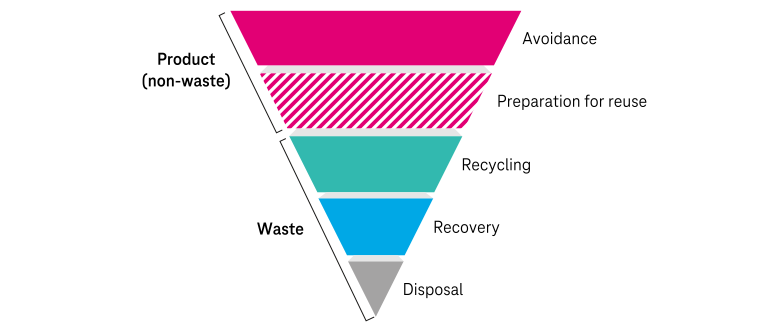
We monitor implementation of the waste management system with a set of KPIs that are continuously being refined. We not only focus on the waste generated by Deutsche Telekom itself, but also include the upstream and downstream value chain in our analysis. In the upstream value chain, this particularly refers to increasing the share of refurbished devices or prioritizing the modular design of network technology in order to avoid waste. Later reuse, refurbishment or recycling at the end of life is also taken into account in procurement and product design. In the downstream value chain, we take responsibility for electronic waste, such as by implementing the circular economy policies mentioned above (e.g., buy-back, refurbishment, collection). Our waste management approaches aim to counteract the negative impacts of the waste we produce, for example through the construction and operation of data centers or the network build-out. The individual segments are responsible for implementing the waste management system. The most important metrics in waste management are incorporated into the TCS described above. T‑Mobile US is also committed to effectively reducing waste and disposing of it responsibly. Targeted efforts are being made to train and empower internal teams and external partners on waste prevention. In addition, the company actively works with partners who support the repair, reuse, and resale of equipment.
Because our supply chains are international, the associated geographical regions related to the policies for resource conservation and circular economy and to the procurement strategy must be considered globally. The policies for product design and waste are focused primarily on Europe.
ESRS E5‑2 – Actions and resources in relation to resource use and circular economy
The following actions are in line with our approach to circularity, our procurement strategy, and our waste management. They are ongoing with no defined end date and are applicable in Europe and, in part, globally. Some of the topics are also incorporated into the TCS, for example the recycling of electronic waste or the refurbishment of devices. The sustainability factor is also used in the purchase evaluation at T‑Mobile US. The remaining actions mentioned below apply only to Deutsche Telekom excluding T‑Mobile US.
The following actions apply primarily to the upstream value chain:
- We weight the sustainability factor in our procurement assessment and thus make it an economic differentiation factor in procurement.
- We use an internal platform for used network technology to make it available for reuse in other areas of the company and at other locations. This aims to reduce the use and procurement of new equipment.
- We collaborate with our strategic suppliers for the network build-out to reduce the quantity and size of packaging for network equipment/technology and hence also minimize negative environmental impacts, e.g., due to the high use of plastics.
The following actions apply primarily to the downstream value chain:
- Our business model in the area of customer premises equipment (CPE) – such as modems, routers, or TV receivers – is based on the principle of circular economy, since the devices are predominantly leased by customers and their return is thus usually ensured. We resell or re-lease the returned products, which means that they have a longer useful life. We also advocate the refurbishment and professional recycling of CPE, with the aim of recovering the valuable raw materials they contain.
- We also try to avoid electronic waste by encouraging our customers to make use of our take-back offers so that we can add used devices to our recycling processes.
- We have adopted a binding policy concerning the recycling of copper cables. Such cables are being partially replaced over the course of our fiber-optic build-out.
Targets
ESRS E5‑3 – Targets related to resource use and circular economy
As part of our Europe-wide resource efficiency strategy, our European national companies have voluntarily committed to being almost fully circular in technology and devices by 2030. In this context, we aim to ensure by 2030 that almost all of the products we bring into the market are circular. This includes all network technology, most T‑branded products, and a large share of the mobile devices we sell. In addition to recycling, the goal also includes aspects such as design, material selection, useful life, and durability. We use the TCS as a management tool for achieving this target. T‑Mobile US does not have any formal targets for the circular economy.
The sub-target “zero ICT waste to landfill,” which was already achieved by the end of 2022, also contributes to our European circularity target: EU law requires all electronic waste or returned devices, such as smartphones, routers, or laptops, attributable to Deutsche Telekom throughout Europe to be properly disposed of or recycled. We are also working to avoid the incineration of electronic waste. Our minimum target in this regard is to fully recycle electronic waste – both our own and that of our customers. Our target (excluding T‑Mobile US) was defined in cooperation with the segments. We monitor implementation and target achievement through overarching, consistent sustainability-related reporting. Our target of recycling all our electronic waste was nearly achieved in the reporting year. T‑Mobile US remains committed to responsibly managing network equipment and electronic waste across the network. The company prioritizes sustainability by repairing and reusing equipment where possible, reselling parts that are no longer needed to extend their useful life, and sending the remainder to certified recyclers, a process that generates value back to the company while avoiding unnecessary landfill waste. For customers, there is a Device Reuse and Recycling program, extending the device lifecycle through reuse, recycling, and resale.
Our goal of being almost fully circular in technology and devices by 2030 calls for a holistic approach across the entire value chain. We are currently developing a specific target for increasing our circular material use ratio for network technology. Target development has already been initiated and is expected to be completed in 2026. Starting in January 2026, the TCS will map the expansion of circular product design, minimization of primary materials, and procurement and use of renewable resources.
Our approach to defining our circularity targets and prospectively defining targets for the TCS is based on scientific studies, case studies (including from the Ellen MacArthur Foundation), and existing policies such as the waste pyramid already described. These are intended to help us to ensure that our approaches are methodologically sound and that their substance is robust. The interests and views of our external stakeholder groups are indirectly taken into account in target setting, for example through information collected from committee work.
Metrics
The metrics reported here are based on measurements and, in part, on estimates and projections. They are not additionally validated externally.
ESRS E5‑4 – Resource inflows
The material resource inflows for the network build-out include, in particular, mobile communications antennas and optical fiber. Raw materials and materials for mobile communications antennas include iron, aluminum, copper, nickel, magnesium, cobalt, silicon, precious metals (gold, platinum), rare earths, plastics and fiber-reinforced plastics (FRP). The essential materials used in optical fiber are glass and plastics (PE, PC).
t |
|
|
|
2025 |
2024 |
|---|---|---|
Optical fiber |
1,216 |
1,473 |
Mobile communications antennas |
7,101 |
6,371 |
Total weight |
8,316 |
7,844 |
Use of sustainably sourced biological materials for the build-out and maintenance of the network infrastructure is mainly limited to fresh fibers used for network technology packaging. These sustainably sourced fresh fibers are added to recycled fibers to increase the stability of the (cardboard) packaging. In addition, sustainably sourced fresh wood is used for cable drums. Due to the low weight of the packaging in relation to the total weight, the corresponding proportion is estimated at 5 % (2024: 5 %) of the total weight. Since manufacturers did not submit any information on this, an estimate was made based on experience from previous years. The level of accuracy of the estimate is therefore limited. For certification, we primarily focus on responsible forestry labels, such as the internationally recognized certificate issued by the Forest Stewardship Council (FSC).
We use recycled materials primarily in packaging, as well as in network technology materials and components. This mainly concerns recycled metals such as iron, aluminum, and copper, and – to a lesser extent – recycled plastics. It also relates to recycled sources for packaging. Specifically, this includes recycled fibers for (cardboard) packaging in network technology and recycled or reused wood for cable drums. The recycling rate is estimated at around 15 % (2024: 15 %) of the total weight. This corresponds to approximately 1,247 metric tons (2024: 1,177 metric tons). The level of accuracy of the estimate is considered low because no data is disclosed and the estimate is based on assumptions derived from experience in previous years.
We use historical average weights to record data on fiber-optic cables and mobile communications antennas. For cables, these are based on data on the total length of cables used and the average weight per unit of length. To calculate the total weight of the antennas, we multiply the number of antennas by the average weight per unit. When collecting the data, we use two weight categories in order to measure the weights of different cable and antenna types per unit as precisely as possible.
We are not aware of any overlap between reuse and recycling.
ESRS E5‑5 – Resource outflows
At Deutsche Telekom, we distinguish between the following categories of technical waste: electronic waste, cables, and other. Non-technical waste is broken down into paper waste, municipal waste, and other waste. We divide these items into “hazardous” and “non-hazardous” waste. How we treat the waste depends on its categorization. To calculate the waste quantities per recovery method, the waste quantities are multiplied by quotas per recovery type depending on the type of waste. To calculate the proportion of non-recycled waste, the corresponding quantity is divided by the total amount of waste. If no separate data is available, which is the case in particular for municipal and office waste due to data collection limitations, the figures are extrapolated using average values per workplace.
t |
|
|
|
||
|
|
2025 |
2024 |
||
|---|---|---|---|---|---|
Total waste destined for recovery |
|
47,514 |
54,292 |
||
Waste destined for recovery – preparation for reuse |
|
85 |
44 |
||
of which: non-hazardous waste |
|
14 |
20 |
||
of which: hazardous waste |
|
71 |
24 |
||
Waste destined for recovery – recycling |
|
43,091 |
52,965 |
||
of which: non-hazardous waste |
|
40,434 |
46,359 |
||
of which: hazardous waste |
|
2,657 |
6,606 |
||
Waste destined for recovery – other recovery operations |
|
4,338 |
1,283 |
||
of which: non-hazardous waste |
|
600 |
965 |
||
of which: hazardous waste |
|
3,738 |
318 |
||
Total waste destined for disposal |
|
16,738 |
17,093 |
||
Waste destined for disposal – incineration |
|
5,549 |
5,972 |
||
of which: non-hazardous waste |
|
5,546 |
5,925 |
||
of which: hazardous waste |
|
4 |
46 |
||
Waste destined for disposal – landfilling |
|
11,150 |
11,091 |
||
of which: non-hazardous waste |
|
11,130 |
11,073 |
||
of which: hazardous waste |
|
21 |
18 |
||
Waste destined for disposal – other disposal operations |
|
38 |
30 |
||
of which: non-hazardous waste |
|
32 |
29 |
||
of which: hazardous waste |
|
7 |
1 |
||
Non-recycled waste |
|
21,161 |
18,420 |
||
Non-recycled waste – percentage of total waste |
% |
33 |
26 |
||
Total hazardous waste |
|
6,496 |
7,013 |
||
Total radioactive waste |
|
n.a. |
n.a. |
||
Total waste generation |
|
64,252 |
71,385 |
||
|
|||||
The biomass we generate primarily relates to biowaste in office buildings and canteens. In the field of network technology and IT, the following waste is generated: metals, rare earths, nonmetallic minerals, and plastics. These elements can be found both in the waste generated by active technology (transmitter and receiver technology, storage technology, etc.) and in passive technology (e.g., cables, technology housings). The same applies to the devices taken back from customers in the fixed network (routers, TV boxes, etc.) and mobile communications businesses (e.g., smartphones, tablets). A small quantity of textiles accumulates in the office buildings from textile floor coverings and work clothing.