
ESRS E1 – Climate change
Digitalization is changing our society. We intend to support this change and simplify people’s lives. However, increasing digitalization requires large quantities of energy. We want to play a pioneering role in climate change mitigation, which is why we set climate-related targets that apply throughout the entire Group.
The following index shows the disclosure requirements relating to the topical standard “Climate change” identified by the materiality assessment.
ESRS index under ESRS 2 IRO-2
| Disclosure requirement | Name with reference | |
|
ESRS E1 – Climate change |
||
|
ESRS 2 GOV-3 E1 |
Integration of sustainability-related performance in incentive schemes |
|
|
ESRS E1‑1 |
||
|
ESRS 2 SBM-3 E1 |
Material impacts, risks, and opportunities and their interaction with strategy and business model |
|
|
ESRS 2 IRO-1 E1 |
Description of the processes to identify and assess material impacts, risks, and opportunities |
|
|
ESRS E1‑2 |
Policies related to climate change mitigation and adaptation |
|
|
ESRS E1‑3 |
Actions and resources in relation to climate change policies |
|
|
ESRS E1‑4 |
||
|
ESRS E1‑5 |
||
|
ESRS E1‑6 |
||
|
ESRS E1‑7 |
GHG removals and GHG mitigation projects financed through carbon credits |
|
|
ESRS E1‑8 |
||
|
ESRS E1‑9 |
Anticipated financial effects from material physical and transition risks and potential climate-related opportunities |
|
Strategy
ESRS E1‑1 – Transition plan for climate change mitigation
We drew up a Climate Transition Plan that we use for internal management and planning of our emission reduction actions. It also helps us to inform our stakeholders about our pathway to net zero. The Transition Plan is based on greenhouse gas emissions calculations from previous years, as well as our short-, medium- and long-term climate-related targets. The Transition Plan has been approved by Deutsche Telekom AG’s Board of Management and Supervisory Board.
For further information on our GHG emission reduction targets, please refer to the section “ESRS E1‑4.”
Transition Plan for net zero emissions
CO2e emissions (kt)
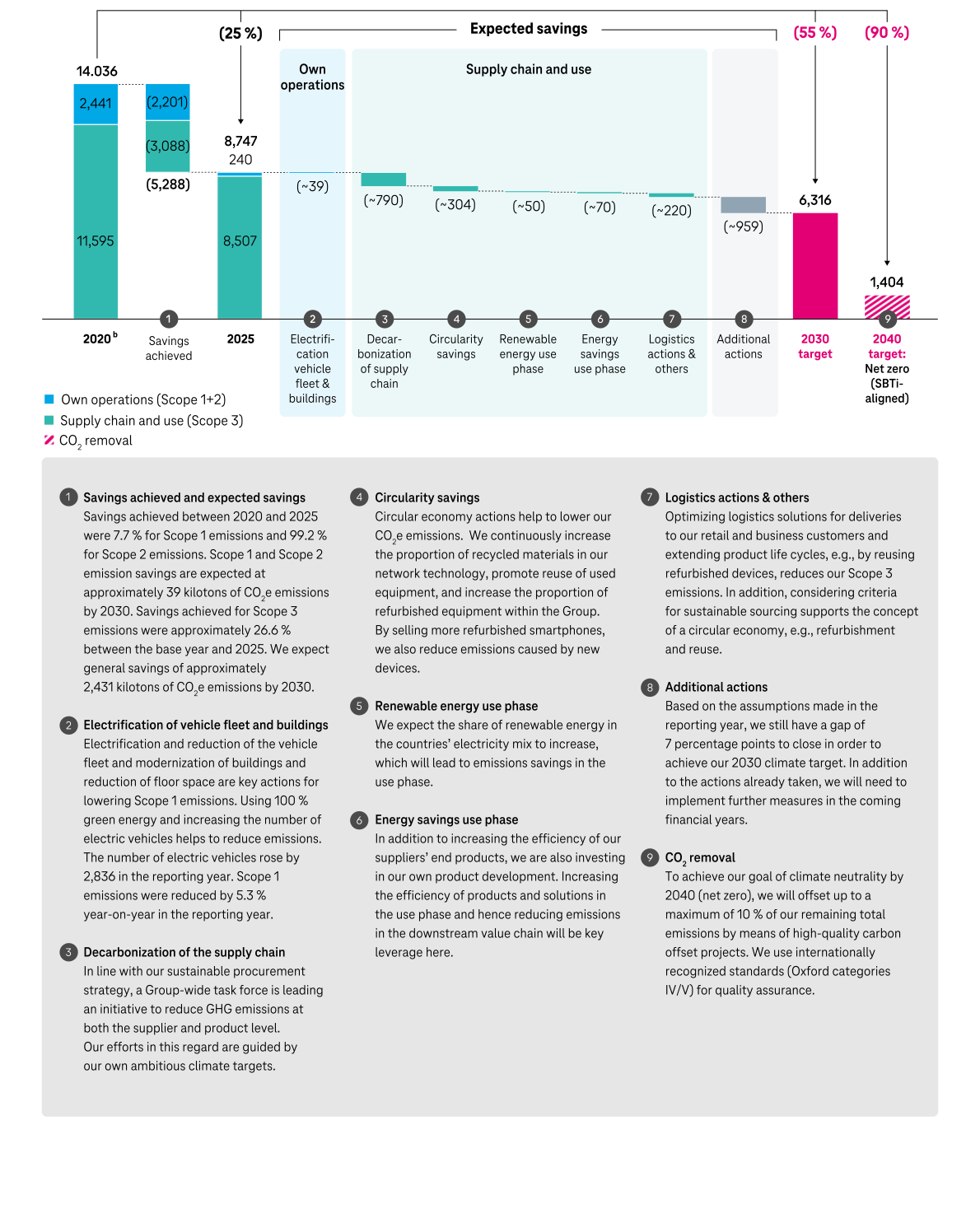
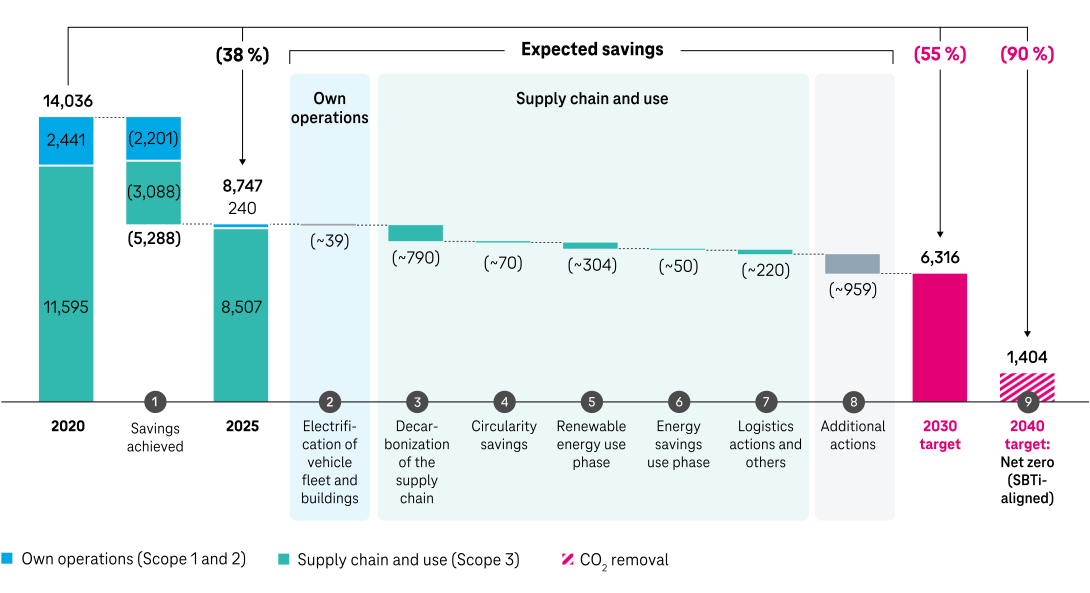
The figures are based in part on estimates, assumptions, and projections. The figures for 2020 were adjusted retrospectively in the reporting year due to updated emissions factors and changes in methods and structures applied. These adjustments have yet to be made in the case of 51 % of the Scope 3 emissions in categories 1, 2, and 4. Adjustments to the base year have necessitated adjustments to the absolute target values.
The Transition Plan sets out key starting points for our decarbonization, such as the power consumption of our networks, fuel consumption in our fleet, thermal energy consumption in buildings, reducing emissions in our suppliers’ production processes, and increasing product efficiency in the use phase. The decarbonization levers in the Transition Plan are broken down by Scope 1, 2, and 3. For Scope 3 emissions, they include both upstream and downstream emissions. We describe current and planned actions to reduce GHG emissions (Scope 1, 2, and 3) in the section “ESRS E1‑3.”
The financial quantification of our reduction actions is fully taken into account in the Transition Plan. In this, we are planning operating and capital expenditures (opex and capex) of around EUR 0.2 billion (2025–2028: approx. EUR 0.3 billion) in the downstream value chain for the 2026–2029 period. Increasing the efficiency of products and solutions in the use phase will create key leverage here. This relates primarily to investments in property, plant, and equipment. In the supply chain, actions are mostly concentrated in the upstream value chain. Since the actions are implemented at the suppliers, they do not require significant opex or capex on our part. With regard to Scope 1 emissions, the electrification of our vehicle fleet provides key leverage. To achieve this, we are planning opex and capex of approximately EUR 0.1 billion (2025–2028: approx. EUR 0.2 billion) for the period referred to above. T‑Mobile US is not included in the quantification of our actions at the present time. The key levers for decarbonizing our business activities mentioned are not yet covered by the EU Taxonomy, which is why taxonomy-eligible economic activities make up only a small part of our Transition Plan.
For further information on the Taxonomy, please refer to the section “Disclosures pursuant to Article 8 of Regulation (EU) 2020/852 (Taxonomy Regulation).”
There are no locked-in GHG emissions from our key assets and products. Our data centers run exclusively on electricity generated from renewable energy sources. Fugitive GHG emissions, which may arise from leakages, ventilation systems, or other uncontrolled releases, do not jeopardize our GHG emission reduction targets or increase transition risks.
Due to our affiliation with the telecommunications/network technology industry, we are affected by the EU Paris-aligned Benchmarks, which are aligned with the Paris climate targets as “climate benchmarks” and are intended to create more transparency and better comparability of sustainable investments.
ESRS 2 SBM-3 E1 – Material impacts, risks, and opportunities and their interaction with strategy and business model
In our double materiality assessment, we considered possible impacts, risks, and opportunities in relation to climate change. The table below shows the material impacts of our business activities on society and the environment that we identified in the process.
We provide overarching information on how material impacts, risks, and opportunities interact with our strategy and business model in the section “ESRS 2 SBM-3.”
|
|
|
Value chain/ |
Nature of impacts |
Description |
|---|---|---|
Climate change mitigation and climate change adaptation |
||
Upstream/ |
Negative |
Our business activities lead to Scope 3 emissions in the upstream value chain. Manufacturing and transportation of the products with relevance for Deutsche Telekom’s business (including software and hardware as well as fixed-network and mobile communications infrastructure) generate GHG emissions that contribute to global warming, exacerbating man-made climate change. Significant emissions are particularly generated in the production of components such as cables, antennas, lines, and distributors. Build-out and maintenance of the infrastructure also lead to temporarily higher GHG emissions, especially as a result of the intensive fiber-optic build-out. |
Own business activities/ |
Negative |
Our own business activities generate Scope 1 and Scope 2 emissions. |
Own business activities/ |
Positive |
We conclude power purchase agreements (PPAs) to increase the share of renewable energy sources in the electricity mix. In addition, building data centers that are self-sufficient from an energy accounting perspective can have potentially positive impacts through the interaction of renewable generation, storage, and volatile electricity loads. |
Downstream/ |
Negative |
Scope 3 emissions in the downstream value chain arise, for example, in the treatment of electronic waste as well as in the transportation and the use phase of our products. |
Downstream/ |
Positive |
When physical processes are replaced by online services, this leads directly or indirectly to resource and GHG emission savings for business customers and individuals. Energy-efficient hosting on Deutsche Telekom’s infrastructure and optimizing processes by using online services, enable customers to save energy directly or indirectly (enablement). |
Energy |
||
Own business activities / |
Negative |
Use of our networks entails high energy consumption. Due to growing demand for digital services, a further rise in energy consumption can be expected. Maintenance of the networks also pushes up internal energy consumption on account of more intensive use. |
The following overview illustrates Deutsche Telekom’s material risks and opportunities and their financial effects on our financial position, financial performance, and cash flows.
For further information on risks and opportunities that represent a top risk or top opportunity in the next two years, please refer to the section “Risk and opportunity management.”
|
|
|
Value chain |
Risk/opportunity |
Description |
|---|---|---|
Climate change mitigation and climate change adaptation |
||
Own business activities |
Opportunity |
The growing demands of stakeholder groups, particularly investors, NGOs, and customers, may offer a strategic opportunity for more environmentally responsible behavior. The increasing expectations and demands of these groups are prompting us to make our business strategies and practices more sustainable. This also provides an incentive to develop innovative, environmentally friendly solutions, which in turn creates financial opportunities. Competitive advantages can likewise be achieved by positioning ourselves as a responsible, forward-thinking company. |
Own business activities |
Physical risk |
The effects of climate change, e.g., extreme weather events, can lead to repair costs for network infrastructure failures, for example, due to flooding or forest fires. Insurance costs may also rise. |
Energy |
||
Upstream/ |
Transition risk |
Higher costs due to energy pricing, which can be exacerbated by geopolitical tensions, may constitute a financial risk. |
We updated our climate scenario analysis in 2024 and carried out the associated resilience analysis. The scenario analysis remains valid for the 2025 reporting year. The results show that only minor physical risks apply for the majority of the Company’s locations in Germany up to the year 2050. We anticipate moderate hazards at the locations of our Croatian and Hungarian national companies, for example due to heat, while in Greece, forest fires in particular represent a hazard. The most common potential physical risks facing T‑Mobile US sites are related to heat stress, drought stress, and precipitation stress. We are prepared for the rising impacts of physical risks, such as changes in precipitation patterns and extreme weather variability, and have already implemented comprehensive adaptation actions. Our risk and opportunity management is based on multiple pillars: we structure our telecommunications networks with built-in resiliency. For most of our critical locations, we use uninterruptible emergency power supply systems incorporating batteries as well as mobile and stationary diesel generators. Our crisis management also helps with rapid recovery in the event of disruptions. We cover the risks of damage to buildings and to Deutsche Telekom’s network infrastructure by taking out insurance policies.
We cannot guarantee absolute resilience with regard to some climate risks, such as fire or flood events. It is not possible to fully protect Deutsche Telekom’s locations from these physical climate-related hazards. We therefore developed an action strategy with our Emergency Response Plan that is triggered when extreme weather events damage the network infrastructure, for example. This ensures that telecommunications networks can provide services even in the event of a crisis. The resilience analysis of physical climate risks in our own business activities focused on the overarching site types of data centers, mobile communications network, and fixed network. Material risks with a very high risk extent but a very low probability of occurrence may result from extreme weather events.
In addition, we analyzed how resilient our business model is to potential future consequences of climate change. For this we considered transition aspects, i.e., factors connected with the transition to a low-emission, climate-resilient economy. These may give rise to transition risks, e.g., as a consequence of political change or legislation. In the transitory resilience analysis, we only considered our own business activities, i.e., our data centers, mobile communications and fixed networks, and devices (smartphones, routers, etc.).
The critical assumptions for analyzing the resilience of our business model with regard to physical climate risks are based on climate scenario SSP5-8.5, which is used by the Intergovernmental Panel on Climate Change (IPCC), and for transition climate risks on the Net Zero Emissions (NZE) 2050 scenario of the International Energy Agency (IEA). The key critical assumptions are as follows:
- SSP5-8.5: This scenario results in a global temperature increase of 4°Celsius. It describes a societal development trajectory accompanied by steadily intensifying fossil fuel exploitation.
- NZE: According to the IEA’s estimates, this scenario is the only one that will limit global warming to 1.5° Celsius by 2050.
When assessing risks and opportunities we considered financial effects and also included physical and transition climate risks, taking into account existing or planned adaptation and mitigation actions. This relates primarily to the implemented climate change mitigation strategy, which influences transition risk assessments, as well as to adaptation actions to mitigate negative financial effects arising from physical climate risks.
The analysis showed that Deutsche Telekom is highly resilient overall to both material transition risks and physical climate risks. This means that we are able to adapt our business model to climate change in the short, medium, and long term. We will not have to redeploy, upgrade, or decommission any of our assets, products, or services.
For further disclosures on the resilience analysis, for example, relating to the scope or the use of climate scenarios, please refer to the section “ESRS 2 IRO-1 E1.”
Impact, risk, and opportunity management
ESRS E1‑2 – Policies related to climate change mitigation and adaptation
Deutsche Telekom wants to play a leading role in climate change mitigation and environmental protection in the context of its current and future business activities. We underpin our commitment in our Environmental Guidance (excluding T‑Mobile US), which takes into account all relevant environmental aspects in our own business activities as well as in the upstream and downstream value chain. T‑Mobile US has also implemented its own environmental policy (T‑Mobile Environmental Policy) that formulates the key elements and requirements of a sustainable business policy, such as a commitment to climate change mitigation and resource conservation.
These environmental policies are part of our Group-wide CR strategy. They are publicly accessible and make our Group-wide targets and voluntary commitments transparent to all of our stakeholders. The Environmental Guidance of Deutsche Telekom (excluding T‑Mobile US) is the remit of GCR, which is also responsible for the direction taken with the T‑Mobile Environmental Policy and thus has overall responsibility. The Group companies are required to implement the requirements set out in these policies in their business activities within the boundaries of the applicable legal framework and to ensure that they implement any systems needed to do this, instruct their employees accordingly, and provide regular training as needed. Implementation is documented by means of the existing data collection systems and controlling processes in the national companies. We review these environmental policies annually and adapt them if one of the following conditions applies:
- change in regulatory requirements;
- change in key references and the underlying standards, such as the ISO standards or the Greenhouse Gas Protocol (GHG Protocol);
- new findings concerning existing and insufficiently addressed environmental aspects, e.g., as a result of further refinements to the sustainability strategy;
- relevant changes in the requirements of our stakeholders that we identify through our stakeholder communication and various dialogue formats.
If Group companies have implemented policies that go beyond the requirements of the Environmental Guidance, we give these preference.
Among other aspects, these environmental policies consider the negative impacts of our GHG emissions (Scope 1–3) in terms of climate change mitigation and adaptation, e.g., due to the energy-intensive operation of our data centers. They also include our mitigation actions.
Deutsche Telekom’s Environmental Guidance (excluding T‑Mobile US) also addresses the positive impacts associated with the extension of PPAs and the improvement in energy efficiency resulting from the modernization of our networks. In addition, it takes the climate strategy described below into account. Both are integrated into our CR strategy.
Climate-neutral business practices are a key objective of our overarching CR strategy. Our climate strategy focuses on the key areas of GHG emissions management, renewable energy, energy efficiency, and environmentally friendly products. In addition to the climate-related targets specified in the section “ESRS E1‑4”, it covers actions that we describe in the section “ESRS E1‑3.”
The climate strategy is subject to a continuous review and update process to reflect changes in the market and internal requirements. In addition, Deutsche Telekom supports various internationally recognized standards and seals of quality for improving the energy efficiency of products and services – including the EU Code of Conduct for Data Centers and the Blue Angel seal in Germany. We contribute to developing these further, for instance by participating in working groups.
We have implemented a Group-wide environmental management system (EMS) for managing our environmental impacts. This is part of the integrated HSE (health, safety, and environment) management system in place in many Group companies The EMS covers all Group companies and is regularly certified by external auditors. The basic requirements of the system apply to all Deutsche Telekom employees. We successively integrate existing management systems and certificates outside the EMS into the Group certificate or, if these go beyond the Group EMS, adapt them to regional approaches in relation to management systems.
We take responsibility both for our own business activities and for our supply chains. We communicate our environmental and human rights-related requirements to our suppliers and outsourcing partners by means of our supplier codes of conduct. In signing this, our suppliers are contractually obligated to comply with Deutsche Telekom’s minimum sustainability requirements, as well as with statutory requirements and international standards. We regularly review the requirements for our products, services, and suppliers. Sustainability criteria are incorporated into our decisions on contract awards in tenders. Part of our sustainable procurement strategy is also contractually agreeing with our suppliers that they must increase transparency regarding GHG emissions and draw up mitigation plans.
ESRS E1‑3 – Actions and resources in relation to climate change policies
Specific actions for reducing GHG emissions result from the identified key decarbonization levers that we described in the section “ESRS E1‑1.” As a general rule, the actions have 2030 as their target year or the overarching target of net zero emissions by 2040. For Scopes 1 and 2, these include the following:
- procurement of electricity from renewable sources, with a focus on increasing coverage through PPAs and our own generation;
- energy efficiency actions by using more efficient technologies and decommissioning outdated ones;
- reducing floor space in buildings as well as upgrades and efficiency measures;
- electrification and reduction of our vehicle fleet;
- electrification of heating with heat pumps.
In line with our sustainable procurement strategy, a Group-wide task force is currently leading an initiative to reduce GHG emissions at both the supplier and product level (Scope 3). This task force plays a key role in coordinating efforts across all segments and ensures a consistent approach is taken to reducing emissions. Other Scope 3 actions include extending the life cycle of products, improving the energy efficiency of devices sold, and more sustainable sourcing of materials and packaging.
We are continually improving the energy efficiency of our data centers through a range of actions. The Power Usage Effectiveness (PUE) metric serves as an indicator for the efficiency enhancement in our data centers. We determine this metric using the method recommended by the standard DIN EN 50600 for data centers, which takes the total energy consumed by data centers into account, not just that used to operate the servers. The PUE metric is calculated using the ratio between the total electrical energy consumed by the data center and the amount of electrical energy consumed by IT. In the reporting year, the average global PUE score for our T‑Systems data centers was 1.53 (2024: 1.56).
Thanks to our adequate liquidity reserves and solid investment-grade rating, we have the necessary financial flexibility and unobstructed access to the capital markets. This means that there are no factors limiting our ability to finance capital spending and implement the actions planned.
Targets
ESRS E1‑4 – Targets related to climate change mitigation and adaptation
The chart in the section “ESRS E1‑1” (Transition Plan) shows our climate-related targets. It also specifies the key levers that we have identified for decarbonization.
Our Group-wide climate-related targets are:
- 100 % of electricity from renewable energy sources (Scope 2, market-based method). We achieved this target by the end of 2021.
- We reached our target of achieving net zero emissions in our own business operations (Scope 1 and 2) by the end of 2025. To achieve this, we reduced emissions from our own operations globally by more than 94 % against the 2017 level. We offset the remaining emissions of our CO2e footprint through high-quality carbon offset projects, for example, through afforestation.
- As an interim goal on the journey towards GHG neutrality along the entire value chain, we aim to reduce CO2e emissions across Scopes 1 to 3 by 55 % in absolute terms by 2030 compared with 2020. We are in close dialogue with our suppliers to reduce emissions in the production phase through more sustainable manufacturing and to develop products that consume less energy in the utilization phase.
- By 2040 at latest, we want to achieve net zero emissions along the entire value chain – across Scope 1, 2 and 3 emissions. To achieve this, we aim to reduce total emissions by at least 90 % from a 2020 baseline; only up to 10 % may be offset through high-quality CO2e removal projects.
In general, we want to offset GHG emissions that we cannot avoid so that they are permanently removed from the atmosphere. GHG emissions from technology such as diesel generators to safeguard emergency power supply, which will take time to be converted to a more environmentally friendly alternative or for which there is currently no suitable alternative, are considered unavoidable. However, these emissions are not attributable to key assets or products and have no impact on the achievement of our climate-related targets. These GHG emissions can be offset, for example, through natural sinks, where greenhouse gases are absorbed by natural ecosystems. We only want to use high-quality offsetting projects in accordance with Oxford category IV and V, i.e., we strive to remove carbon from the atmosphere through short- and long-lived storage.
We have developed our climate-related targets in line with current scientific and regulatory conditions. In 2024, the Science Based Targets initiative (SBTi) confirmed that our current climate-related targets continue to contribute to compliance with the Paris Agreement under its new, stricter guidance. The initiative also reviewed the baseline value. When setting our reduction targets and forecasting our progress towards them, we considered a variety of factors: expected market developments (customer figures, sales figures), technical developments in our own operations and in products, and regulatory elements (e.g., expansion of renewable energy/electricity mix).
One of the ways in which we monitor our climate-related targets is through reduction of our GHG emissions. To achieve this, several KPIs are integrated in our internal controlling process, including multi-year planning and projections during the year. Our progress is in line with our original planning. The market-based method is used for Scope 2 emissions.
We continuously evaluate new technologies and processes in terms of whether they can help the Group act more efficiently in the market and conserve essential resources. This extends to both our own product development and our collaboration with strategic suppliers and also applies in particular to our own network technologies. Going forward, artificial intelligence (AI) will increasingly be used to optimize processes. We use an AI application in 5G towers, for example, to improve energy efficiency.
Metrics
The metrics in this standard are not additionally validated externally. The metrics are based in part on estimates, assumptions, and projections.
ESRS E1‑5 – Energy consumption and mix
Total energy consumption decreased year-on-year from 11,991 GWh to 11,957 GWh. In the reporting year, 13,905 MWh (2024: 7,819 MWh) of energy was generated from renewable sources. We are not active in high climate impact sectors.
MWh |
|
|
||
|
2025 |
2024 |
||
|---|---|---|---|---|
Total fossil energy consumption |
812,912 |
870,723 |
||
Consumption from nuclear sources |
0 |
0 |
||
Total renewable energy consumption |
11,144,078 |
11,120,011 |
||
of which: fuel consumption for renewable sources including biomass (also comprising industrial and municipal waste of biologic origin), biofuels, biogas, hydrogen from renewable sources, etc. |
4,629 |
1,090 |
||
of which: consumption of purchased or acquired electricity, heat, steam, and cooling from renewable sources |
11,125,544 |
11,111,102 |
||
of which: consumption of self-generated non-fuel renewable energy |
13,905 |
7,819 |
||
Total energy consumption |
11,956,990 |
11,990,733 |
||
|
||||
The disclosures are based on data reported by our operating segments. This data comes from consumption bills and figures supplied by local utilities. If it was not available in due time, projections were made to extrapolate consumption levels without precise consumption figures based on information about the significant consumers. Consumption data from the previous year and the relevant prior periods as well as additional information about adjustments to energy requirements were used for these calculations. All renewable electricity certificates are validated by an authorized or accredited certification authority.
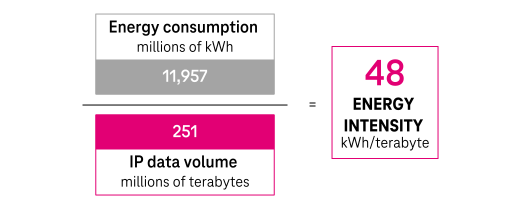
We measure progress in improving energy efficiency through network modernization by means of the Energy Intensity ESG KPI. This KPI puts our energy consumption in relation to the transmitted data volume. Using data volume as a denominator makes it possible to create a direct link to the performance of our networks. This takes into account the data volume transported between our customers and the relevant service providers. Any multiple counting of a package across multiple sections of our networks is avoided by various assumptions, such as by limiting it to the first entry into the base network. The numerator of the KPI takes into account the total energy consumption of all energy sources – electricity, fuel, gas, and district heating. In the reporting year, energy consumption relative to IP data volume was approximately 48 kWh/terabyte (2024: 57 kWh/terabyte). The figure reported for 2024 was adjusted retrospectively in the reporting year due to changes in electricity distribution at individual sites. The KPI is relevant because large quantities of energy are needed to operate and maintain the networks.
Energy Intensity ESG KPI
ESRS E1‑6 – Gross Scopes 1, 2, 3 and total GHG emissions
We present our Scope 1–3 GHG emissions in a standardized format to make them comparable. To that end, emissions are converted into metric kilotons of CO2e. Breaking down the GHG emissions along our value chain gives us an overview of the points in the value chain where the majority of them occur.
The factors that influence gross GHG emissions are regularly reviewed. We document any changes or additions in our Emission Calculation Manual. We communicate any significant changes that affect the annual comparability of our GHG emissions. We use the following sources of emissions factors in our calculations: UK Government (2025), published by the Department for Energy Security and Net Zero (DESNZ), formerly by the Department for the Environment, Food and Rural Affairs (DEFRA), International Energy Agency (IEA) (2021/2024), United States Environmental Protection Agency (EPA) (2024), ecoinvent version 3.10, CDP (2024), the German heat and power association (Energieeffizienzverband für Wärme, Kälte und KWK e.V. (AGFW)) (2023), and World Resources Institute (WRI) (2015).
We apply the market-based and location-based methods to calculate GHG emissions, particularly in relation to usage of electricity. The market-based method considers specific emissions factors of the electricity suppliers that an entity actually uses. The location-based method uses average emissions factors for the geographical location in which the electricity is consumed. Our GHG emissions are largely generated by the vehicle fleet, fossil fuels, and district heating. We differentiate between the two methods, thereby adhering to the GHG Protocol Scope 2 Guidance. We disclose market-based and location-based emissions in CO2e. We calculate Scope 1 and 2 emissions as well as Scope 3 emissions based on the GHG Protocol. We derive the latter from direct supplier data as well as from indirect statistical data.
From Deutsche Telekom’s perspective, the market-based approach is the leading method in non-financial reporting. We use this method to calculate emissions with a specific emissions factor (provider factor) per company. This factor depends on a company’s actual energy procurement (electricity mix); procuring renewable energy (direct purchase, certificates) has a decreasing effect on emissions.
For the location-based method, we always use the IEA emissions factors for the country in question (country mix factor). A company’s actual energy procurement (electricity mix), including the procurement of renewable energy that goes beyond the country mix, is not taken into account.
t CO2e |
|
|
||||
|
2025 |
2024 |
||||
|---|---|---|---|---|---|---|
Scope 1 and 2 (market-based) |
240,165 |
252,568 |
||||
of which: t CO2e emissions, Scope 1 |
223,790 |
236,355 |
||||
of which: t CO2e emissions, Scope 2 (market-based) |
16,375 |
16,212 |
||||
t CO2e emissions, Scope 2 (location-based) |
3,736,800 |
4,002,218 |
||||
t CO2e emissions, Scope 3 (total) |
8,507,234 |
9,733,536 |
||||
of which: t CO2e emissions, Scope 3 (upstream) |
5,861,714 |
7,312,103 |
||||
of which: t CO2e emissions, Scope 3 (downstream) |
2,645,520 |
2,421,432 |
||||
Total t CO2e emissions Scopes 1–3 (location-based) |
12,467,824 |
13,972,109 |
||||
Total t CO2e emissions Scopes 1–3 (market-based) |
8,747,399 |
9,986,103 |
||||
|
||||||
Scope 1 biogenic emissions from the incineration of organic materials amount to 1,180 metric tons of CO2e (2024: 229 metric tons of CO2e). The IEA factors we use do not allow for any breakdown by biogenic emissions, so the location-based Scope 2 figures do not include any additional biogenic emissions from electricity consumption.
Scope 3 emissions declined from 9.73 million metric tons of CO2e to around 8.51 million metric tons of CO2e compared with the prior year. The vast majority of the Scope 3 emissions were generated in the categories of the manufacturing of products and components (in particular of devices and network technology) and from the use of our products and services (e.g., sold or leased fixed-network and mobile phones, routers, and media receivers) by our customers. The proportion of emissions calculated using primary data from suppliers was approximately 58 % in 2025 (2024: 60 %). This is predominantly CDP data for the categories of purchased goods and services and capital goods, plus disposal company information for the category of waste generated in operations.
t CO2e |
|
|
||
|
2025 |
2024 |
||
|---|---|---|---|---|
Indirect emissions (upstream) |
5,861,714 |
7,312,103 |
||
of which: purchased goods and services |
3,064,914 |
3,573,544 |
||
of which: capital goods |
1,834,815 |
2,143,298 |
||
of which: fuel- and energy-related activities |
275,909 |
313,079 |
||
of which: upstream transportation and distribution |
368,371 |
964,364 |
||
of which: waste generated in operations |
14,604 |
17,994 |
||
of which: business travel |
54,095 |
58,153 |
||
of which: employee commuting |
249,006 |
241,671 |
||
Indirect emissions (downstream) |
2,645,520 |
2,421,432 |
||
of which: transportation of products sold to customers |
279,089 |
294,935 |
||
of which: use of sold products |
1,362,542 |
1,258,060 |
||
of which: disposal and recycling of sold products |
38,403 |
34,644 |
||
of which: downstream leased assets |
856,577 |
795,914 |
||
of which: investments |
108,908 |
37,879 |
||
|
||||
Scope 3 GHG emission categories comprise all indirect GHG emissions that occur in a company’s value chain, both upstream and downstream. These categories are described in the GHG Protocol and comprise 15 specific types of emissions ranging from the production of raw materials up to the use and disposal of the products. Deutsche Telekom does not cover category 8 “Upstream leased assets,” category 10 “Processing of sold products,” and category 14 “Franchises” because these are not relevant for our business model.
The following overview shows the reporting boundaries, calculation methods, and calculation tools based on the categories of Scope 3 GHG emissions in the GHG Protocol.
|
|
Scope 3 GHG emissions category |
Description |
|---|---|
1. Purchased goods and services |
Emissions factors per euro, which are based on our suppliers’ Scope 1–3 emissions data divided by their total revenue, are taken from CDP questionnaires and multiplied by the order volume in the relevant procurement categories. If no CDP factors are available for a given supplier, we normally calculate an average emissions factor in the corresponding procurement category for this supplier. For 48 % of emissions in category 1 from suppliers without CDP data, we use the Comprehensive Environmental Data Archive (CEDA) database from the sustainability tool provider Watershed. Similar to CDP, the CEDA database likewise provides plausible emissions factors for the relevant procurement category. We adopted this new approach so that the emissions of areas of the Group with a different supplier base could be depicted more clearly. |
2. Capital goods |
Similar procedure to Scope 3 category 1. |
3. Fuel- and energy-related activities |
Well-to-tank (WTT) emissions factors from the supplier’s ecoinvent database are mainly used to calculate emissions from the Group-wide consumption of energy from different sources. |
4. Upstream transportation and distribution |
In this category, the approach for calculating the corporate carbon footprint takes into account the GHG emissions caused by the upstream transportation of purchased goods and capital goods, including purchased devices. Emissions are calculated based on estimates of the proportion of product/service costs that are attributable to transportation costs. The respective share of the procurement volume is multiplied by the weighted average emissions factor of our logistics service providers (similar to the calculation of categories 1 and 2). For 37 % of emissions in category 4, we do not apply this approach, but instead use Watershed’s sustainability tool and therefore frequently the CEDA emissions factors, as this tool can be used to assign the corresponding transport expenditure to category 4. This new approach will also allow the emissions of areas of the Group with a different supplier base to be depicted more clearly. |
5. Waste generated in operations |
The calculation includes all waste produced during the reporting year and the annual generation of wastewater. Datasets from ecoinvent for waste treatment were used to calculate emissions. |
6. Business travel |
The actual data for business travel is tracked. Traffic-specific emissions factors are used to calculate the GHG emissions. The emissions factors applied for the different modes of transport are taken from the ecoinvent database. Emissions from hotel accommodation are also included in the stated figure. |
7. Employee commuting |
The calculation is based on Group-wide queries on employees’ commuting patterns. Remote working emissions are also included here in some parts of the Group. |
8. Upstream leased assets |
Category 8 emissions are not relevant to Deutsche Telekom. |
9. Transportation of products sold to customers |
Emissions from our customers’ shop visits are reported under category 9. To calculate these emissions, we multiply the number of shop visits (based in part on extrapolations) by the average distance traveled and by an emissions factor for passenger transportation based on a study. |
10. Processing of sold products |
Category 10 emissions are not relevant to Deutsche Telekom. |
11. Use of sold products |
Direct emissions in the use phase were calculated by determining product-specific energy consumption and the average energy mix in the relevant countries. The number of devices sold in each device category (e.g., smartphones or routers) is multiplied by the average annual power consumption (based on average product usage) for the relevant device category per country, and the result is then multiplied by the average product life cycle (e.g., three years) and the country-specific electricity grid mix factor. |
12. End-of-life treatment of sold products |
The emissions calculation includes the average end-of-life emissions for each device sold, which are mainly taken from internal and external product carbon footprint studies. The number of devices sold is multiplied by the average end-of-life emissions per device. |
13. Downstream leased assets |
The number of pieces of equipment leased to end customers (in particular routers and TV set-top boxes) was multiplied by the corresponding energy consumption of the products used and the average country-specific emissions factor for electricity. The same energy consumption data was used as in category 11. Only the emissions from the use phase were considered. All devices leased to end customers in the reporting year were factored into the calculation. |
14. Franchises |
Category 14 emissions are not relevant to Deutsche Telekom. |
15. Investments |
We began to report emissions in this category in 2022. The carbon emissions of our largest financial assets were multiplied by our ownership percentage according to the published Scope 1 and Scope 2 emissions or calculated using industry-specific factors from the EPA database. |
16. Other Scope 3 emissions in the upstream value chain |
All upstream GHG emissions were recorded in the existing eight upstream categories in accordance with the GHG Protocol. |
17. Other Scope 3 emissions in the downstream value chain |
All downstream GHG emissions were recorded in the existing seven downstream categories in accordance with the GHG Protocol. |
We are not aware of any biogenic CO2e emissions from the incineration or bio-degradation of biomass in our upstream and downstream value chain. Furthermore, we are not releasing CO2e emissions or other types of GHG from life cycles of biomasses that would be relevant for the calculation of our Scope 3 emissions.
We report the Carbon Intensity ESG KPI based on revenue. The numerator of the KPI takes into account total CO2e emissions (Scopes 1–3) for all energy sources – electricity, fuel, gas, and district heating. Location-based carbon intensity in the reporting year was 105 metric tons of CO2e/€ million (2024: 121 metric tons of CO2e/€ million). Market-based carbon intensity was 73 metric tons of CO2e/€ million (2024: 86 metric tons of CO2e/€ million). The figures reported for 2024 were adjusted retrospectively in the reporting year due to updated emissions factors and changes in methods and structures applied.
For information on net revenue, please refer to the “Consolidated income statement” in the consolidated financial statements and to note 20 “Net revenue” in the notes to the consolidated financial statements.
t CO2e |
|
|
|
|
|
|
|
|
||||
|
Retrospective |
Milestones and target years |
||||||||||
|---|---|---|---|---|---|---|---|---|---|---|---|---|
|
|
|
|
|
|
|
|
|
||||
|
2020 |
2024 |
2025 |
Change against prior year |
2025 |
2030 |
2040 |
Annual % of target/ |
||||
Scope 1 GHG emissions |
|
|
|
|
|
|
|
|
||||
Gross Scope 1 GHG emissions |
260,110 |
236,355 |
223,790 |
(5.3) |
188,000 |
|
|
|
||||
Percentage of Scope 1 GHG emissions from regulated emission trading schemes |
n.a. |
n.a. |
n.a. |
n.a. |
|
|
|
|
||||
Scope 2 GHG emissions |
|
|
|
|
|
|
|
|
||||
Gross Scope 2 GHG emissions (location-based) |
4,815,423 |
4,002,218 |
3,736,800 |
(6.6) |
|
|
|
|
||||
Gross Scope 2 GHG emissions (market-based) |
2,180,598 |
16,212 |
16,375 |
1.0 |
16,000 |
|
|
|
||||
Significant Scope 3 GHG emissions |
|
|
|
|
|
|
|
|
||||
Total gross indirect Scope 3 GHG emissions |
11,595,000 |
9,733,536 |
8,507,234 |
(12.6) |
9,972,000 |
|
|
|
||||
1. Purchased goods and services |
4,099,338 |
3,573,544 |
3,064,914 |
(14.2) |
|
|
|
|
||||
2. Capital goods |
2,525,715 |
2,143,298 |
1,834,815 |
(14.4) |
|
|
|
|
||||
3. Fuel- and energy-related activities |
700,001 |
313,079 |
275,909 |
(11.9) |
|
|
|
|
||||
4. Upstream transportation and distribution |
1,282,193 |
964,364 |
368,371 |
(61.8) |
|
|
|
|
||||
5. Waste generated in operations |
48,986 |
17,994 |
14,604 |
(18.8) |
|
|
|
|
||||
6. Business travel |
20,400 |
58,153 |
54,095 |
(7.0) |
|
|
|
|
||||
7. Employee commuting |
213,401 |
241,671 |
249,006 |
3.0 |
|
|
|
|
||||
8. Upstream leased assets |
n.a. |
n.a. |
n.a. |
n.a. |
|
|
|
|
||||
9. Transportation of products sold to customers |
252,488 |
294,935 |
279,089 |
(5.4) |
|
|
|
|
||||
10. Processing of sold products |
n.a. |
n.a. |
n.a. |
n.a. |
|
|
|
|
||||
11. Use of sold products |
1,100,604 |
1,258,060 |
1,362,542 |
8.3 |
|
|
|
|
||||
12. End-of-life treatment of sold products |
43,377 |
34,644 |
38,403 |
10.9 |
|
|
|
|
||||
13. Downstream leased assets |
1,226,096 |
795,914 |
856,577 |
7.6 |
|
|
|
|
||||
14. Franchises |
n.a. |
n.a. |
n.a. |
n.a. |
|
|
|
|
||||
15. Investments |
82,401 |
37,879 |
108,908 |
187.5 |
|
|
|
|
||||
Total GHG emissions |
|
|
|
|
|
|
|
|
||||
Total GHG emissions (location-based) |
16,670,533 |
13,972,109 |
12,467,824 |
(10.8) |
|
|
|
|
||||
Total GHG emissions (market-based) |
14,035,708 |
9,986,103 |
8,747,399 |
(12.4) |
10,176,000 |
6,316,000 |
1,404,000 |
4.5 |
||||
|
||||||||||||
ESRS E1‑7 – GHG removals and GHG mitigation projects financed through carbon credits
The total amount of carbon credits outside our value chain that were verified against recognized quality standards and canceled in the reporting period is 250,000 metric tons of CO2e (2024: 35,167 metric tons of CO2e). Carbon credits from removal projects account for the greater part, at 243,000 metric tons of CO2e. Of the carbon credits canceled in the reporting period, 188,300 metric tons of CO2e (2024: 25,000 metric tons of CO2e) are attributable to biogenic sinks and 61,700 metric tons of CO2e (2024: 8,000 metric tons of CO2e) are attributable to technological sinks.
The following table provides an overview of the canceled carbon credits and lists, for example, the different standards that we have selected for our portfolio. These standards guarantee the integrity and credibility of the emission reductions and ensure that the credits meet international requirements.
% |
|
|
|
||
|
|
2025 |
2024 |
||
|---|---|---|---|---|---|
Total |
t CO2e |
250,000 |
35,167 |
||
Share from removal projects |
|
97.2 |
6.2 |
||
Share from reduction projects |
|
2.8 |
93.8 |
||
|
|
|
|
||
Recognized quality standard: Verra |
|
4.4 |
51.2 |
||
Recognized quality standard: Gold Standard |
|
3.2 |
48.8 |
||
Recognized quality standard: Climate Action Reserve |
|
67.7 |
n.a. |
||
Recognized quality standard: Puro Earth |
|
8.3 |
n.a. |
||
Recognized quality standard: Carbon Standards International |
|
16.4 |
n.a. |
||
|
|
|
|
||
Share from projects within the EU |
|
0.9 |
2.8 |
||
|
|
|
|
||
Share of carbon credits that qualify as corresponding adjustmentsa |
|
0.8 |
9.0 |
||
|
|||||
t CO2e |
|
|
Amount until 2028 |
|---|---|
Total |
455,340 |
As begun in 2025, we have also planned to purchase carbon credits from removal projects in accordance with the Scope 1 and 2 plan quantities in the Group for the 2026–2028 period. The total amount of carbon credits outside the value chain planned to be canceled and that are based on contractual agreements is 455,340 metric tons of CO2e (2024: 625,340 metric tons of CO2e). Of this figure, 328,840 metric tons of CO2e (2024: 455,140 metric tons of CO2e) are attributable to biogenic sinks and 126,500 metric tons of CO2e (2024: 170,200 metric tons of CO2e) are attributable to technological sinks.
ESRS E1‑8 – Internal carbon pricing
In the reporting year, internal carbon pricing systems were only used at T‑Mobile US. Specifically, these are shadow prices that are used in activities related to capital expenditures, in procurement, and in operations. T‑Mobile US’s internal CO2e price is calculated based on the cost of acquiring guarantees of origin for electricity from renewable sources (renewable energy certificates – RECs) for the 2024 calendar year. The figure was calculated using the Emissions & Generation Resource Integrated Database (eGRID) sub-regional file for 2023 so as to ensure accurate emissions factors. The applied internal CO2e price was USD 6.40/t CO2e (2024: USD 7.33/t CO2e). The internal CO2e price is used to ensure an accurate assessment of the financial effects of reducing CO2e emissions, alongside other project costs and benefits. Savings in RECs costs achieved through lower energy consumption are also taken into account. By evaluating the cost of purchasing renewable energy, T‑Mobile US can identify opportunities for cost savings. This pricing approach underpins our strategy of reducing Scope 2 emissions by prioritizing the reduction of energy consumption and investing in energy-efficient technologies. 100 % of T‑Mobile US’ Scope 2 emissions are covered through the internal CO2e pricing mechanism. In 2025, T‑Mobile US’ location-based Scope 2 emissions amounted to 2,522,988 metric tons of CO2e (2024: 2,633,330 metric tons of CO2e).
T‑Mobile US’ internal CO2e price is used to assess the financial effects of energy consumption and emission reduction, but not to measure assets or determine residual value.
The Greenhouse Gas Protocol divides emissions of greenhouse gases into the categories of Scope 1, Scope 2, and Scope 3, depending on their source.
- Scope 1 includes all emissions directly generated in the Company, e.g., as a result of the consumption of fuel or fuel oil.
- Scope 2 covers all indirect emissions associated with the generation of energy purchased by the Company from external sources, e.g., electricity and district heating.
- Scope 3 applies to all other emissions generated along the corporate value chain. This comprises both indirect emissions in the company itself (e.g., business trips, commuting), and emissions from upstream value chain stages (e.g., procurement, logistics) and downstream stages (e.g., during customer use of products and services, during disposal).