
Our contribution to the Sustainable Development Goals
Deutsche Telekom contributes to 15 of the 17 Sustainable Development Goals (SDGs) of the United Nations (UN). The use of information and communication technology (ICT) is considered a key lever for supporting the SDGs. Recent studies show that digital technologies can contribute to the achievement of numerous SDG goals if they are used in a targeted manner – for example, through improved resource efficiency, access to information and education, and the promotion of social inclusion.
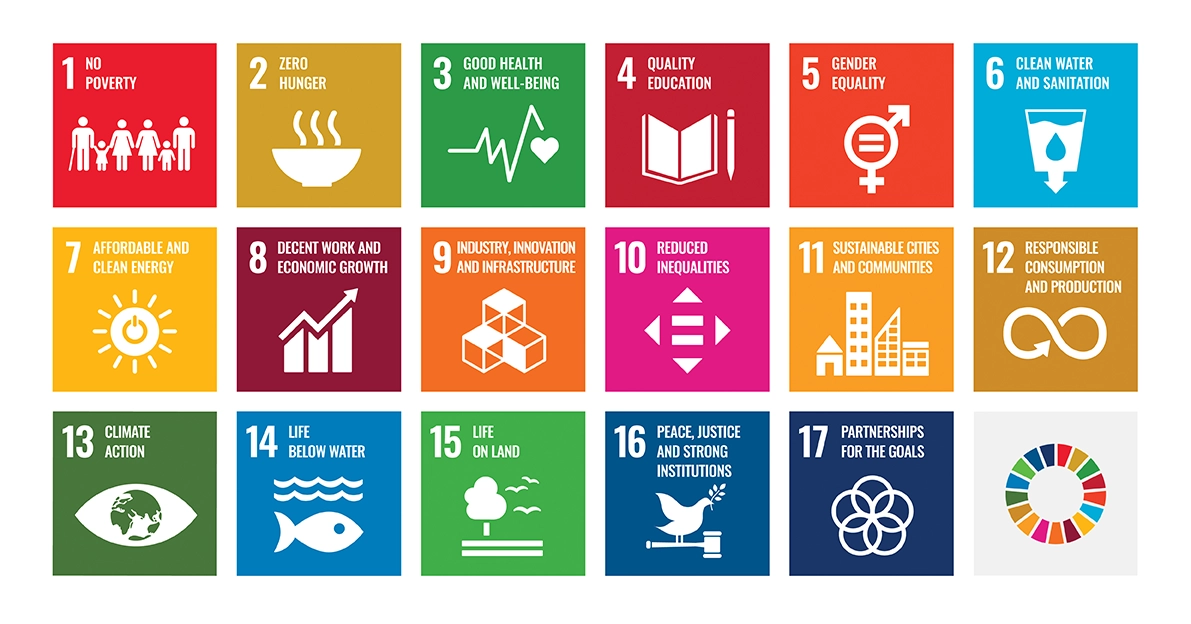
Our network infrastructure forms the technological foundation of our global business activities: it creates connections and enables solutions to social and environmental challenges. On this basis, our activities can be assigned to a large number of the SDGs.
The following overview shows our contribution to the SDGs and refers to selected examples in this CR report and beyond.
SDG 1: No poverty
End poverty in all its forms everywhere
Our contribution
By expanding our networks, we create the conditions for economic and social participation and thus, for example, facilitate access to education – an important basis for combating poverty. We expect our suppliers to pay minimum wages in accordance with ILO conventions; this requirement is enshrined in the Supplier Code of Conduct. In addition, we offer various products and special tariffs throughout the Group to enable affordability where it is most urgently needed.
Further information
SDG 3: Good health and well-being
Ensure healthy lives and promote well-being for all at all ages
Our contribution
We support people’s health both internally and externally through measures for our employees. With our e-health solutions, we contribute to the digital support of medical care services.
Further information
Employees: promoting co-determination and strengthening employer attractiveness
Corporate culture and inclusion: valuing diversity and respecting needs
SDG 4: Quality education
Ensure inclusive, equitable and quality education and promote lifelong learning opportunities for all
Our contribution
We strengthen the qualification and further development of our employees through individual training and further training opportunities. We also promote the development of media literacy in society. The Deutsche Telekom foundation supports numerous projects in the STEM field.
Further information
Employee development: promoting digital skills and showing future prospects
Voluntary and financial commitment: engagement for the common good
Deutsche Telekom Stiftung (Deutsche Telekom foundation) (only available in German)
SDG 5: Gender equality
Achieve gender equality and empower all women and girls
Our contribution
We are specifically committed to the promotion of women in management positions. We support our employees with a wide range of offers, e.g., to help them achieve a better work-life balance. We are also committed to promoting women in STEM professions. We expect our suppliers to prohibit any kind of discrimination, including on the basis of gender.
Further information
ESRS 2 GOV‑1 – The role of the administrative, management, and supervisory bodies
Corporate culture and inclusion: valuing diversity and respecting needs
SDG 6: Clean water and sanitation
Ensure access to water and sanitation for all
Our contribution
In our own operations, we focus on the efficient use of resources and also take into account water consumption, which is low overall in our company. We expect our suppliers to ensure adequate sanitation and hygiene standards for their employees. This requirement is enshrined in the Supplier Code of Conduct.
Further information
SDG 7: Affordable and clean energy
Ensure access to affordable, reliable, sustainable and modern energy
Our contribution
Throughout the Group, we obtain 100 % of our electricity requirements from renewable energies. To this end, we are increasingly concluding long-term purchase agreements to support the expansion of renewable energies. In this way, we contribute to a more sustainable energy industry. In order to optimize our consumption, we are also focusing on modernizing our network infrastructure and operating our networks and data centers as efficiently as possible.
Further information
SDG 8: Decent work and economic growth
Promote inclusive and sustainable economic growth, employment and decent work for all
Our contribution
Our network and products create the technological basis for innovative solutions and digital business models and can thus support sustainable growth in line with the SDGs. We focus on fair working conditions for our employees and take social and environmental aspects into account along our supply chain.
Further information
SDG 9: Industries, innovation and infrastructure
Build resilient infrastructure, promote sustainable industrialization and foster innovation
Our contribution
Our aim is to give as many people as possible access to the digital world. To this end, we are investing billions in a stable and secure network infrastructure and developing our portfolio in a targeted manner. In this way, we create an important basis for economic performance and social participation.
Further information
SDG 10: Reduced inequalities
Reduce inequality within and among countries
Our contribution
We are committed to enabling fair opportunities and are committed to inclusion. We expect our suppliers to pay minimum wages in accordance with ILO conventions. This requirement is enshrined in the Supplier Code of Conduct.
Further information
SDG 11: Sustainable cities and communities
Make cities inclusive, safe, resilient and sustainable
Our contribution
With the expansion and operation of mobile, fiber-optic and IoT networks as well as the consistent use of artificial intelligence, we provide the technological basis for digital applications in the municipal environment and can thus support the further development of urban infrastructures.
Further information
SDG 12: Responsible consumption and production
Ensure sustainable consumption and production patterns
Our contribution
We are continuously working to increase the recyclability of our products. In this way, we are helping to use resources more efficiently and keep valuable raw materials in use for longer – both in our own business and in the use of our products.
Further information
ESRS E5‑1 – Policies related to resource use and circular economy
Circular economy: a systematic approach along the value chain
SDG 13: Climate action
Take urgent action to combat climate change and its impacts
Our contribution
With our Climate Transition Plan, we are pursuing the systematic reduction of greenhouse gas emissions along the entire value chain. The key levers are increasing energy efficiency, purchasing electricity from renewable energies throughout the Group and continuously reducing emissions in its own business operations. In addition, our products and digital solutions help to enable emission reductions in the use phase and support climate protection potential for customers.
Further information
ESRS E1‑3 – Actions and resources in relation to climate change policies
Operational resource protection: environmentally conscious in everyday work
Mobility: expansion of the electric fleet and charging infrastructure
SDG 15: Life on land
Sustainably manage forests, combat desertification, halt and reverse land degradation, halt biodiversity loss
Our contribution
With selected projects and collaborations, we address aspects of environmental protection and implement selective measures to promote biodiversity in our own business operations; at the same time, we expect our suppliers to share Deutsche Telekom’s commitment to dealing with the challenges of climate change and to strive to contribute to environmental and nature conservation.
Further information
Operational resource protection: environmentally conscious in everyday work
Digital water management in agriculture, Diepholz district (T‑Systems)
SDG 16: Peace, justice and strong institutions
Promote just, peaceful and inclusive societies
Our contribution
Through clear ethical principles, a Group-wide compliance management system, support for the principles of the UN Global Compact and high data protection standards, we contribute to legally compliant structures in our own business operations.
Further information
SDG 17: Partnerships to achieve the goals
Revitalize the global partnership for sustainable development
Our contribution
To achieve the SDGs, we cooperate with associations, institutions and companies at national and international level and promote global cooperation within the Group in various committees.