

Artificial intelligence (AI), cryptocurrencies, streaming services – technological development is proceeding at a rapid pace, and with it the energy demand of digital applications is increasing. Despite growing data volumes and network expansion, we are pursuing the goal of keeping energy consumption at least stable in the medium term (2027 compared to the base year 2023, excluding T‑Mobile US). In recent years, we have been able to continuously reduce energy intensity – i.e., our energy consumption in relation to the volume of data transmitted. In addition, the expansion of renewable energies also plays an important role for us: they can help limit energy-related emissions and reduce dependence on fossil fuels – especially in combination with battery storage systems.
We deal in more detail with the topics of energy consumption, mix and efficiency as well as climate protection under “Climate change” and “General disclosures” in our audited Sustainability statement 2025. There we describe our goals and the plans for their implementation. You can also find more information on climate protection here in the CR report.
Milestones achieved, ongoing projects and goals
Since 2021, we have been sourcing 100 % of our electricity from renewable energies (Scope 2, market-based method) throughout the Group – from long-term supply contracts, direct electricity purchasing and certified guarantees of origin. To ensure stable energy consumption in the medium term, we are focusing on modernizing our grid infrastructure and operating our networks and data centers as efficiently as possible.
Scroll to learn more
Where we come from
-
In the Annual Report for 2011, we reported a key figure on our energy consumption for the first time.
-
We added the “Energy Intensity” KPI to the previous “Energy Consumption” KPI, which compares our energy consumption to the volume of data transmitted.
-
We set ourselves the goal of covering 100 % of our electricity needs throughout the Group from renewable energies by the end of 2021.
-
We implemented our Group-wide Energy Guideline, which provides guidance on how to optimize energy efficiency.
-
We covered 100 % of our electricity requirements Group-wide from renewable energies (Scope 2, market-based method).
-
Our company Power and Air Condition Solution Management GmbH (PASM) began to build the first large-scale battery storage systems in Germany.
-
We doubled our energy efficiency in Germany and Europe (compared to 2020). We measure our progress with the KPI “Energy Intensity” (energy consumption in relation to the volume of data transmitted).
-
We commissioned the first two large-scale battery storage systems in Germany in Münster and Bamberg with a total capacity of 36 MWh.
Where we stand in the reporting year
-
We are increasingly using AI and machine learning applications to optimize energy efficiency in the operation of our network infrastructure, for example to analyze and forecast data and voice traffic volumes in the network.
-
In the data center in Magdeburg, we use AI‑based software from the start-up etalytics to control the cooling systems.
-
We are driving forward the planning and development of the Industrial AI Cloud, Germany’s first AI factory, in Munich together with technology partners such as NVIDIA. The AI factory is supplied with electricity from renewable energies.
-
We will continue to purchase electricity from renewable energies and conclude further power purchase agreements (PPAs), i.e., long-term electricity supply contracts – in the reporting year, for example, a 10-year contract with a new PV park in Mecklenburg-Western Pomerania.
Where we want to go
-
In Germany and Europe, we want to keep our energy consumption at least stable compared to the base year 2023 by further increasing our energy efficiency – despite grid expansion and increasing data volumes.
-
By 2040 at the latest, we aim to achieve net zero emissions along the entire value chain – across Scope 1–3. To this end, we want to reduce emissions by at least 90 % compared to 2020; only up to 10 % may be neutralized via high-quality projects that bind CO2e from the atmosphere.
Grid infrastructure: innovations for energy efficiency
The operation of the mobile and fixed network infrastructure in Europe and the USA accounts for the largest share of our energy needs. We want to avoid that the constantly increasing data consumption of users is accompanied by a corresponding increase in energy consumption. That is why we are continuously working to make the energy consumption of our networks as efficient as possible. We are pursuing the goal of keeping energy consumption at least constant by 2027 compared to 2023 (excluding T‑Mobile US). This goal is supported by programs and investments in energy-saving measures for all energy sources, by the optimization of infrastructure and by the use of innovative technology components.
In Group-wide innovation projects, we are developing new approaches to our grid operation: For example, we are modernizing the grid infrastructure, relying on operational energy-saving functions and other technologies to improve energy efficiency. In mobile communications, for example, so-called power saving features are used (excluding T‑Mobile US). They automatically switch off certain functions when the network is only under low load.
AI can also help to control the use of energy in the mobile network in a more targeted manner. In Greece, for example, AI and machine learning algorithms are used for this purpose: They analyze the utilization of the network and adjust the energy consumption of a network component – the Radio Access Network (RAN) – according to demand. For customers, this has no noticeable impact.
We also use AI to adapt network capacities more closely to expected loads, for example by dynamically controlling individual mobile phone cells: Antenna power can be increased at major events such as open-air concerts or football matches; during periods of low demand – for example, at night or on non-match days – certain frequencies can automatically switch to a sleep mode.
“Green Coding & AI Community”: sharing best practices and anchoring them in practice
Energy and resource efficiency are also playing an increasingly important role in software development. Under the keyword “Green Coding”, teams at Deutsche Telekom are working on ways to develop applications in such a way that they can be executed in a more resource-efficient way.
A separate Green-Coding-Community brings together developers who want to promote such approaches in their everyday work – for example at hackathons or BarCamps. Prototypes and new ideas are created there. At events such as “Watt the Hack?! – Battle for the Leanest Kubernetes Cluster”, for example, teams explore how different approaches can affect resource requirements. A winning team emerged from the internal competition: Their proposal showed around 30 % lower energy consumption under the test conditions compared to the previous solution, while maintaining the same service quality. Such formats help to test ideas, share experiences and further anchor “Green-Coding” principles in everyday work.
On the initiative of the green coding community, so-called CO2 labels for cloud projects were also introduced in 2025 in the internal developer portal Magenta CICD. This allows developers to view the CO2 footprint of their project directly in their everyday work and gain transparency on how cloud projects can be classified based on CO2 related parameters. From 2026, this labelling will gradually include data from other providers.
Modern telecommunications infrastructure generates a lot of heat during operation. Therefore, cooling systems at telecom sites and data centers also play an important role in overall energy consumption. Data-based and automated systems can control cooling demand according to demand and adapt the output to the actual heat load.
A look at Greece shows what this looks like in practice, where intelligent automation is used at more than 1,500 network locations. They are part of a central energy management system and support the control of the cooling.
In addition, the “Optimal Temperature Set Point” application is used: AI or machine learning-based automation continuously evaluates the temperatures of network elements and derives a suitable setpoint for the air conditioning system in technical rooms.
In the Zagreb data center, too, sensors record the current heat situation every minute. With the help of this data, AI‑based controls control fans and cooling units so that they adapt flexibly to the respective load and are switched on and off as needed. In this way, the cooling is adapted to the heat generation. The “White Space Cooling Optimization” (WSCO) project is being implemented in Croatia jointly by Hrvatski Telekom and Siemens.
We describe further measures to stabilize energy consumption and increase energy efficiency in the “Deep Dive” section and in our audited Sustainability statement 2025. Closely linked to our approach to energy-efficient grids are also the topics of Operational resource protection and Raising awareness among employees here in the CR report.
KPI “Energy Intensity”
We have been able to steadily reduce energy intensity (i.e., our energy consumption in relation to the volume of data transmitted) in recent years. In the reporting year, energy intensity fell from 57 kWh/terabyte (2024) to 48 kWh/terabyte (2025). This corresponds to a reduction of around 16 %. Investments in modern technology have made this development of recent years possible – as has the shutdown of outdated network technologies. Detailed information on our KPI “Energy Intensity” can be found in our Sustainability statement 2025. As an indicator of the increase in efficiency in our data centers, we also use the so-called PUE value (Power Usage Effectiveness). Detailed information on this metric can be found in the “Deep Dive”.
Energy Intensity – Data volume
in kWh/Terabyte
Renewable energies: electricity supply contracts and large-scale battery storage systems
We purchase electricity from renewable sources through various instruments – we conclude electricity supply contracts with electricity producers, so-called Power Purchase Agreements (PPAs), purchase more electricity from renewable sources directly or acquire corresponding guarantees of origin
These supply contracts offer us price stability and can increase planning and investment security.
At the end of 2025, we purchased 31.7 % (2024: 36.2 %) of our electricity Group-wide via PPAs and self-generation. Excluding T‑Mobile US, the share was 26.1 % (2024: 22.6 %). We continuously monitor the electricity markets in the individual countries to identify new PPA options and conclude corresponding contracts if they make economic sense and fit our hedging strategy. One example of this is the photovoltaic park in Tützpatz, Mecklenburg, which went into operation in 2025 – the largest of its kind in Germany. We purchase the PV electricity generated there in full via a ten-year PPA. An overview of the annual development of the PPA share since 2022 can be found in the “Deep Dive”.
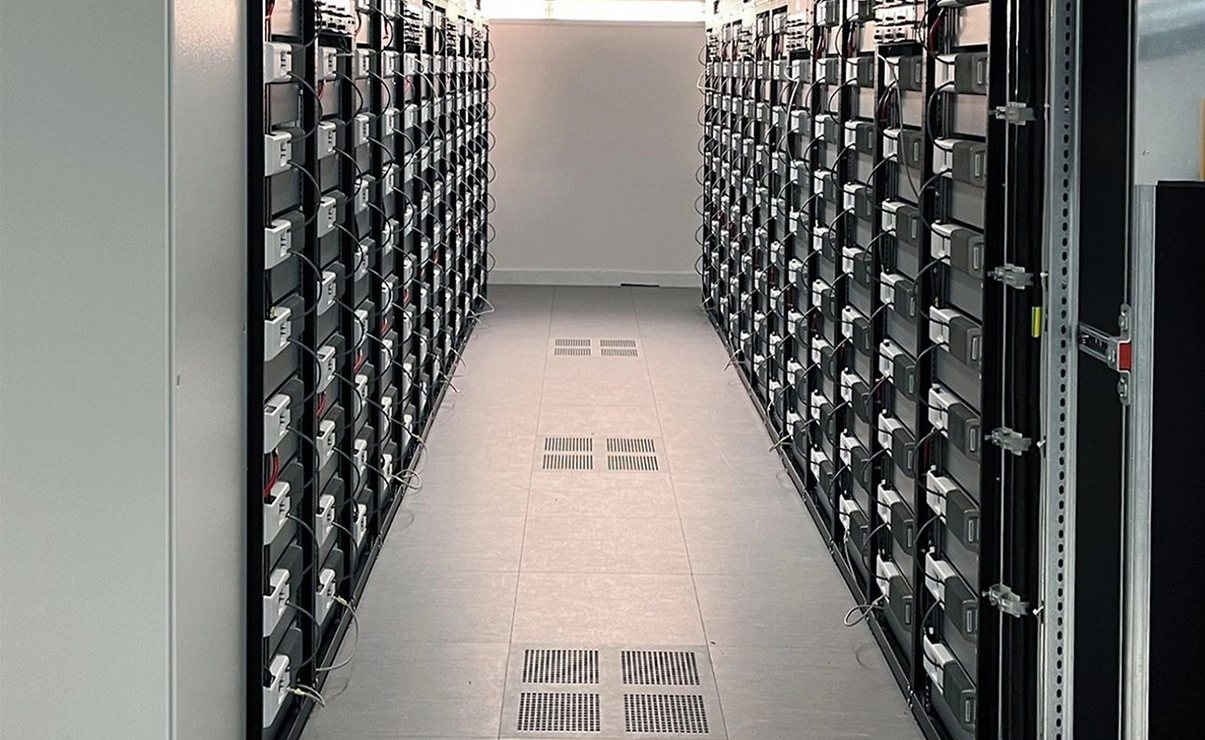
In 2025, PASM operated large-scale battery storage systems at its Bamberg, Hanover and Münster sites. They are used to temporarily store electricity from renewable sources and make it flexibly available. At the end of 2025, a total capacity of 16 MW was reached. The storage capacity is a total of 96 MWh (per day).
USA: diversified energy portfolio
To manage energy sustainably, T‑Mobile US deploys energy efficient technologies and focuses on sourcing renewable energy. The company has strategically built a diverse renewable energy portfolio by engaging in a range of projects, including medium- to long-term virtual power purchase agreements (VPPAs) with wind and solar farms, on-site and community solar energy contracts, and shorter-term retail renewable agreements.
This strategy helps to reduce price volatility and maintain a diversified energy portfolio.
Diversified energy portfolio (T‑Mobile US)
T‑Systems: strong performance, efficient performance
T‑Systems focuses on the operation of data centers and services for business customers, among other things. Since 2021, our data centers worldwide have been sourcing 100 % of their electricity from renewable energies – either directly, through the conclusion of PPAs, through their own energy generation or by purchasing guarantees of origin. We continuously improve the energy efficiency of our data centers and measure the increase in efficiency via the PUE value (more on the calculation in the “Deep Dive”). The average global PUE value was 1.53, as was the PUE value of our T‑Systems data centers in Germany (2024: global: 1.56; Germany 1.53).
Energy efficiency of T-Systems data centers
Data centers are becoming more energy-efficient (PUE factor)
During operation, T‑Systems pays attention to the use of server and storage hardware that is as efficient as possible, optimized cooling during the operation of data centers, and automated software features, for example. In the data center in Magdeburg, for example, an AI‑based solution from the start-up etalytics has been controlling the cooling systems in regular operation since 2025. After a successful test phase of around a year, the solution takes over the optimization of the complex cooling infrastructure in regular operation. It not only adjusts the outlet temperature of the chillers, but also sets the optimal operating mode for each cooling module, even in changing external and internal conditions. In the test phase, an efficiency potential of up to 33 % was shown under the conditions under consideration in terms of cooling-related energy consumption compared to the initial operation.
In the medium and long term, we would like to further develop our cloud applications from an energy efficiency perspective (“green coding”). T‑Systems has been participating in the “EU Code of Conduct on Data Centre Energy Efficiency” since 2014. This is a voluntary code of conduct with the aim of motivating operators and owners of data centers to reduce energy consumption and thus the negative effects on the environment, economy and energy security. At the end of 2025, T‑Systems was operating a total of 16 FMO (Future Mode of Operation) twin-core data centers at seven locations in Europe as well as four local, customer-specific data centers. Since 2024, all nine internal FMO twin-core data centers have been listed in the EU Code of Conduct. In addition, T‑Systems joined the Climate Neutral Data Centre Pact (CNDCP) in 2021. We have been a certified member since 2023.
Germany’s first AI factory
In the reporting year, the planning and construction of the Industrial AI Cloud, Germany’s first AI factory, was pushed forward in Munich. The aim is to provide AI computing capacity to companies, research institutions and the public sector. The project was created in partnership with technology companies such as NVIDIA, and the opening took place on February 4, 2026. In the future, the AI factory is to form a central component of a sovereign European AI infrastructure. In addition to aspects of digital sovereignty and industrial competitiveness, climate protection considerations also played a role in the planning: The AI factory is supplied with electricity from renewable energies. Furthermore, the AI factory uses a cooling concept in which water from a nearby stream is included in the cooling. Moreover, applications such as digital twins and simulation-based Physical AI approaches are to be supported. These can help companies to make development and production processes more resource-efficient and energy-efficient.
Looking ahead
In the coming years, we want to further stabilize our energy consumption by continuously increasing our energy efficiency – despite rapidly growing data volumes. An important focus is also on the further expansion of renewable energies and large-scale storage solutions. In addition, we are increasingly relying on the use of digital and AI‑based solutions to further optimize energy consumption, especially in data centers.
Deep Dive for Experts
Management & Frameworks
The telecom company PASM obtains the energy for the German Telekom Group companies. Its energy management system is certified according to the international standard ISO 50001.
We have achieved our goal of sourcing 100 % of our electricity requirements from renewable energies throughout the Group by the end of 2021 (market-based, Scope 2). To emphasize this commitment, we have joined the global RE100 initiative. Its goal is to promote the purchase of electricity from renewable sources.
Further measures to stabilize energy consumption and increase energy efficiency
We have already firmly anchored the topic of energy efficiency in the selection of new technologies in the architecture and design phase through specifications and specifications. The guideline covers technical installations along the entire infrastructure: from network elements and data centers to air conditioning and monitoring systems.
Group-wide self-production of renewable energies rose from 7.8 GWh in 2024 to 13.9 GWh in 2025. To this end, we cooperate with various suppliers in the field of renewable energies. At the same time, there is a focus on the use of electricity storage systems and the implementation of intelligent load management. In Germany, waste heat is used in PASM’s ICT network nodes (information and telecommunications technology). One example is the supply of the Pallaseum building in Berlin (only available in German). In 2025, 732 MWh of heat was generated from waste heat at the Winterfeldtstraße site in Berlin with the help of a heat pump and delivered to GASAG for heating the residential building.
KPI “PUE”
We are continuously improving the energy efficiency in our data centers a with various measures. One indicator of the increase in efficiency of our data centers is the “Power Usage Effectiveness (PUE)” value, which we determine according to the method of the data center standard EN 50600. The PUE value results from the ratio between the total electrical energy consumed by the data center and the electrical energy consumption of the IT.
Data Center PUE
KPI “Renewable Energies”
We use the “Renewable Energies” KPI to measure our progress. The key figure shows the share of electricity from renewable energies in relation to total electricity consumption. In addition, we have developed Group-wide parameters that we use to evaluate electricity purchases in all national companies with regard to sustainability aspects.
|
|
|
|
|
|
|
|
|
|
|
|
|
||||||||
|
2025 |
2024 |
2023 |
2022 |
||||||||||||||||
|---|---|---|---|---|---|---|---|---|---|---|---|---|---|---|---|---|---|---|---|---|
|
|
|
|
|
|
|
|
|
|
|
|
|
||||||||
|
Da |
EUb |
Group |
Da |
EUb |
Group |
Da |
EUb |
Group |
Da |
EUb |
Group |
||||||||
Total energy consumption (GWh) |
2,184 |
1,728 |
11,957 |
2,274 |
1,759 |
11,991 |
– |
– |
– |
– |
– |
– |
||||||||
Total renewable energy consumption (GWh) |
1,897 |
1,549 |
11,144 |
1,948 |
1,564 |
11,120 |
– |
– |
– |
– |
– |
– |
||||||||
Share of renewable energy |
87 % |
90 % |
93 % |
86 % |
89 % |
93 % |
– |
– |
– |
– |
– |
– |
||||||||
Total electricity consumption (in GWh) |
1,894 |
1,549 |
11,139 |
1,947 |
1,564 |
11,118 |
1,911 |
1,540 |
11,316 |
2,265 |
1,576 |
12,252 |
||||||||
Electricity from renewable energy (in GWh) |
1,894 |
1,549 |
11,139 |
1,947 |
1,564 |
11,118 |
1,911 |
1,540 |
11,316 |
2,265 |
1,576 |
12,252 |
||||||||
Share of renewable electricity |
100 % |
100 % |
100 % |
100 % |
100 % |
100 % |
100 % |
100 % |
100 % |
100 % |
100 % |
100 % |
||||||||
Certificates |
67 % |
66 % |
51 % |
68 % |
66 % |
44 % |
74 % |
68 % |
46 % |
53 % |
63 % |
50 % |
||||||||
Power Purchase Agreementsc |
33 % |
20 % |
32 % |
29 % |
17 % |
36 % |
26 % |
5 % |
32 % |
23 % |
0 % |
28 % |
||||||||
Direct purchased |
1 % |
14 % |
17 % |
4 % |
17 % |
20 % |
0 % |
26 % |
21 % |
23 % |
22 % |
23 % |
||||||||
Self-generationc |
– |
– |
– |
– |
– |
– |
0.18 % |
0 % |
0.05 % |
0.1 % |
0 % |
0.04 % |
||||||||
|
||||||||||||||||||||
Even though we prefer to cover our electricity consumption through PPAs and self-generation as well as direct purchases, we still have to resort to guarantees of origin due to limited capacities.
Renewable Energy in the Group
in MWh
bSince this reporting year this position includes other renewable sources next to biogas (e.g. biofuels such as HVO100). The wording and previous year’s figures were adjusted accordingly.
Relevant Standards
Global Reporting Initiative (GRI)
GRI 3-3 (Management of material topics); GRI 302: Energy
GRI 302-1 (Energy consumption within the organization)
GRI 302-3 (Energy intensity)
GRI 302-5 (Reduction of energy requirements for products and services)
Task Force on Climate-related Financial Disclosures (TCFD)
The most important key figures for measuring and managing climate-related opportunities and risks
GSM Association (GSMA) Indicators for Telecom Operators
GSMA-ENV-03 (Energy consumption)
a aOperation and use as multi-customer and multi-platform data centers.