
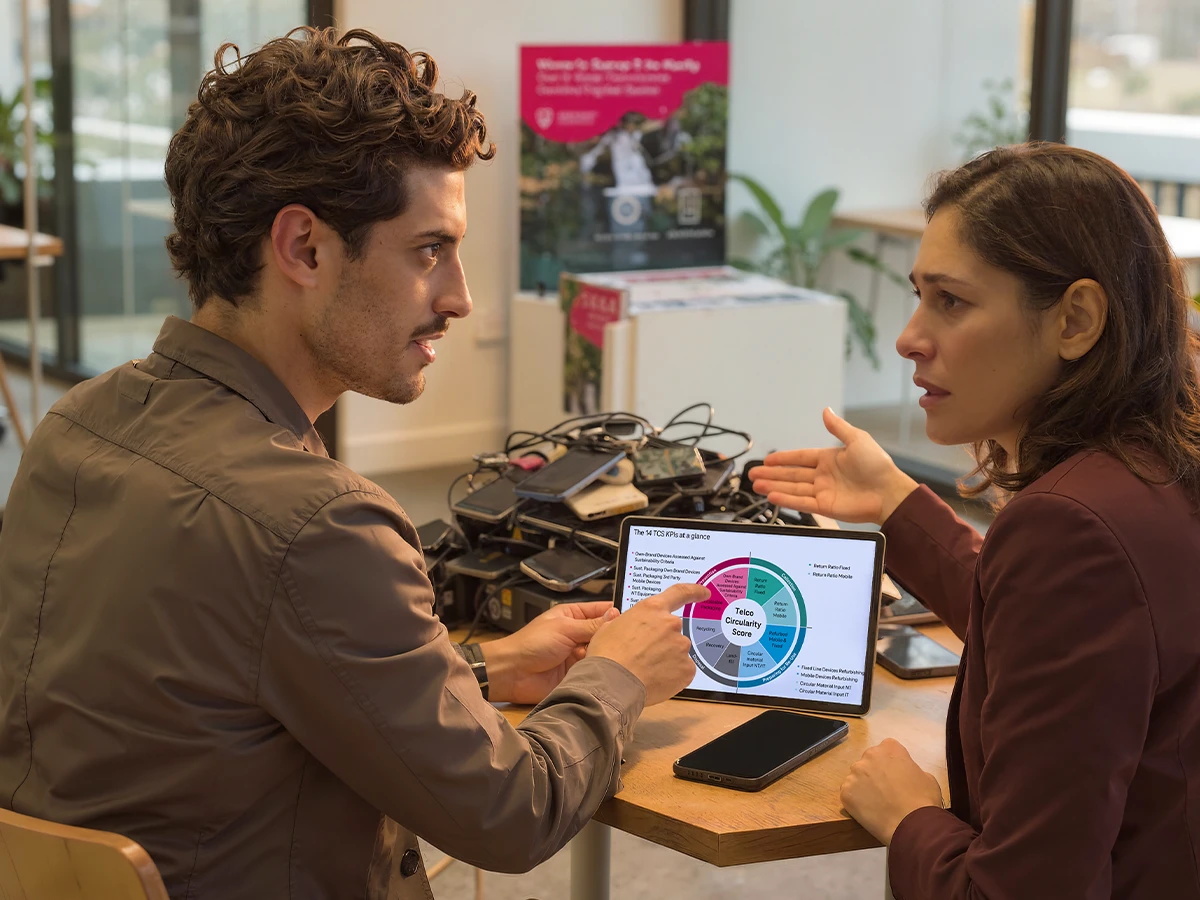
Telecommunications services and devices such as smartphones, tablets or routers have become an indispensable part of our everyday lives. However, a smartphone does not only begin its life cycle with its use by customers, but already with the extraction of raw materials, the design and the selection of the materials used – and it often does not end with the first use: devices are repaired, passed on or reused before they are finally no longer used. Repairability, replaceable components, the longest possible service life and recycling at the end of the life cycle are therefore central components of a holistic circular economy approach.
With the growing number of networked devices, the dependence on critical raw materials is also increasing. After use, the amount of electronic waste, in which valuable raw materials are bound, also increases. Geopolitical tensions, supply bottlenecks – for example for semiconductors – and the increasing shortage of critical raw materials illustrate the importance of resilient material and supply chains. If implemented consistently, the circular economy can help reduce dependencies and strengthen security of supply. At the same time, it makes a significant contribution to reducing greenhouse gas emissions.
Deutsche Telekom is responding to this development with a structured circular economy approach for end devices and technology. The aim is to close material cycles, reduce the use of primary raw materials and extend the service life of equipment and technology. In this way, we also want to contribute to the further development of cycles within industry.
We also address the topic of the circular economy as well as our goal, measures and progress in our audited Sustainability statement 2025.
Milestones achieved, ongoing projects and goals
For more than 20 years, Deutsche Telekom has been working to recover resources from end devices and technology and to avoid electronic waste. Our current circular economy approach has gradually developed from various individual initiatives.
Scroll to learn more
Where we come from
-
Together with Deutsche Umwelthilfe, we launched a mobile phone take-back system in Germany to support environmental and nature conservation projects.
-
For the first time, we took back 100,000 mobile phones in a single year across the Group.
-
We established the “Take-back of mobile devices” KPI as a Group-wide performance indicator.
-
We adopted an International Waste Management Framework, which sets out Group-wide principles for waste management.
-
We introduced a Group-wide policy with requirements for the recycling of copper cables.
-
We put packaging machines into operation that can provide packaging tailored to the size of the product. Since then, the machines have been used in Germany for technical infrastructure products to avoid oversized packaging.
-
In a packaging guideline, we defined ecological criteria for own-brand appliances. With the KPI “Sustainable Packaging”, we also reported the proportion of devices packaged in accordance with the guidelines for the first time.
-
Since 2022, we have been packaging all new own-brand appliances in accordance with the sustainability criteria of our packaging guideline.
-
In order to further increase the collection rate of old mobile phones, we set up new, specially designed mobile phone collection boxes in all T‑Shops throughout Europe.
-
We presented the concept for our new measurement and control instrument Telco Circularity Score (TCS) at our Capital Markets Day.
Where we stand in the reporting year
-
We are taking back around 10.5 million mobile devices across the Group.
-
Together with suppliers and other partners, we continue to work on approaches to reduce packaging quantities and sizes for network technology.
-
We launch an internal marketplace for used network technology to support extended service life.
-
We will introduce the Telco Circularity Score (TCS), which we plan to use as a measurement and control tool from 2026 onwards.
Where we want to go
-
We will use the Telco Circularity Score (TCS) to measure and manage progress within Deutsche Telekom. In the future, the approach is intended to enable comparability within the industry.
-
Our goal is to ensure that almost all the products we put into circulation can be returned to the cycle. This includes the entire network technology as well as a large part of our own-brand devices and the mobile devices we sell.
Measuring and managing the circular economy: introducing the Telco Circularity Score
Circular economy is a central lever for responsibly managing raw materials and resources within planetary boundaries and at the same time strengthening the resilience of a company. Against this background, we are pursuing a holistic approach aimed at extending the service life of technology and end devices and keeping materials in the cycle for as long as possible. Building on this, we have set ourselves the goal of being almost completely recyclable in technology and devices by 2030 (excluding T‑Mobile US). In concrete terms, this means that by 2030, almost all the products we put into circulation can be returned to the cycle. This includes the entire network technology as well as a large part of our own-brand devices and the mobile devices we sell.
Such an aspiration requires a consistent basis in order to be able to record progress uniformly throughout the Group and manage it in a targeted manner. For this purpose, we have developed the Telco Circularity Score (TCS). It serves as an overarching measurement and control tool for our circular economy activities and forms the basis for a total of 14 TCS KPIs (Key Performance Indicators). T‑Mobile US pursues its own circular economy approach with its own methodology and is not included in the TCS. Further information can be found in the “Deep Dive”.
The TCS covers the entire life cycle of end devices, network technology and IT equipment. The conceptual framework is formed by four dimensions that address different levers of the circular economy along the life cycle and together structure the TCS approach.
The 14 TCS KPIs at a glance
To date, there is no established, industry-wide standard for measuring circularity. The TCS can close this methodological gap by bringing together central aspects of the circular economy in a uniform logic and condensing them into an overall score. This allows us to set priorities more clearly, target measures in a more targeted manner and systematically improve the recyclability of the products we put into circulation along key levers – because we can only effectively control what we measure. At the same time, the approach is designed in such a way that it can also support the comparability of circular economy services within the industry in the future.
The concept of TCS was first presented at our Capital Markets Day in 2024. In the reporting year, we further specified it and integrated it into our data collection and reporting processes. The publication of an aggregated overall score is planned from the 2026 reporting year, after the newly introduced key figures have been collected over a complete reporting cycle and a reliable starting point has been created.
Details on the methodology of the TCS, the weighting of the four dimensions and the KPIs can be found in the “Deep Dive”.
Avoidance: setting the course in product development
Waste prevention begins long before a device is in use. We make important decisions in the early stages of product development – for example, for product design or packaging. We make both aspects comprehensible with the help of our TCS KPIs, thus creating a basis for measuring progress in waste prevention in the future.
TCS KPI “Share Of Own-Brand Devices Assessed Against Sustainability Criteria”
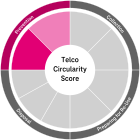
With the TCS KPI “Share Of Own-Brand Devices Assessed Against Sustainability Criteria”, we measure the extent to which ecological requirements are already taken into account in the product design of our own-brand devices. Own-brand devices are considered to be assessed against sustainability criteria if they have either been evaluated against defined ecological criteria as part of our impact measurement process or hold external environmental certifications.
We include own-brand devices in the KPI, for which we have identified ecological improvements in our impact measurement process. We also consider devices with recognized environmental labels such as the Blue Angel or a TÜV Green Label.
The KPI indicates the percentage share of own‑brand devices that have been assessed against these criteria in relation to all own‑brand devices offered during the reporting year, which was 50 % in 2025.
TCS KPIs “Sustainable Packaging”
In order to make our packaging requirements systematically measurable, we use the TCS KPIs “Sustainable Packaging”. Packaging is considered “sustainable” if it meets our internal packaging requirements. These requirements include, among others, the use of recycled paper and cardboard as well as the avoidance of single-use plastics. The TCS KPIs “Sustainable Packaging” indicate the share of our devices and technical components for which the packaging complies with the requirements of our packaging guideline.
The KPIs are shown in four different device categories:
Own-brand devices: share of devices with guideline-compliant packaging in all own-brand devices sold in the reporting year (2025: 100 %).
3rd party mobile devices: share of devices with compliant packaging across all 3rd party mobile devices sold in the reporting year (2025: 94 %).
Network equipment: proportion of procurement projects completed in the reporting year with a binding clause on packaging in accordance with the guidelines. The ten largest network technology suppliers are taken into account. These procurement projects are scheduled to be recorded in 2026.
IT equipment in data centers: share of IT equipment procured annually with packaging in compliance with guidelines, measured by number of units (2025: 95 %).
Collection: take-back of devices at the end of the useful life
End devices that are no longer needed often disappear unused in drawers – even though they still contain valuable materials. We therefore focus specifically on making it easier to return devices at the end of their useful life and to support them with suitable take-back solutions.
The focus is on two groups of devices:
Fixed devices: take-back of routers, repeaters, media receivers and other stationary devices, especially in the context of rental and exchange models.
Mobile devices: take back smartphones, tablets and mobile routers via appropriate return channels.
TCS KPI “Return Ratio Fixed and Mobile”
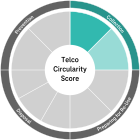
With the TCS KPIs “Return Ratio Fixed and Mobile”, we record the percentage of taken back devices in all fixed and mobile devices sold in the reporting year. The KPIs include devices that were recorded in the reporting year via defined take-back channels. Both own-brand devices and third-party mobile devices are considered.
In 2025, almost 700,000 mobile devices and around 4.9 million fixed line devices were taken back. This equates to a take-back rate of 11 % for mobile devices and 60 % for fixed devices. The figures refer to the TCS assessment excluding T‑Mobile US. The Group‑wide value is disclosed in the “Deep Dive” section.
Practical examples: activating returns in a targeted manner
Whether in the shop, as part of promotions or together with partners: We want to make it as easy as possible for customers to return devices that are no longer in use and provide targeted incentives. The following examples show current measures from different countries:
Germany: In Germany, we operate the mobile phone collection center together with an external partner to collect used mobile phones. In 2025, we were able to collect over 66,000 old devices via our take-back system. This has been awarded the state eco-label “Blue Angel”. For every device collected on behalf of a cooperation partner, 50 cents are donated to environmental and social projects run by our partners. In addition, customers were able to sell used devices to our partner Assurant in the reporting year via the “HandyAnkauf”, which uses them for refurbishment. In addition, we implemented the collection campaign “From old to gold” in 2025. Customers had the opportunity to take part in a competition when they handed in an old device to a Telekom shop and win a 1-kilogram gold bar made of recycled gold. In addition, we donated two euros for each returned smartphone to the children’s aid organization “Ein Herz für Kinder”. As part of the campaign, we collected around 30,000 old devices.
Hungary: Magyar Telekom collaborated with refurbishment provider Recommerce in 2025 to offer take-back solutions for mobile phones, tablets and game consoles. In addition, used equipment was collected together with partners such as Budapest Sportiroda (BSI) and UNICEF in order to reuse or recycle it. In addition, the company supported the Jane Goodall Institute’s “Pass it back, bro!” program with around one euro per device, which was collected through its own logistics channels. In total, over 40,000 mobile devices were taken back in Hungary in 2025.
Slovakia: Slovak Telekom continued the collection of WEEE in 2025 and recorded over 45,000 taken back devices by the end of 2025. In addition to acceptance in the shops, a new digital return option has been introduced. Customers can initiate the return process via the website and return their old devices by parcel delivery.
Greece: OTE Group implemented targeted initiatives in the reporting year to further develop the collection of mobile devices in the COSMOTE and GERMANOSE retail network. These included information campaigns, buy-back and recycling offers, as well as the introduction of an AI‑supported evaluation process for buy-back devices in the shops. In this way, over 70,000 mobile devices were collected in 2025.
Preparation for reuse: preparation for further use
Not all returned devices have reached the end of their service life. We therefore rely on preparing suitable devices and components for further use and extending their use as much as possible. The focus is on two approaches: the reprocessing of devices and the use of circular materials. We make both of these things traceable through our TCS KPIs, thus creating the basis for being able to measure progress in preparing for reuse in the future.
TCS KPIs “Number of Fixed Line and Mobile Devices Refurbished“
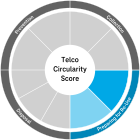
With the TCS KPIs “Number of Fixed Line and Mobile Devices Refurbished”, we show how many returned devices are being refurbished for reuse. To this end, we have end devices and technology tested by specialized service providers and – if they are suitable for this purpose – prepared for further use.
To this end, we record the number of fixed and mobile devices refurbished in the reporting year, both of our own brands and of 3rd party providers. Fixed devices include routers, repeaters, media receivers and TV ticks; to mobile devices, smartphones and mobile routers.
In 2025, around 2.5 million fixed line devices and around 224,000 mobile devices were refurbished by external service providers.
Number |
|
|
2025 |
|---|---|
Fixed line devices refurbishing |
2,451,124 |
Mobile devices refurbishing |
224,077 |
TCS KPIs “Circular Material Input”
In addition to the reuse of returned equipment, we also look at the use of materials in new purchases. With the TCS KPIs “Circular Material Input”, we make it visible to what extent recycled technology and materials with recycled content are taken into account – measured by weight.
When it comes to the network technology used in our network infrastructure, we look at both the proportion of remanufactured or reused components and the proportion of recycled materials in new products. These include metals such as iron, aluminum and copper in particular and, to a lesser extent, recycled plastics.
The IT equipment in our own data centers and those leased by us includes both refurbished and reused equipment as well as newly procured equipment with proportionately recycled materials.
We use reliable average values as the basis for the calculation. The KPIs set the weight of the remanufactured technology and the recycled materials used in relation to the total weight of the network technology or IT equipment procured annually.
In 2025, the circular use of materials was 14 % for network technology and 10 % for IT equipment.
Practical examples: refurbished is in demand
End devices: refurbished as a second phase of use
Customers can purchase used smartphones in connection with the conclusion of a contract in several national companies, including in Germany, Croatia, Austria, Slovakia and Hungary. The European national companies mainly offer fixed devices in a rental model. After replacement, the devices are technically tested and, if suitable, refurbished and reused.
Greece: OTE Group has established a process for reconditioning terminal equipment such as routers, network sockets and TV receivers. With an annual capacity of 265,000 devices (as of 2025), this project is intended to meet the growing demand for used equipment. In addition, more than 2,000 smartphones suitable for refurbishment were collected in 2025 as part of a shop-based Buy-Back program.
Hungary: Magyar Telekom offers refurbished mobile phones. Since the launch of the service two years ago, more than 30,000 such devices have been sold in cooperation with partner Recommerce.
Croatia: Hrvatski Telekom has introduced a refurbishment process for fixed and mobile devices. In 2025, 187,000 end devices were refurbished. A large proportion of these refurbished devices were put back into use in the same year: 138,000 devices were rented to customers.

Current figures from Germany
Around 1.3 million customer devices such as routers and TV set-top boxes have been refurbished for reuse in Germany. In addition, about 200,000 smartphones were refurbished.
Around 800,000 refurbished fixed line devices were sold or rented, of which around 300,000 were offered as service replacement devices.
About 600,000 non-reusable fixed line devices and about 100,000 smartphones were recycled.
Network technology: internal marketplace for reusable equipment
Due to the network expansion and the transition from 4G to 5G mobile communications, discarded network technology is regularly produced. Since 2025, we have been using the internal marketplace Telekom Equipment Exchange (TEE) throughout the Group, with the exception of T‑Mobile US.
Through the TEE, we systematically make used network technology available within the Group, thus enabling it to be reused at other locations and in alternative technical contexts. This should help to ensure that less new equipment is needed and that technical components can be used for longer. The TEE is a central instrument of our circular economy strategy in the grid sector and complements existing measures for the reuse, processing and recycling of technology.
From old to new: prototype of the NeoCircuit router
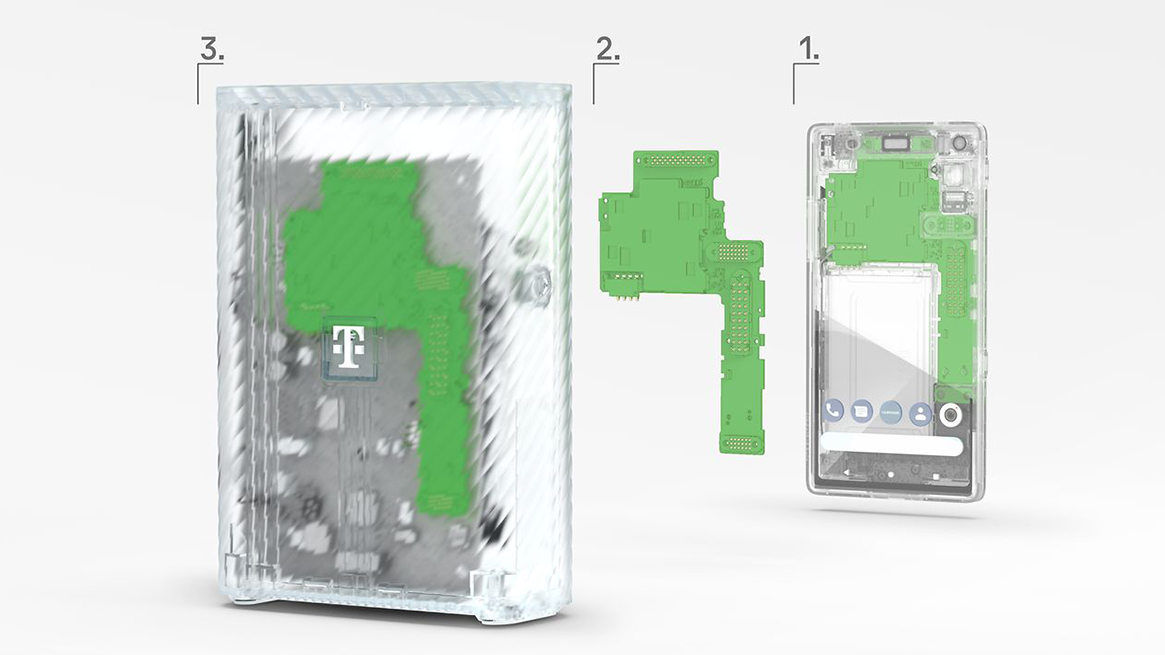
In cooperation with an industry consortium (including Citronics, Evonik, Fairphone, Infineon, MaxLinear, Sagemcom and the INC Innovation Center), we have developed an innovative approach to use electronic components from old devices for the production of new devices. The first prototype, the NeoCircuit Router, is already fully functional and was unveiled at Mobile World Congress 2025.
For the router, central electronic components such as the motherboard, processor and memory chips from old devices – including smartphones such as the Fairphone 2 – as well as from DSL and USB cores, cables and power plugs are reused. The housing is also made of 100 % recycled plastic.
In the first expansion stage, the prototype achieves a degree of circularity of around 70 % in relation to the electronics on this basis. According to initial calculations, the CO2 footprint is around 50 % lower than that of conventional routers.
The assessment of the degree of circularity and the CO2 effects is based on a weight-related analysis of the reused electronic components as well as an indicative comparison with existing life cycle analyses of conventional routers. The router is still in prototype status, will not be mass-produced and will not be offered on the market.
You can find more information about the NeoCircuit router on our website.
Waste: handling equipment at the end of its life cycle
At the end of the product life cycle, there are materials and devices that cannot be reused. Our goal is to avoid waste as much as possible and to recycle any waste generated in the best possible way – especially in the case of electrical and electronic waste.
To this end, we implement various measures along the waste hierarchy. This includes clearly regulated processes for the collection, treatment and professional recycling of electrical and electronic waste in order to ensure controlled handling and avoid its disposal in landfills.
TCS KPIs “WEEE Waste Recycled”, “Zero WEEE/Energy Recovery” and “Zero WEEE/Landfill”
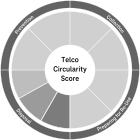
With these TCS KPIs, we record the treatment of electrical and electronic waste at the end of its life cycle. We distinguish between three forms of treatment:
recycling,
energy recovery
landfill
To this end, we collect the TCS KPIs “WEEE Waste Recycled”, “Zero WEEE/Energy Recovery” and “Zero WEEE/Landfill”.
The respective waste quantities are set in relation to the total amount of electrical and electronic waste generated. This makes it possible to understand what proportion of waste is recycled, energetically recovered or landfilled.
Looking ahead
From 2026 onwards, we will focus on the practical application of the Telco Circularity Score as a measurement and control tool. In the future, the TCS is designed to create a reliable benchmark and to be able to compare circular economy approaches in the telecommunications industry.
Deep Dive for Experts
Background: Telco Circularity Score (TCS)
The TCS covers the entire device lifecycle of end-user devices, network equipment, and IT hardware. To this end, it considers four dimensions:
- Avoidance: influencing design, materials, and packaging during product development.
- Collection: supporting the return of devices at the end of their useful life.
- Preparation for reuse: refurbishment of used devices and components for further use.
- Waste: management of devices and materials at the end of their lifecycle, in particular electrical and electronic waste.
The four dimensions are equally weighted in the TCS (25 % each). Key performance indicators (KPIs) have been defined for each dimension. They depict quantities, shares and developments along the four dimensions in a comparable way. In doing so, we are partly drawing on established key figures related to the circular economy that have already been collected in recent years. In addition, we defined further KPIs in the reporting year to reflect all four dimensions.
In the following, we explain our approaches in the four dimensions:
Avoidance: The framework is formed by defined requirements for the design of equipment and packaging. These are set out in internal guidelines (excluding T‑Mobile US).
Telekom Design Specifications: In the development of our own-brand devices, the responsible departments are guided by the Telekom Design Specifications. Among other things, they define requirements for the use of materials, the handling of potentially critical ingredients and the energy efficiency of appliances.
Packaging guideline: As part of the Telekom Design Specifications, the packaging guideline makes binding specifications for packaging for end devices, as well as for network technology and IT equipment. Among other things, the guideline provides for the use of recycled paper and labels without ingredients that are hazardous to health, and excludes the use of single-use plastic. In addition, only materials that are either biodegradable in municipal composting plants or suitable for material recycling may be used.
To measure progress in the “avoidance” dimension in the future, we use five KPIs in the TCS that map how our ecological requirements are implemented in product and packaging design.
Collection: The collection of old devices is based on clearly regulated processes (excluding T‑Mobile US). The basis for this is, among other things, the legal requirements for the handling of waste electrical and electronic equipment, contractually regulated take-back processes in sales, service and logistics, as well as requirements for the handover of equipment to certified service providers.
In the private customer business, our customers can use specially designed collection boxes in Telekom shops that are designed for the safe return of disused devices. In addition, we regularly support collection campaigns and work together with various organizations to do so. We also offer purchase options where customers can sell their used phones online or in the Telekom Shop. In the business customer sector, take-back processes are integrated into end devices and service models, for example as part of device-as-a-service offerings.
After the devices are returned, data is deleted and, depending on the condition of the device, prepared for reuse.
To measure progress in the “collection” dimension in the future, we use two KPIs in the TCS that record the shares of returned fixed-line and mobile devices in all devices sold.
Preparation for reuse: Preparation for reuse is carried out according to clearly defined processes. After take-back, devices are checked by specialized service providers to determine whether they are fundamentally suitable for further use. Remanufacturing involves several stages – from optical and functional testing to repairs and replacement of individual components. In the case of end devices, data is also deleted. Devices that do not meet the requirements for recycling are sent for recycling.
We also look at the circular use of materials in network technology and IT equipment. In doing so, we look at our procurement processes: We record refurbished or remanufactured technology as well as recycled materials (e.g., metals or plastics) in newly procured technology. With this view on the procurement side, we want to provide clear impetus for the use of circular materials along the supply chain.
To measure progress in the future dimension of “preparation for reuse”, we use four KPIs in the TCS that map the reprocessing of equipment and the circular use of materials.
Waste: The handling of waste is regulated by the “International Framework for Waste Management” (excluding T‑Mobile US). The framework represents a uniform standard and at the same time makes it possible to respond flexibly to country- and company-specific framework conditions.
The aim is to avoid waste as much as possible and to recycle waste as much as possible. In this context, we are pursuing various approaches, for example, to ensure the controlled handling of electronic waste and to avoid its disposal in landfills. The waste hierarchy serves as a methodological orientation framework for us: waste prevention comes first, followed by reuse, recycling and other recovery (e.g., energy) – so that in the end only those materials remain for disposal that cannot be treated at upstream stages.
The central regulatory basis for the handling of electrical and electronic waste in Europe is the EUWEE Directive (Waste Electrical and Electronic Equipment). It regulates the treatment of waste electrical and electronic equipment.
Against this background, the European sub-goal “Zero ICT Waste to Landfill” is relevant for Deutsche Telekom. It is based on the EU legal requirements for the professional disposal and recycling of electronic waste and returned devices. The sub-target was already achieved at the end of 2022.
In addition, we try to ensure that electronic waste is not incinerated, but – where possible – professionally recycled by external bodies. For professional recycling, we work together with recycling companies so that metals, plastics and rare earths can be kept in the cycle as much as possible.
To measure progress in the “waste” dimension in the future, we use three KPIs in the TCS that record the proportion of electrical and electronic waste that is recycled, recovered for energy or landfilled at the end of its life cycle.
End of life for devices at T‑Mobile US
T‑Mobile US is currently not integrated into the Telco Circularity Score (TCS), but is implementing its own measures:
T‑Mobile US offers customers redemption options for eligible devices, which are supported by a Trade-in Estimator Tool.
A free Device Reuse and Recycling Program is available in stores, including for smartphones, tablets, smartwatches, hotspots, internet routers, and IoT devices.
In 2025, group-wide 10.5 million mobile devices were collected and processed for reuse, resale or recycling. The majority of these devices – 9.8 million mobile devices – were collected and processed by T‑Mobile US.
Waste generation (including e-waste)
As part of our waste management, we transparently map our waste volume. We have not set a Group-wide target for the reduction of hazardous and non-hazardous waste. Rather, the national companies are guided by our “International Framework for Waste Management”; on this basis, they develop or update their own waste strategies. The Group-wide amount of waste fell by 10 % compared to 2024. In our interactive key figure tool for company comparison, we provide detailed information on the key figures of the individual companies.
Waste generation Deutsche Telekom Group
in t
Reclaimed copper cables
For decades, telephone lines consisted largely of copper cables, which are now being successively replaced by fiber optic expansion. In 2025, we pulled around 1,200 tons of copper cable from cable duct systems in Germany or recovered them from assembly and cable residues. Certified waste management companies process them and, if possible, return them to the raw materials market.
Copper cable recovered since 2018
in thousand tons
Management & Frameworks
With our HSE management system for health, safety and environmental protection, we are committed to continuous improvement. It has been recertified according to international standards such as ISO 14001. Our Environmental Guidance summarizes key ecological commitments, e.g., on the circular economy and biodiversity.
Requirements for handling conflict-prone raw materials are enshrined in our Supplier Code of Conduct, which is part of the General Terms and Conditions of Purchase (excluding T‑Mobile US). T‑Mobile US addresses procurement risks through its own Responsible Sourcing Policy. Further information on our handling of conflict-prone raw materials can be found in our audited Sustainability statement.
Relevant Standards
Global Reporting Initiative (GRI)
GRI 3-3 (Management of material topics); GRI 301: Materials
GRI 301-3 (Reclaimed products and their packaging materials)
GRI 3-3 (Management of material topics); GRI 306: Waste
GRI 306-1 (Waste generated and significant waste-related impacts)
GRI 306-2 (Management of significant waste-related impacts)
GRI 306-3 (Waste generated)
GRI 306-4 (Waste diverted from disposal)
GRI 306-5 (Waste directed to disposal)
Sustainability Accounting Standards Board (SASB)
TC-TL-440a.1 (End of Life Product Management)
GSM Association (GSMA) Indicators for Telecom Operators
GSMA-ENV-04 (Circularity)
GSMA-ENV-05 (Waste)
Task Force on Climate-related Financial Disclosures (TCFD)
The most important key figures for the recording and management of climate-related opportunities and risks)