

The digital world is changing at an ever faster pace – currently driven primarily by rapid progress in the development of artificial intelligence (AI). At the same time, our personal, economic and social well-being depends heavily on digital inclusion. Against this background, Deutsche Telekom is committed to breaking down barriers and facilitating access to the digital world. We are investing massively in the further development of digital infrastructures, making sure that we also offer affordable services and implementing measures to strengthen the competent use of digital media.
We also deal with the topic of “digital inclusion” in detail in the audited Sustainability statement in the Annual Report 2025. Closely linked to this topic is also our commitment to better interaction on the internet, which we describe here in the CR report under Digital values.
Milestones achieved, ongoing projects and goals
More than 80 million – that is how many people are expected to benefit cumulatively from our commitment to promoting the digital society across the Group between 2024 and 2027: As beneficiaries, they learn new skills or adapt their attitudes or behavior. Vulnerable and disadvantaged groups are also taken into account. Our beneficiaries in the area of digital society include people who use our media literacy platforms, participants in workshops and users of free telephone counselling services and discounted rates (including household members). We measure our progress with the KPI “Beneficiaries – Digital Society”. In the 2025 reporting year, we reached around 40 million people with our measures.
Scroll to learn more
Where we come from
-
Increased focus on promoting participation in the information and knowledge society in our social engagement.
-
Launch of the EU initiative “Teachtoday” in many European countries, together with leading telecommunications companies and the European Schoolnet (EUN).
-
Deutsche Telekom AG has taken over the “Teachtoday” initiative and has been running it independently ever since.
-
For the first time, social engagement is measured using two KPIs: “Community Investment” (now “Community Contribution”) and “Beneficiaries”.
-
Bundling of our measures to promote digital inclusion under the aspects of “access, affordability, ability”.
-
The commitment to a digital society that is based on our basic democratic values and enables all people to participate safely, competently and confidently is one of four focal points in the further development of our CR strategy. For more information, see CR Strategy.
-
We have developed our “Design for All” guideline: It is intended to provide our employees with orientation so that they can design products and services to be as discriminatory and barrier-free as possible.
-
With the launch of “Teachtoday International”, we have bundled our Group-wide media literacy measures on one platform.
Where we stand in the reporting year
-
We are revising our strategic approach to promoting digital inclusion and aligning it with current social and technological developments.
-
We are introducing the AI smartphones T Phone 3 and T Phone 3 Pro and want to make AI accessible to a broad target group through comparatively affordable devices.
-
We are expanding “Teachtoday” with detailed information materials for parents and guardians, including a media literacy test for children, young people and parents.
Where we want to go
-
From 2024 to 2027, we want to reach more than 80 million people in the “Digital society” area across the Group.
Our approach to digital inclusion
To ensure that all people can participate equally in the networked society, we promote three dimensions in particular with our activities:
Access
In order to enable technical access, we are constantly expanding our network. We also cooperate with partners – especially in remote areas. In addition, we are driving forward the development of technology and products for various target groups. Our guideline “Design for All” is intended to provide orientation for design that is as barrier-free and non-discriminatory as possible.


Affordability
Affordability where it counts: We are committed to this with products and services, such as special rates for schools, affordable devices and reduced basic fees for various target groups.
Ability/Media Literacy
We support people in moving around the internet safely, competently and confidently. To this end, we offer free, easy-to-understand and entertaining materials and formats on the various aspects of media literacy.

Access: access through network expansion
You can find out more about network expansion in our audited
Annual Report 2025Our investments in network expansion are crucial for ensuring that large parts of society have access to fast internet.
In the expansion of the mobile network, we are concentrating on the supply of 5G, which is currently the most powerful standard. In the fixed network, we are pushing ahead with fiber-optic expansion in order to provide our customers with a reliable connection at gigabit speeds. In the FTTH (Fiber to the Home) expansion, we run fiber-optic lines directly to households. In this way, we want to close gaps in care, especially in rural areas, while expanding in conurbations in line with demand. In addition, we offer hybrid solutions, for example by combining fixed network and mobile communications.
Our high power quality has been confirmed for many years in independent tests and awards. For more information, see CR Strategy in this CR report.
Access: AI-powered protection of critical infrastructure
Cyberattacks, system failures or undiscovered vulnerabilities can have significant consequences in highly networked areas of critical infrastructure – such as healthcare. In order to identify risks at an early stage and remain able to act even in crisis situations, Telekom MMS and the University Hospital Bonn have developed an AI-supported real-time situation picture. The solution continuously monitors sensitive IT environments and predicts potential undesirable developments before they escalate. In the long term, the solution is to be used productively in hospital operations; the approach can also be transferred to other areas such as energy, water or transport networks.
In addition, Deutsche Telekom uses AI-based network intelligence to detect and resolve disruptions in the network before they affect customers.
Access: “Design for All”
When developing products, services and other offerings, we take care to take into account the widest possible range of human diversity – in addition to different physical and mental abilities, this includes other dimensions of diversity such as age, gender or ethnic origin. The framework for this is provided by our guideline “Design for All”. Our claim: to create an inclusive environment that involves more people and excludes no one as far as possible – even beyond legal requirements for accessibility. For example, we offer parts of our website in plain language. Another example of this is an offer from Magyar Telekom for customers who prefer or need a stimulus-reduced environment: In the reporting year, our Hungarian subsidiary introduced a monthly “quiet hour” in all shops. Due to fewer acoustic and visual stimuli, neurodivergent customers in particular should be able to use our services with less barriers.
Our recent progress
In 2025, we tested and further developed our products and digital offerings for accessibility. For example, we have revised central solutions such as MagentaTV, our Europe-wide online shops and the Europe-wide customer service apps: for example, by adjusting contrasts, font sizes and operating sequences. In Germany, we have added additional accessibility information to our website and introduced a new process to make it easier for users to report barriers.
Reducing barriers: application examples
To make it easier for seniors to participate in the digital society, we offer special technology and products for them, such as large button settings, emergency call buttons and clear displays.
Deaf and hard of hearing people can take advantage of special counselling services, in Germany, for example, video-based live chats in sign language and text chats in simple language. We also offer discounted mobile and landline offers tailored to your needs.
You can find out more about “Design for All” in our audited Sustainability statement in the Annual Report 2025.
Affordability: digital inclusion through affordability
Affordability is also an important factor in enabling digital inclusion. For this reason, we offer various products and special rates.

Affordable devices
To ensure that as broad a proportion of the population as possible can benefit from our expansion of 5G networks, we have so far offered the 5G smartphones T Phone 3 and T Phone 3 Pro in ten European countries, and in 2025 we launched the third generation of them as AI phones. In the USA, similar products are available under the name REVVL. The T Tablet 2 comes from the same series, which is also available in ten countries in Europe and the USA. The models are aimed at a broad target group and provide selected AI functions directly on the device, including assistance and translation applications.
With these comparatively affordable devices, we want to give more people access to the digital world and AI.
Plans for different target groups
We offer social and subsidized tariffs throughout the Group. In this way, we enable eligible users to make free or discounted calls or surf the web. The offer differs from country to country and is designed differently in each case.
Our special rates are aimed in particular at:
low-income individuals, single parents and families
people with disabilities
refugees in Germany and the USA
people from systemically important occupational or social groups (e.g., employees of the German Red Cross or the fire brigade in Germany)
pupils, students, teachers, school authorities and districts
seniors
start-ups (within the framework of special programs)
Focus on education
With special tariff offers, we promote the teaching of digital skills in educational institutions.

As part of the “Telekom@School” initiative, we offer broadband connections for educational purposes to all general and vocational schools in Germany. Depending on the bandwidth, schools receive the connections free of charge or significantly at a reduced price. In the reporting year, we supported the initiative with services worth around EUR 10.3 million. Around 6.6 million people benefited from this.
Since 2020, we have also been offering school authorities in Germany an education flat rate, which allows students to use unlimited data volume for educational content. Funding for this education tariff amounted to around EUR 6.6 million in the reporting year. About 138,000 people benefited from this.
United States segment: affordable internet in education
Through “Project 10Million”, launched in 2020 by T‑Mobile US, the company has committed to offering free internet connections and mobile hotspots to up to 10 million eligible primary and secondary education student households in the United States. School districts can also get data plans at a reduced rate as well as access to affordable laptops and tablets.
In 2025, T‑Mobile US continued to enhance “Project 10Million” to support students’ evolving connectivity needs. These included providing 5G hotspots to participating households, redesigning the online application and support pages for greater ease of use, and launching an onboarding campaign to help families maximize their connectivity benefits from day one.
In order to reach more students, T‑Mobile US also continued its nationwide partnership with Boys & Girls Clubs of America (BGCA) throughout 2025. Together, they worked with 28 club organizations serving 433 total sites in 20 U.S. states to raise awareness of the program and ultimately get more student households connected.
Since the start of the project, T‑Mobile US has done the following through “Project 10Million”
connected nearly 6.7 million students to the internet and
provided in-kind contributions in the form of products and services worth USD 8.3 billion (as of the end of 2025).
Ability: promoting media literacy
Media literacy means being able to use digital media safely and competently. This is not only about learning basic skills for safe use – but also about knowing how to protect your privacy or deal with hate and disinformation. Our measures are aimed at many different target groups, including vulnerable groups, such as people with special support needs. For more information on how to measure the success of our key initiatives to advance the digital society, click here.
Educating people on how to use technology in the most environmentally friendly way possible is also part of our media literacy: We want to show people how they can use digital solutions cleverly to reduce their greenhouse gas emissions or save resources. One example are the Teachtoday sustainability detectives: In this initiative for children, we explain in various videos how they can contribute to ecological sustainability in everyday life, for example by using a certain search engine or consciously streaming video.
In the reporting year, the Teachtoday sustainability detectives were awarded the GreenUp label for sustainable educational media. For more information, see CR Strategy here in the CR report.
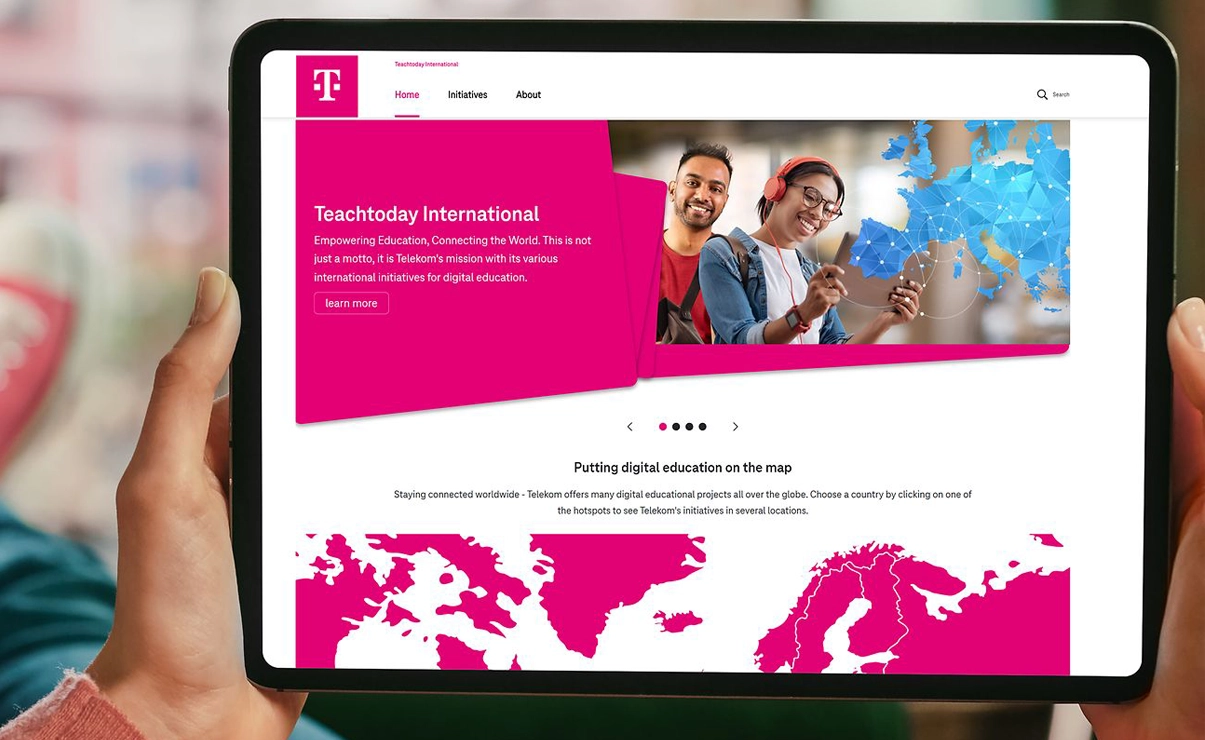
Teachtoday International
The platform “Teachtoday International”, launched in 2024, provides an overview of Deutsche Telekom’s Group-wide media literacy initiatives. The platform is available in English.
The most important target groups of our media literacy offers:
Children and young people: Young people today grow up in an environment that is strongly influenced by digital media. It is essential that they learn to move confidently and safely on the internet at the same time. We want to support them in this and promote their media literacy with numerous measures and initiatives: in Germany, for example, with our initiative “Teachtoday.de” and the interactive children’s magazine “SCROLLER”, which are aimed at young people and their adult caregivers. Our employees are also involved in corporate communities to promote more media literacy among children and young people. You can find more information under Voluntary and financial commitment in this CR report.
Parents: Digital inclusion of children and young people can only succeed if parents, as the most important caregivers, have sufficient media competence and can teach their children how to deal with digital content safely, critically. That is why we want to dispel uncertainties about topics such as disinformation, cyberbullying or age-appropriate media use and strengthen parents in their role as companions, e.g. with a guidebook and a media literacy test on “Teachtoday.de”. Since 2023, our Hungarian subsidiary Magyar Telekom has been supporting parents on the digital platform “Hello Parent” in bringing their children closer to the digital world in an age-appropriate way.
Europe segment: Parents’ guide to digital media literacy (T‑Mobile Czech Republic)
With a printed parenting guide and supplementary online content, T‑Mobile Czech Republic wants to help parents better understand their children’s online lives, accompany them safely and promote conversations about digital topics. The focus of active parental support is on online safety and responsible media use. Almost 450,000 people benefited from this offer in 2025.
Seniors: Together with partner organizations and through our own offers, we are committed to strengthening the media literacy of seniors: For example, we offer seminars and workshops on the safe and independent use of digital devices, for example in our shops. This is intended to help them make better use of digital services – such as telemedicine and health apps – to maintain social contacts more easily and to prevent loneliness in old age. You can find more information about current activities for seniors here.
Excursus: digital solutions for healthcare
Good medical care is by no means a matter of course. A shortage of skilled workers, complex bureaucratic processes and inadequate communication often stand in its way. How can these hurdles be overcome and better availability, higher quality and greater efficiency be ensured? Solutions from T‑Systems for the healthcare sector are intended to make a contribution here.
For example, the start-up Fuse-AI, which is supported by T‑Systems, develops AI-based applications to assist with medical diagnoses. They are intended to relieve radiologists of the burden of evaluating MRI images, increase the quality of diagnosis and reduce costs. The results from the AI analyses can help specialists, for example, to detect abnormalities such as potential cancers more reliably. For the comprehensive analyses, Fuse-AI draws on IT resources from T‑Systems’ T Cloud Public.
Measuring success in 2025: KPIs “Community Contribution – Digital Society” and “Beneficiaries – Digital Society”

EUR 977 million of our financial, human and material commitment contributed to the promotion of the digital society (2024: EUR 1,102 million).

Almost 40 million people have benefited directly or through multipliers such as parents or educators from our measures to promote the digital society (2024: around 34 million).
KPI „Beneficiaries – Digital Society“ (target)
in million persons
You can find more information on our performance measurement under Social engagement in this CR report.
Digital society initiatives at a glance
An overview of our most important initiatives to promote the digital society can be found here.
Looking ahead
Around 40 million people benefited from our commitment to promoting the digital society in 2025. This brings us a big step closer to our goal of reaching more than 80 million people cumulatively between 2024 and 2027. Based on this development, we expect to achieve the target as early as 2026. For next year, we have set ourselves the goal of supporting parents in particular in providing their children with a safe digital environment.
Deep Dive for Experts
Management & Frameworks
In our “Corporate Digital Responsibility@Deutsche Telekom” framework published in 2022, we outline what we mean by digital responsibility. In doing so, we focus on people. As a cross-cutting topic, Corporate Digital Responsibility (CDR) creates added value for various areas and is taken up in existing structures: e.g., with Digital inclusion in the Group Corporate Responsibility (GCR) area. At the core of the CDR framework is our “House of Digital Responsibility”, which is all about technology with people at the center.
We are committed to upholding and promoting human rights – taking into account the responsibilities arising from technological change and digitalization. In our Code of Human Rights, we emphasize that our technologies are based on a humanistic value system.
Our Guidelines for Artificial Intelligence (AI Guidelines) provide our developers and designers with clear guidelines for the responsible use of AI. In order to ensure the development of AI in the supply chain that meets our high ethical requirements, we have anchored the essential contents of the AI guidelines in our “Supplier Code of Conduct”. In addition, we have provided the “Professional Ethics” guideline for our product developers and expanded our central quality assurance process to include a review of ethical AI requirements.
Impact measurement of ecological and social impacts
Deutsche Telekom uses a multi-step impact measurement approach to assess the potential ecological and social impacts of selected products, services and digital solutions. The process was externally validated in 2023. Further information can be found here.
Relevant Standards
GSMA-INC-03 (Digital skills training programs)
GSMA-INT-03 (Online safety measures)