
Performance-based remuneration components
In 2025, the members of the Board of Management participated in the performance-based (variable) remuneration components shown in the table below. In this context, it should be noted that, in the 2025 financial year, only the STI for the current Board of Management members was calculated in accordance with the regulations of the 2025 remuneration system. All other performance-related remuneration instruments were calculated based on the regulations of previous remuneration systems. The regulations of the 2022 remuneration system continued to apply to the STI for the members of the Board of Management who left during the financial year. The level of target achievement for the STI target for the two members who left the Board is therefore presented in a separate section.
|
|
|
Remuneration components |
Features |
Objectives and bearing on strategy |
|---|---|---|
Short-Term Incentive (STI) |
2022 remuneration system:
2025 remuneration system:
|
|
Mandatory personal investment |
|
|
Share Matching Plan (SMP) |
|
|
Long-Term Incentive (LTI) |
2022 remuneration system:
2025 remuneration system:
|
|
Short-Term Incentive (STI)
Short-Term Incentive (STI) for the current members of the Board of Management
Functionality
The STI is the short-term variable remuneration instrument, with a term of one year. In accordance with the 2025 remuneration system, it is comprised of three Group financial targets and three segment financial targets with a one-year assessment period, which are added together. The level of target achievement for the STI target is also influenced by an ESG & Strategy multiplier whose values may vary between 0.8 and 1.2. All values of the multiplier of less than 1.0 have the effect of a penalty and all values greater than 1.0 have the effect of an additional bonus for Board of Management members. The multiplier consists of two ESG targets and personal strategic targets for each Board of Management member, which also have an assessment period of one year. Target achievement is applied to the target amount resulting from the service contract for the Board of Management member. Maximum target achievement per target parameter is limited to 166.67 %. After the ESG & Strategy multiplier is applied, total target achievement is limited to a maximum of 200 % of the target amount.
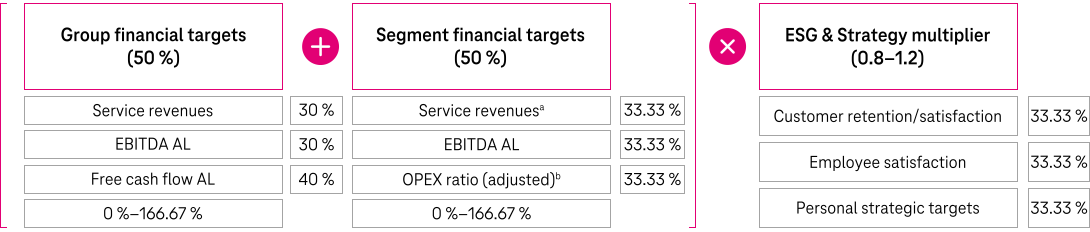
bInstead of the (adjusted) OPEX ratio, the (adjusted) EBITDA AL margin is used for T‑Systems.
Contribution to long-term development of the Company
The main aim of the STI is to reflect the economic success of the current financial year. In addition, by deriving budget values from the four-year medium-term planning, the STI also contributes to the Company’s long-term development. The details provided below for the STI generally refer to unadjusted KPIs, which correspond to the actual values published in the Annual Report. Based on these values, the Supervisory Board makes target-relevant adjustments that are necessary for appropriate incentivization. Any adjustments are explained in the corresponding footnotes.
The objective of incentivization via the Group financial targets is to reinforce the cross-department collaboration in the Board of Management team. At the same time, the Supervisory Board considers it to be important that the performance of members of the Board of Management with responsibility for operational business is determined on the basis of the success of their respective segment. For members of the Board of Management who do not have any operational responsibility, this measurement takes place at Group level and, depending on the area of responsibility, includes or excludes U.S. business (see the figure in the section on segment targets). Furthermore, the Supervisory Board supports the significance of employee and customer retention/satisfaction and the personal strategic targets that are anchored in the ESG & Strategy multiplier and also have an assessment period of one year.
Target achievement for the STI in the 2025 financial year
2025 was a successful financial year for Deutsche Telekom AG, allowing it to exceed the original capital market expectations in the relevant areas. Total target achievement for the successful 2025 financial year can be seen in the following table. Target achievement was calculated on the basis of precise figures (not rounded). For reasons of clarity, the figures reported in the table are rounded. The STI will be paid out in the 2026 financial year after the Shareholders’ Meeting.
|
|
|
|
|
|
|
|
|
|
|
|
|
||||||
Target structure |
|
Target achievementc |
||||||||||||||||
|---|---|---|---|---|---|---|---|---|---|---|---|---|---|---|---|---|---|---|
|
|
|
Weighting |
|
Dr. Ferri Abolhassan |
Birgit Bohle |
Rodrigo Diehl |
Timotheus Höttges |
Dr. Christian P. Illek |
Thorsten Langheim |
Dominique Leroy |
Dr. Abdurazak Mudesir |
||||||
Group financial targets |
|
Service revenues |
30 % |
|
125 % |
|||||||||||||
|
EBITDA AL |
30 % |
|
95 % |
||||||||||||||
|
Free cash flow AL |
40 % |
|
147 % |
||||||||||||||
|
Target achievement |
|
|
125 % |
||||||||||||||
|
|
|
|
|
|
|
|
|
|
|
|
|
||||||
Segment financial targets |
|
Service revenuesa |
33.33 % |
|
92 % |
96 % |
81 % |
125 % |
125 % |
125 % |
162 % |
96 % |
||||||
|
EBITDA AL |
33.33 % |
|
131 % |
149 % |
115 % |
95 % |
95 % |
95 % |
156 % |
149 % |
|||||||
|
OPEX ratio (adjusted)b |
33.33 % |
|
100 % |
110 % |
95 % |
110 % |
110 % |
110 % |
162 % |
110 % |
|||||||
|
Target achievement |
|
|
107 % |
118 % |
97 % |
110 % |
110 % |
110 % |
160 % |
118 % |
|||||||
|
|
|
|
|
|
|
|
|
|
|
|
|
||||||
Collective target achievement |
|
|
116 % |
122 % |
111 % |
118 % |
118 % |
118 % |
143 % |
122 % |
||||||||
|
|
|
|
|
|
|
|
|
|
|
|
|
||||||
ESG & Strategy multiplier |
|
Customer retention/ |
33.33 % |
|
130 % |
|||||||||||||
|
Employee satisfaction |
33.33 % |
|
120 % |
||||||||||||||
|
Personal strategic targets |
33.33 % |
|
150 % |
105 % |
105 % |
125 % |
115 % |
135 % |
130 % |
115 % |
|||||||
|
Target achievement |
|
|
133 % |
118 % |
118 % |
125 % |
122 % |
128 % |
127 % |
122 % |
|||||||
|
|
|
|
|
|
|
|
|
|
|
|
|||||||
|
Multiplier outcome |
|
1.10 |
1.05 |
1.05 |
1.07 |
1.06 |
1.08 |
1.08 |
1.06 |
||||||||
|
|
|
|
|
|
|
|
|
|
|
|
|
||||||
Total target achievement |
|
|
128 % |
128 % |
116 % |
126 % |
125 % |
127 % |
154 % |
129 % |
||||||||
|
||||||||||||||||||


Prior to the start of the financial year, the Supervisory Board derives the target and threshold values for the Group financial targets, the segment financial targets, and the ESG targets from the medium-term company planning. The 100 % target value corresponds to the budget value from the planning. Target achievement for each target parameter can range between 0 % and 166.67 %.
Group financial targets
Service revenues are defined as revenues that are generated through customers’ use of services (i.e., revenue from fixed network and mobile communications, voice services, incoming and outgoing calls, and data services) plus roaming revenues, monthly basic charges and visitor revenues, as well as revenue generated from the ICT business (information and communications technologies). As a result, the service revenues are an important indicator for the successful implementation of the growth strategy of the Group.
Earnings before interest, taxes, depreciation and amortization after leases (EBITDA AL) is the most important KPI when it comes to measuring the operational performance of the Company and reflects the growth strategy on the customer side (consumers and business customers) as well as savings for promoting investment. EBITDA AL is calculated by adjusting EBITDA for depreciation of right-of-use assets from leases and for interest expenses on recognized lease liabilities.
Free cash flow after leases (free cash flow AL) is a further important KPI when it comes to measuring the operational performance of the Group that is directly linked to the finance strategy (the ability to pay a dividend and the ability to reduce liabilities). When determining free cash flow AL, the free cash flow (cash generated from operations minus payments for investments) is adjusted for the repayment of lease liabilities.
For the 2025 financial year, the following target values and target achievement figures derived from them applied:
billions of € |
|
|
|
|
|
|
||
|
Weighting |
Lower threshold |
Target value |
Upper threshold |
Resulta |
Target achievement |
||
|---|---|---|---|---|---|---|---|---|
Service revenues |
30 % |
93.2 |
98.1 |
100.7 |
99.0 |
125 % |
||
EBITDA AL |
30 % |
38.3 |
42.5 |
43.7 |
42.3 |
95 % |
||
Free cash flow AL |
40 % |
17.0 |
18.9 |
19.9 |
19.6 |
147 % |
||
|
||||||||
In terms of service revenues and free cash flow AL, results were considerably better than assumed in the budget, leading to target achievement of 125 % and 147 %, respectively. This is particularly due to a better than expected development of business in the U.S. At 95 %, only the target achievement of EBITDA AL was slightly below target. This results in a total weighted target achievement for the Group financial targets for the 2025 financial year of 125 %.
Segment financial targets
The explanations for the Group financial targets above in regard to the targets of service revenues and EBITDA AL also apply to the segment financial targets.
The target parameter “OPEX ratio” provides incentive to reduce the ratio of external indirect costs to service revenues. As a consequence, profitability can also be achieved through disproportionate increases in service revenue and not exclusively through cost savings. This enables a certain level of operational flexibility: Even if additional cost savings are now only possible to a limited extent, the target achievement can still be positively influenced if service revenue grows faster than the external indirect costs.
At the same time, savings made in terms of external indirect costs and a higher net margin contribute to the improvement of the operational performance that is reflected in EBITDA AL and free cash flow AL and, consequently, have a positive impact on the valuation of the Company on the capital market. In terms of the external adjusted indirect costs AL, adjusted indirect costs are also calculated, in a similar manner to the determination of EBITDA AL, by adjusting for depreciation of right-of-use assets from lease arrangements and for interest expenses on recognized lease liabilities.
The segment financial targets for the individual members of the Board of Management are broken down as follows:
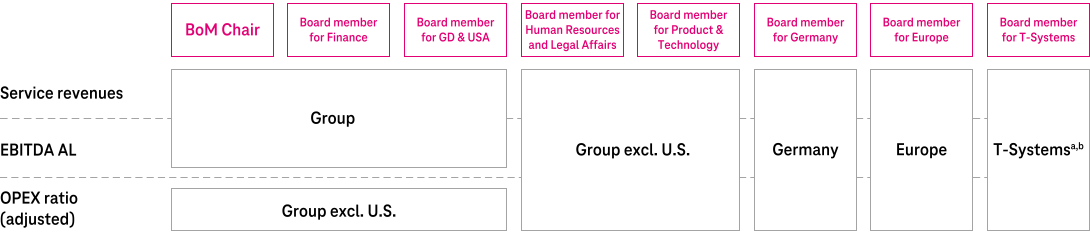
bInstead of the (adjusted) OPEX ratio, the (adjusted) EBITDA AL margin is used for T‑Systems.
In contrast to the Group financial targets, the target values for the segment financial targets are not published in detail because of the large number of KPIs and the differences from one Board of Management member to another.
ESG & Strategy multiplier
The customer retention/satisfaction and employee satisfaction ESG targets and personal strategic targets each have a weighting of one-third in the ESG & Strategy multiplier.
ESG targets
A high level of customer retention/satisfaction is extremely important for Deutsche Telekom’s business success. At Deutsche Telekom, customer retention/satisfaction is determined for the Germany, Europe, and T‑Systems business units with the help of the globally recognized TRI*M method. The results of systematic surveys conducted by an external service provider are expressed by an indicator that combines questions on customer retention/satisfaction, the likelihood of recommendation to others, the further willingness of use, and the competitive advantage. The TRI*M indexes calculated for all the operational entities involved are aggregated as an approximation of the respective entities’ percentage of total revenue to create a TRI*M Group value. When preparing the ambition level, the Supervisory Board takes the specific competitive situation of the individual entity involved into consideration.
The Board of Management also relies heavily on its employees to implement Deutsche Telekom’s strategy, which is why employee satisfaction is likewise incentivized in Board of Management remuneration. The most important feedback instruments across the Group (excluding T‑Mobile US) for assessing employee satisfaction include the employee surveys carried out at least once a year. From the regularly used set of questions, the Supervisory Board selects some of the questions that it believes are of particular significance when it comes to evaluating employee satisfaction. For these questions, the Supervisory Board analyzes the development of the response behavior from the past and defines target levels that it believes should be achieved in future survey results. When setting the ambition level, the Supervisory Board calculates the average of the relevant questions, including all questions with the same weighting.
The level of ambition and the target achievement for the ESG targets can be seen in the following table:
|
|
|
|
|
|
|
|
Weighting |
Lower threshold |
Target value |
Upper threshold |
Result |
Target achievement |
|---|---|---|---|---|---|---|
Customer retention/ |
33.33 % |
75.6 |
80.0 |
82.9 |
81.3 |
130 % |
Employee satisfaction |
33.33 % |
64 |
74 |
81 |
76 |
120 % |
Personal strategic targets |
33.33 % |
Details see below |
|
|
||
Personal strategic targets
By agreeing on personal strategic targets for the individual Board of Management members, the Supervisory Board aims to incentivize the strategic priorities of Board of Management members on an annual basis. After the end of the financial year, the performance of the Board of Management members with regard to the achievement of the personal strategic targets is evaluated and assessed by the Supervisory Board. The following personal strategic targets for the 2025 financial year have been agreed with the individual active Board of Management members:
Member of the Board of Management |
Personal strategic targets |
Target assessment |
||
|---|---|---|---|---|
Timotheus Höttges |
|
125 % |
||
Dr. Ferri Abolhassana |
|
150 % |
||
Birgit Bohle |
|
105 % |
||
Rodrigo Diehl |
|
105 % |
||
Dr. Christian P. Illek |
|
115 % |
||
Thorsten Langheim |
|
135 % |
||
Dominique Leroy |
|
130 % |
||
Dr. Abdurazak Mudesir |
|
115 % |
||
|
||||
Short-Term Incentive (STI) for the Board of Management members who left in the 2025 financial year
Functionality
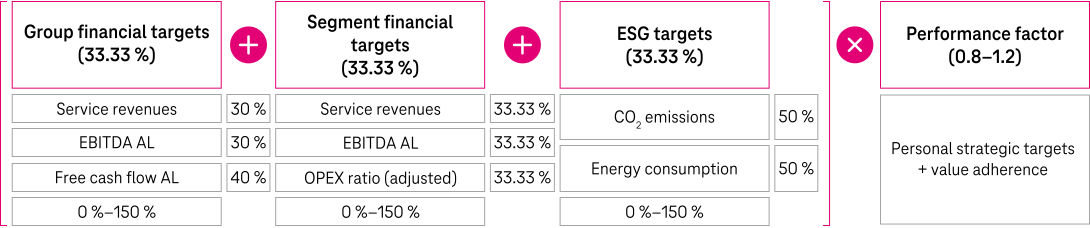
The STI for the Board of Management members who left in the financial year continues to be aligned with the regulations of the 2022 remuneration system. The STI is based in equal parts (one-third each) on Group financial targets, segment financial targets, and ESG targets. To determine the final target achievement, the Supervisory Board applies a personal performance factor, based on which the calculated target achievement can be adjusted between 0.8 and 1.2. All scores higher than 1.0 have the effect of a bonus, while scores lower than 1.0 have the effect of a penalty. When deciding to apply the performance factor, the Supervisory Board assesses the strategic personal targets agreed with the respective member of the Board of Management and also assesses individual value adherence. Target achievement is applied to the target amount resulting from the service contract for the Board of Management member, which is then adjusted according to the performance factor. Maximum target achievement per target parameter is limited to 150 %. If the performance factor is applied, total target achievement is limited to a maximum of 180 % of the target amount.
Target achievement for the STI in the 2025 financial year
Total target achievement for the 2025 financial year for the two Board of Management members who left can be seen in the table below. Target achievement was calculated on the basis of precise figures (not rounded). In accordance with the regulation for the active members of the Board of Management, the STI will be paid out in the 2026 financial year after the Shareholders’ Meeting. Srinivasan Gopalan and Claudia Nemat will receive 2/12 and 9/12 of the 2025 STI, respectively, on account of their departure from the Board.
|
|
|
|
|
|
|
|
|
|
|
|
|
|
|
|
Group financial targets |
Segment financial targets |
ESG targets |
|
|
|||||||||
|---|---|---|---|---|---|---|---|---|---|---|---|---|---|---|
|
[weighting: 33.33 %] |
[weighting: 33.33 %] |
[weighting: 33.33 %] |
|
|
|||||||||
|
|
|
|
|
|
|
|
|
|
|
|
|
|
|
|
Service revenues |
EBITDA AL |
Free cash flow AL |
∑ |
Service revenues |
EBITDA AL |
OPEX Ratio (adjusted) |
∑ |
CO2 emissions |
Energy consumption |
∑ |
Target achievement |
Performance factor |
Total target |
Member of the |
[30 %] |
[30 %] |
[40 %] |
|
[33.33 %] |
[33.33 %] |
[33.33 %] |
|
[50 %] |
[50 %] |
|
|
|
|
Srinivasan Gopalan |
125 % |
95 % |
147 % |
125 % |
81 % |
115 % |
95 % |
97 % |
123 % |
141 % |
132 % |
118 % |
1.05 |
124 % |
Claudia Nemat |
125 % |
95 % |
147 % |
125 % |
96 % |
149 % |
110 % |
118 % |
123 % |
141 % |
132 % |
125 % |
1.05 |
131 % |
Group and segment financial targets
The statements regarding active members of the Board of Management apply to the Group and segment financial targets.
Prior to the start of the financial year, the Supervisory Board derives the target and threshold values for the Group financial targets, the segment financial targets, and the ESG targets from the medium-term company planning. The 100 % target value corresponds to the budget value from the planning. Target achievement for each target parameter can range between 0 % and 150 %.
For the 2025 financial year, the following target values and target achievement figures derived from them applied:
billions of € |
|
|
|
|
|
|
||
|
Weighting |
Lower threshold |
Target value |
Upper threshold |
Resulta |
Target achievement |
||
|---|---|---|---|---|---|---|---|---|
Service revenues |
30 % |
93.2 |
98.1 |
100.0 |
99.0 |
125 % |
||
EBITDA AL |
30 % |
38.3 |
42.5 |
43.4 |
42.3 |
95 % |
||
Free cash flow AL |
40 % |
17.0 |
18.9 |
19.7 |
19.6 |
147 % |
||
|
||||||||
This results in weighted target achievement for the Group financial targets for the 2025 financial year of 125 %.
In contrast to the Group financial targets, the target values for the segment financial targets are not published in detail because of the large number of KPIs and the differences from one Board of Management member to another.
ESG targets
Unlike for the active members of the Board of Management, the “energy consumption” and “CO2 emissions” ESG targets continued to apply to the two Board of Management members who left during the financial year.
The aim of the “energy consumption” target is to incentivize the members of the Board of Management to behave in a way so as to ensure that energy consumption that is harmful to the environment remains at least stable in the medium term (2027 compared with 2023, excluding T‑Mobile US). This target is supported by programs and investments in energy-saving measures for all energy sources, optimization of infrastructure, and the use of innovative technology components.
The aim of the “CO2 emissions” target is to motivate the Board of Management members to sustainably promote green energy, to optimize consumption levels in buildings, and to successively convert the Group’s vehicle fleet from fossil fuels to emission-free or low-emission engine types.
The level of ambition and the target achievement for both ESG targets were calculated excluding T‑Mobile US. This is due in part to the fact that we are forging ahead with the intensive build-out of the 5G network in the United States, particularly in rural areas, which leads to increased electricity consumption. T‑Mobile US, like the Group as a whole, has covered 100 % of its electricity requirements from renewable energy sources since 2021. In addition, the Scope 1 emissions at T‑Mobile US are subject to strong fluctuations due to unforeseeable natural disasters and the associated temporary use of equipment such as diesel generators to restore and back up damaged network infrastructure. To be able to account for the country-specific situation in this key market, the decision was taken not to include T‑Mobile US in the ESG targets in respect of short-term variable remuneration. This step aims to ensure that the right incentives are set for the Board of Management toward the sustainable development of the business, while at the same time safeguarding the stability of network operations.
The level of ambition and the target achievement for the ESG targets can be seen in the following table:
|
|
|
|
|
|
|
||||
|
Weighting |
Lower threshold |
Target value |
Upper threshold |
Result |
Target achievement |
||||
|---|---|---|---|---|---|---|---|---|---|---|
CO2 emissions |
50 % |
209 |
174 |
157 |
166 |
123 % |
||||
Energy consumption |
50 % |
4,796 |
4,525 |
4,389 |
4,414 |
141 % |
||||
|
||||||||||
The strong target achievement values for 2025 are primarily attributable to additional measures to reduce energy consumption and CO2 emissions in the Germany and Europe segments. These include, in particular, efficiency measures in building use, such as early termination of leases for space, which reduced heating and electricity requirements. In network operations, especially in mobile communications, additionally implemented measures achieved higher levels of efficiency faster than expected, resulting in optimized energy consumption.
This leads to weighted target achievement for the ESG targets in the 2025 financial year of 132 %.
Performance factor
To measure the performance factor, the Supervisory Board focuses on the one hand on value adherence by the members of the Board of Management and, on the other, on achievement of the personal strategic targets that were agreed with each member of the Board of Management individually prior to the start of the financial year.
Value adherence is determined based on the behavior of the member of the Board of Management in terms of the following categories, which represent the Group’s six Guiding Principles:
- Delight our customers
- Act with respect and integrity
- Team together – team apart
- I am T – count on me
- Stay curious and grow
- Get things done
The members of the General Committee of the Supervisory Board rate each value adherence category per Board of Management member on a scale between one and ten points and then calculate the average value for each Board member. The mathematical result is then put forward as a proposed value to the Supervisory Board, which then decides on total target achievement.
Personal strategic targets
For the 2025 financial year, the Supervisory Board agreed the following personal strategic targets with the two Board members who left and derived the relevant target achievement from them after the end of the reporting year.
Member of the Board of Management |
Personal strategic targets |
Target assessment |
|---|---|---|
Srinivasan Gopalan |
|
105 % |
Claudia Nemat |
|
115 % |
In a comprehensive evaluation, the Supervisory Board translated the scores for value adherence and the personal strategic targets into the following performance factors for the two members of the Board of Management who left: A factor of 1,05 was applied in the case of Srinivasan Gopalan and Claudia Nemat.
Mandatory personal investment
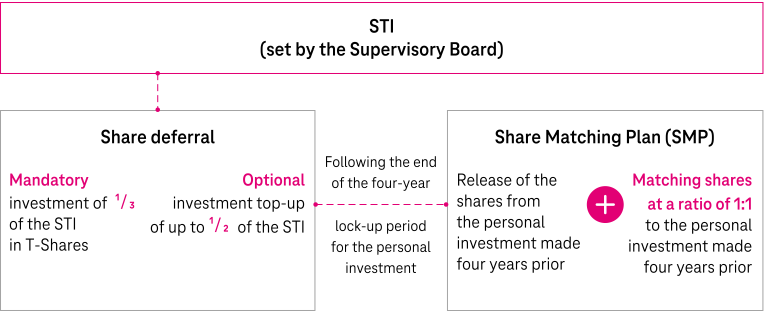
Members of the Board of Management are obligated to invest a sum totaling at least one-third of the annual gross STI as determined by the Supervisory Board in Deutsche Telekom AG shares. They have the option of extending their personal investment to 50 % of the gross STI. The shares are subject to a four-year lock-up period starting from the date of purchase. The shares acquired by the member of the Board of Management for this purpose are held in a special blocked security deposit of the administering bank so that it is not possible to access the shares early.
The relationship between share investment obligations from the STI and participation in the SMP in accordance with the 2022 remuneration system can be seen in the following figure:
Share Matching Plan (SMP)
Functionality
In the 2025 financial year, the SMP continued to function in line with the regulations of the 2022 remuneration system because the personal investment in 2025 results from the STI for the 2024 financial year, which was still based on the 2022 remuneration system. Starting from the 2026 financial year, the SMP will be based on the remuneration system adopted by the 2025 Shareholders’ Meeting.
The personal investment made by the member of the Board of Management results in participation in the SMP. In line with the regulations of the 2022 remuneration system, the member of the Board of Management has free access to their personal investment once the four-year lock-up period is over and receives an additional share free of charge for each share purchased by way of personal investment. The matching shares transferred are then available to the Board of Management member immediately, to use as they wish. The transfer of the shares results in a non-cash benefit for the member of the Board of Management and is taxed in the salary statement which follows the transfer of the shares. When the matching shares mature, the transfer value of the shares resulting from the share price development during the term is capped at a maximum of 150 % of the gross STI paid out for the year of the personal investment. If the value of the matching shares is higher on the transfer date, the number of shares to be transferred is reduced. In this case, the matching ratio is less than 1:1.
The table below shows the relevant amount of the STI applicable to personal investment in 2024 and 2025, the minimum investment obligation and maximum possible investment amount resulting from it, the amount invested by each member of the Board of Management, and the specific number of shares acquired in each case. The number of shares acquired in 2025 is equal to the number of matching shares granted by Deutsche Telekom AG. The table also shows the number of matching shares transferred in 2024 and 2025, based on personal investment in the 2020 and 2021 financial years. The personal investments made by Srinivasan Gopalan and Claudia Nemat in the years 2022 to 2024 and 2025, respectively, remain locked up until the end of the original lock-up period in spite of their resignation from the Board. The claims to matching shares acquired during Srinivasan Gopalan’s Board of Management appointment were forfeited without entitlement to substitution or compensation upon his departure, and an obligation to invest ceased to exist for 2025. All of the matching shares acquired by Claudia Nemat remain unchanged, however.
|
|
|
|
|
|
|
||
Board of Managementa |
Financial year |
STI as measurement base for the personal investment |
Mandatory personal investment/ |
Personal investment made |
Number of shares acquired/ |
Number of shares transferred |
||
|---|---|---|---|---|---|---|---|---|
Dr. Ferri Abolhassan |
2025 |
€ 781,050 |
€ 260,350–€ 390,525 |
€ 260,366 |
7,762 |
– |
||
2024 |
– |
– |
– |
– |
– |
|||
Birgit Bohle |
2025 |
€ 1,154,400 |
€ 384,800–€ 577,200 |
€ 577,187 |
17,207 |
21,280 |
||
2024 |
€ 1,092,000 |
€ 364,000–€ 546,000 |
€ 545,986 |
24,863 |
24,219 |
|||
Timotheus Höttges |
2025 |
€ 2,628,000 |
€ 876,000–€ 1,314,000 |
€ 1,313,975 |
39,172 |
71,084 |
||
2024 |
€ 2,466,000 |
€ 822,000–€ 1,233,000 |
€ 1,232,999 |
56,148 |
99,337 |
|||
Dr. Christian P. Illek |
2025 |
€ 1,197,200 |
€ 399,067–€ 598,600 |
€ 597,984 |
17,827 |
26,189 |
||
2024 |
€ 1,109,700 |
€ 369,900–€ 554,850 |
€ 549,983 |
25,045 |
24,000 |
|||
Thorsten Langheim |
2025 |
€ 1,197,200 |
€ 399,067–€ 598,600 |
€ 598,588 |
17,845 |
25,542 |
||
2024 |
€ 1,123,400 |
€ 374,467–€ 561,700 |
€ 561,688 |
25,578 |
30,475 |
|||
Dominique Leroy |
2025 |
€ 1,201,200 |
€ 400,400–€ 600,600 |
€ 600,567 |
17,904 |
3,273 |
||
2024 |
€ 1,066,975 |
€ 355,658–€ 533,488 |
€ 533,469 |
24,293 |
0 |
|||
Claudia Nemat |
2025 |
€ 1,156,200 |
€ 385,400–€ 578,100 |
€ 578,093 |
17,234 |
26,398 |
||
2024 |
€ 1,090,600 |
€ 363,533–€ 545,300 |
€ 499,981 |
22,768 |
27,350 |
|||
|
||||||||
The personal investments of Rodrigo Diehl and Dr. Abdurazak Mudesir in 2025 were made on the basis of their time as executives (business leaders) and therefore do not constitute Board of Management remuneration. Both Board members are not included in the following table for the same reason as they currently have no claims to a transfer of shares from the SMP from their time on the management board.
Overview of the number of shares granted as part of the Share Matching Plan (SMP)
As of December 31, 2025, the following commitments were made for matching shares resulting from the personal investment of each member of the Board of Management.
|
|
|
|
|
|
|
|
|
Dr. Ferri Abolhassan |
Birgit |
Timotheus |
Dr. Christian |
Thorsten |
Dominique |
Claudia |
|---|---|---|---|---|---|---|---|
Matching shares granted 2022 tranche |
– |
24,273 |
77,550 |
30,250 |
34,946 |
29,297 |
31,718 |
Matching shares granted 2023 tranche |
– |
25,280 |
59,208 |
20,835 |
25,311 |
24,663 |
26,577 |
Matching shares granted 2024 tranche |
– |
24,863 |
56,148 |
25,045 |
25,578 |
24,293 |
22,768 |
Matching shares granted 2025 tranche |
7,762 |
17,207 |
39,172 |
17,827 |
17,845 |
17,904 |
17,234 |
Total |
7,762 |
91,623 |
232,078 |
93,957 |
103,680 |
96,157 |
98,297 |
Long-Term Incentive (LTI)
The LTI for members of the Board of Management is share-based in the form of a Phantom Share Plan. The payment from the 2022 tranche of the LTI will be made in the 2026 financial year in line with the regulations of the 2022 remuneration system. The LTI is based on the strategic performance parameters return on capital employed (ROCE), adjusted earnings per share (EPS), and customer and employee satisfaction. The targets for the performance parameters ROCE and adjusted EPS were derived from the four-year medium-term planning, and both represent important KPIs for Deutsche Telekom AG. The Supervisory Board can make target-relevant adjustments to the financial target figures that are necessary for appropriate incentivization. Footnotes are provided explaining these adjustments. These two parameters were supplemented with customer satisfaction, which is measured using the globally recognized TRI*M method, and employee satisfaction, which the Supervisory Board assesses based on what it considers to be particularly relevant questions for the pulse and employee surveys carried out during the year. The four parameters are weighted equally and the resulting target achievement level can vary between 0 % and 150 %.
The aim of the share-based plan is to harmonize the interests of the Board of Management and those of shareholders. The LTI is also intended to ensure long-term retention of the members of the Board of Management in the Company. At the beginning of the plan term of a tranche, the award amount of a Board member is converted into phantom shares of the Company based on the non-weighted averages of the closing prices of the Deutsche Telekom AG share in the XETRA trading system of Deutsche Börse AG during the last ten trading days before the start of the plan and distributed evenly over four years. During the term of the plan, the number of phantom shares increases due to the dividends paid out during the term, which are also converted into phantom shares. The number of phantom shares also changes depending on the level of achievement of the target parameters adopted by the Supervisory Board for each plan year of the tranche. Upon expiration of the plan, the number of phantom shares obtained is converted into a monetary amount that is based on the non-weighted averages of the closing prices of the Deutsche Telekom AG share in the XETRA trading system of Deutsche Börse AG during the last ten trading days before the end of the plan, and this sum is then paid out to the member of the Board of Management together with the dividend for the last plan year. The maximum amount paid out within the LTI is limited to a maximum of 200 % of the award amount, taking the share price development into account. The following figure demonstrates the functionality of the LTI:
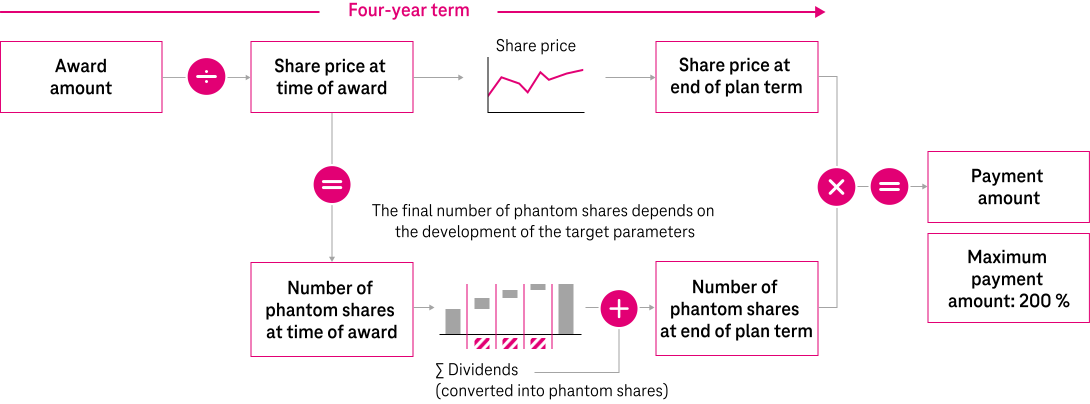
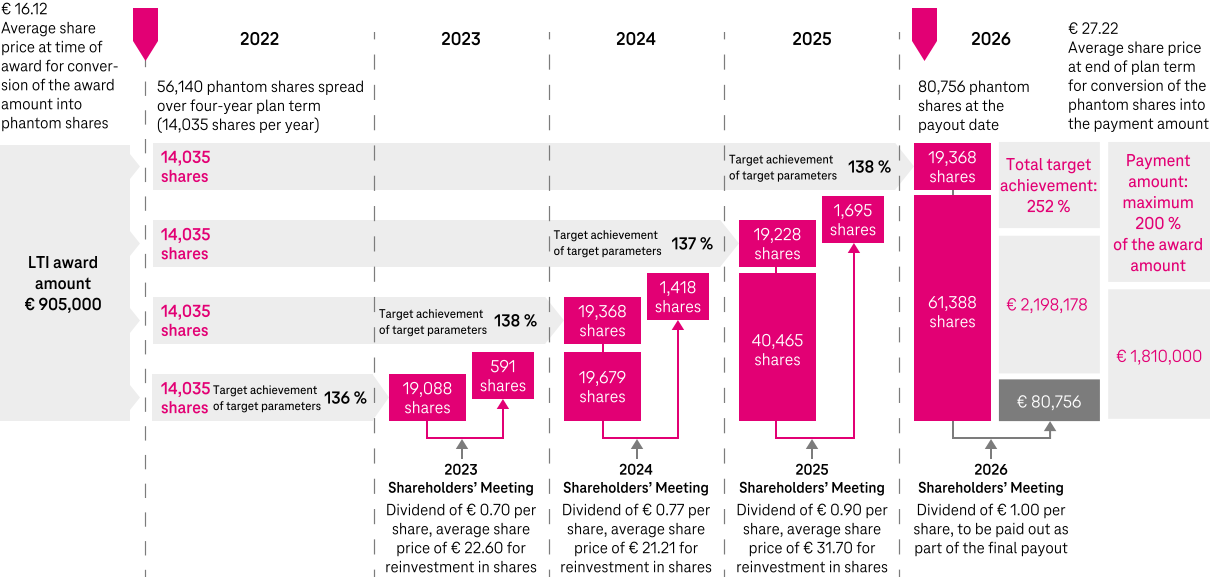
The term of the 2022 tranche of the LTI plan ended on December 31, 2025. The Supervisory Board set the final level of target achievement of the 2022 tranche at 252 %. The LTI amount paid out in the 2026 financial year is limited to a maximum of 200 % of the award amount. Target achievement of the target parameters for the completed 2022 tranche of the LTI is outlined in detail below. The remuneration report does not provide an overview of target achievement for individual years of open LTI tranches on account of the lack of clarity.
|
|
|
|
|
|
|
|
|
|
|
|
|
|
||
|
Year 2022 |
Year 2023 |
Year 2024 |
Year 2025 |
|
||||||||||
|---|---|---|---|---|---|---|---|---|---|---|---|---|---|---|---|
[Weighting] |
[25 %] |
[25 %] |
[25 %] |
[25 %] |
|
||||||||||
|
|
|
|
|
|
|
|
|
|
|
|
|
|
||
|
Target value |
Actual valuea |
Target achievement |
Target value |
Actual valuea |
Target achievement |
Target value |
Actual valuea |
Target achievement |
Target value |
Actual valuea |
Target achievement |
Total target |
||
ROCE |
4.2 % |
4.4 % |
144 % |
5.7 % |
8.8 % |
150 % |
6.6 % |
8.2 % |
150 % |
6.8 % |
7.4 % |
150 % |
149 % |
||
Adj. EPS |
€ 1.24 |
€ 1.75 |
150 % |
€ 1.45 |
€ 1.52 |
131 % |
€ 1.74 |
€ 1.81 |
128 % |
€ 1.88 |
€ 1.94 |
121 % |
133 % |
||
Customer satisfaction |
72.8 |
76.0 |
150 % |
72.9 |
76.2 |
150 % |
73.0 |
77.6 |
150 % |
73.0 |
78.9 |
150 % |
150 % |
||
Employee satisfaction |
72 |
72 |
100 % |
72 |
74 |
120 % |
72 |
74 |
120 % |
73 |
76 |
130 % |
118 % |
||
Total target achievement 2022 tranche |
137 % |
||||||||||||||
|
|||||||||||||||
Due to the fact that the LTI is designed as a share-based plan with phantom shares, the dividends as well as the share price also impact the total target achievement of the LTI during the four-year term of the plan. The following chart provides a sample overview of the composition of total target achievement for the 2022 tranche for an ordinary member of the Board of Management, taking dividends and the share price into account:
Srinivasan Gopalan’s departure from the Board with effect from February 28, 2025 ended his participation in the 2025 LTI tranche. His entitlements to participate in all existing LTI tranches have been forfeited without entitlement to substitution or compensation. Claudia Nemat is still entitled to participate in the LTI tranches for 2022 to 2025.